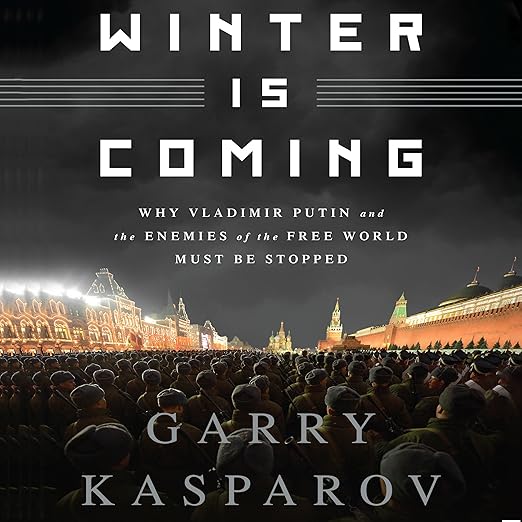
Garry Kasparov published this warning in 2015, and the audiobook has been available ever since while the argument inside it kept getting tested by events. Eleven hours and forty-one minutes, read by George Backman, released through Audible Studios that October. The five reactions gathered underneath the description carry dates running from December 2016 to December 2025, which makes this page something more interesting than a product listing: a nine-year record of readers returning to check a prediction against the news.
The Verdict, Briefly
Putin's ascent from lieutenant colonel of the KGB to the presidency in 1999 is where the book starts, and the description states the thesis without hedging: the world's leading powers appeased him for years, and the result is a leader positioned "at the center of a worldwide assault on political liberty." Kasparov led pro-democracy opposition in what he calls the farcical presidential election of 2008, and the book's darker conclusion is that his Cassandra-like prophecies came true without changing anyone's behavior. The prescription is a forceful stand, diplomatic and economic, taken by democracies while they still can. The reasoning behind that urgency is stated bluntly in the copy: vast resources, nuclear weapons, and a leader who keeps his credibility at home precisely because powerful democracies continue to recognize and negotiate with him abroad.
Backman is the credited reader for every one of those hours, and that creates a gap worth naming before purchase. This is a first-person book whose weight comes from who is speaking: a Russian who opposed the regime publicly and paid for it. The first person on the page belongs to Kasparov, and the voice in the recording belongs to somebody else. That is a completely standard arrangement, and it still changes the relationship between a listener and a testimony delivered in the first person.
Steven Hildreth, Jr. contributes the biography the description takes for granted, describing a writer world-renowned for a genius-level intellect, the youngest chess grandmaster of the 1980s, who displayed political activism early enough to shock his Soviet overlords. That credential is the book's engine. Kasparov is not a foreign policy analyst by training, and the argument leans on having been inside the system it describes rather than on academic authority.
Why Winter Is Coming Works as an Audiobook
Lindaluane chose to reproduce a passage rather than summarize one, and the choice is generous, because the excerpt is the closest thing to a sample this page offers. In it Kasparov recalls saying for years that Putin was a Russian problem for Russians to solve, and would become a regional problem and then a global one if his ambitions went ignored. The passage ends on the coldest line in the book: it is cold comfort to be told you were right.
Charles Freedom Long, grading it four stars, adds the most useful qualification of the five. Reading it around the John McCain funeral events left the experience "both informative and depressing," and the takeaway it credits runs broader than the title suggests: a better grasp of Russia after the Berlin Wall, and of how both Russian and Western choices contributed to the rise of what that response calls a kleptocratic dictatorship. The book is not only an indictment of one man, and this reader noticed. The same note also garbles its own timeline, describing events "following the fall of the Berlin Wall and 2015" as though those were two ends of one span, which is a small reminder that even attentive readers compress three decades when they summarize.
Eduardo Botín, writing from Spain, adds the detail that gives this listing its quiet irony. That response describes attending a talk given by Kasparov, speaking with him briefly, coming away struck by the charisma and lucidity, and only then deciding to read the book. The one person on this page who has actually heard Kasparov speak reports reading rather than listening, on a product whose reading credit belongs to a professional narrator.
Points to Consider
IceClimber's five-star note from Canada, the most recent on the page, praises an analytical genius who warned about "the dangers of Russian mentality." That phrasing points at the risk that comes with a book like this: the argument targets a regime and its enablers, and some readers will carry it further, toward a people. Kasparov writes as a Russian about Russia's government. Listeners should keep the distinction the book itself maintains.
Eleven hours and forty-one minutes recorded in 2015 means everything after 2015 is missing, and the events that followed have been substantial. The description's framing of Putin's Russia alongside ISIS and al-Qaeda is very much of its moment, and the appeasement it protests belongs to a specific decade of policy. None of that makes the book obsolete. It does mean you are hearing an argument that stops mid-story, and no epilogue arrives to tell you how the author would revise it.
Chess appears here as biography rather than subject, so anyone drawn by the grandmaster credential should know this is not a book about the board. It is also not a neutral survey, whatever the history classification suggests. The description calls it a call to action, one response calls it depressing, and the honest label is advocacy written by a participant with a specific policy demand and a personal stake in the outcome. Filed under history with a single tag reading Russia, it will reach some listeners expecting a survey of a country and hand them a case for action instead.
Who Should Listen to Winter Is Coming
Policy readers, students of Russian politics, and anyone who wants a dissident's account rather than an analyst's will get the most from these eleven hours. The unusual bonus here is the review column itself: five reactions spread across nine years, from a 2016 reader quoting the book back at itself to a 2025 reader treating it as a diagnosis. Few listings let you watch an argument age in public like that, and the spread of countries behind those five reactions, from Spain to Canada, says something about who kept picking the book up.
Anybody wanting a balanced survey of modern Russia should look elsewhere, and so should anyone who needs current coverage, since the recording stops where 2015 stopped. What remains valuable is the vantage point: a former world champion who tried to run against the system he describes, speaking before the outcome was settled. Read it as a document of what one opponent said while the argument still felt open.
Does the audiobook cover anything after 2015?
No. The recording dates from October 2015, so every development since then falls outside it, including the events that made the title look prophetic to later readers. The reviews attached run to December 2025, which means people keep arriving at a decade-old argument and finding it current.
Does Kasparov narrate the audiobook himself?
No. George Backman holds the credit for all eleven hours and forty-one minutes, and no line anywhere on the page suggests the author reads any portion. For a book written in the first person by a well-known public figure, that is worth knowing before you press play.
Is this a book about chess?
Only as background. One response describes the author becoming the youngest grandmaster of the 1980s and showing political defiance even then, and that history explains why the argument carries weight. The subject is Russian politics, Western appeasement, and what democracies should do about both.