
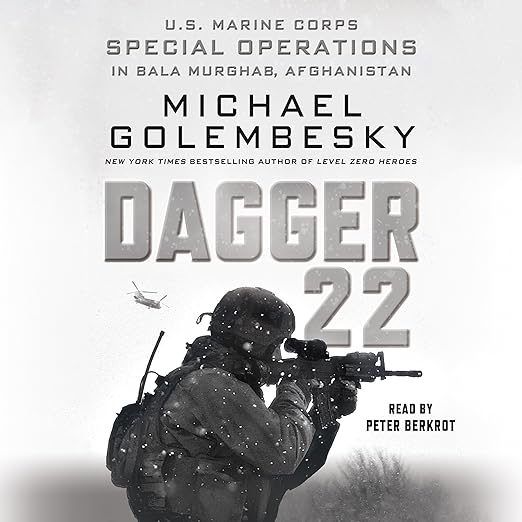
I came to Dagger 22 on a cold Wednesday evening, headphones in while the rain hit the window, and I did not stop until well past midnight. Michael Golembesky's first book, Level Zero Heroes, had already established him as a writer who refuses to glamorize what happened in Bala Murghab, and this sequel doubles down on that commitment. The 22 men of Marine Special Operations Team 8222 are back in the same remote, hostile river valley, and Golembesky does not pretend the mission has gotten easier.
What strikes you immediately is how specific this book is. These are not archetypal warriors standing in for a generation. They are named, flawed, tired men operating in brutal cold, planning a night assault on the village of Daneh Pasab that took place on April 6, 2010. The precision of the date matters. Golembesky wants you to understand that these events happened, and that the people who lived them are still living with the consequences.
What separates Dagger 22 from the crowded field of Afghanistan war memoirs is its willingness to examine the political machinery that shapes ground-level decisions. One reviewer compared the book's underlying argument to Clausewitz's observation that war is the continuation of politics by other means, and that framing is apt. Golembesky does not hide his frustration when command decisions appear to prioritize optics over operator safety. He writes about it with the restraint of a man who knows the chain of command but also knows what it feels like to be the one on the ground when the orders come down.
The April 6 night assault gives the book its structural spine. Everything before it, the firefights, the winter patrols, the slow encirclement of the Taliban command cell in Daneh Pasab, is preparation. Golembesky paces the buildup well, never letting the action sequences feel gratuitous. The violence is present because it was present. He is not writing for thrills. He is writing to be accurate.
What Makes Dagger 22 Worth Hearing
Peter Berkrot's narration is a significant part of why this works as an audiobook. He has the kind of controlled, grounded voice that suits tactical nonfiction, clear enough for the acronyms and unit designations, warm enough for the passages about what these men meant to each other. The emotional moments land without being oversold. When the book turns toward the human cost of extended combat operations, Berkrot gives those sections room to breathe. That restraint mirrors Golembesky's own prose style, and the two work well together.
At nine hours and thirty-eight minutes, the runtime feels proportionate to the material. This is not a book padded with extended background chapters or civilian-facing digression. It assumes you are already inside the story and keeps you there.
Things to Know Before Starting Dagger 22
Readers who come to this expecting a pure action memoir will find something more complicated. The combat is here, and it is written with authority, but the more sustained argument Golembesky makes is about leadership, institutional accountability, and what happens to skilled warriors when political considerations override tactical wisdom. One review described it as a sociopolitical observation made by a non-commissioned officer who understands the schizoid nature of asymmetric warfare in the 21st century. That is a fair description. Golembesky is thinking as well as remembering.
It also helps to have read Level Zero Heroes first. Dagger 22 is a sequel in the truest sense: the stakes are higher because you already know these men, and the winter of 2009 to 2010 weighs differently when you understand what the valley cost them in the prior deployment.
Who Michael Golembesky Is Writing For
This is for listeners who want their military nonfiction honest about the gap between policy and the people who execute it. If you have read works like Sebastian Junger's War or Phil Klay's Redeployment and want something more operationally granular, Dagger 22 belongs on your list. Readers who want straightforward heroic narrative without political friction will find parts of this uncomfortable. That discomfort is the point.
Good to Know
Is Peter Berkrot's narration suitable for listeners unfamiliar with military terminology?
Yes. Berkrot reads clearly and does not rush through the acronyms and unit designations. He gives context through pace and tone, and non-military listeners should have little difficulty following the operational structure of the book.
Does Dagger 22 cover the April 6, 2010 night assault in detail?
Yes, the assault on Daneh Pasab is the operational climax of the book. Golembesky builds toward it across the entire narrative, and when it arrives, it is described with the kind of tactical specificity that makes you understand what was at stake and how much had to go right simultaneously.







