
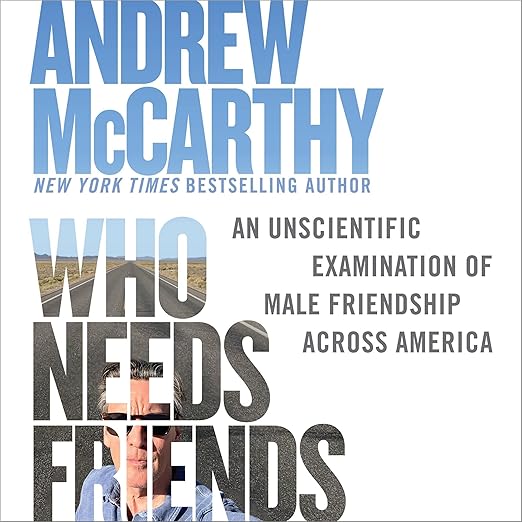
A son asks his father whether he really has any friends, and the father, who is Andrew McCarthy, cannot produce a clean answer. That exchange is where this audiobook begins, and the description quotes the question straight, which tells you the book understands it owns something good. What follows is seven hours of driving, close to ten thousand miles of it, through Appalachia, the Mississippi Delta, the Chihuahuan Desert and the Rocky Mountains, with McCarthy stopping to talk to men about their friendships. He reads the whole thing himself, and on a book of this shape that credit is not a formality.
That question works on the book the way it worked on McCarthy, which is by refusing to be rhetorical. The description says it left him reeling. He did have friends, but the necessities of adult life had pushed them steadily into the background, and once the question was asked out loud he found himself working through what had happened to those friendships, whether he still needed them, what he valued, and what he had to offer. A child's offhand line becomes a reckoning, and the book does not pretend the reckoning was voluntary.
McCarthy is credited on this listing as a bestselling author, a filmmaker and an actor, and for the audio edition the third of those matters most. A trained performer reading his own material brings timing and restraint that a hired reader has to construct from the outside, and he also has the technical means to render other people's speech without turning it into imitation. That skill gets used here, because the book is built from conversations with people who sound nothing like him.
The Ideal Case for Self-Narration Itself
Self-narration is usually a mixed proposition, but a memoir whose central scene is a question from your own child is close to the ideal case for it. Nobody else can deliver that line with the right amount of damage in it. The risk on the other side is real too: an actor can smooth a passage that would land harder if it stayed rough, and seven hours of practiced delivery can round off the edges of a book whose whole subject is discomfort. Prospective listeners are betting on restraint, and the material at least gives him every reason to use it.
Ten thousand miles is the organizing device, and it suits audio better than most structures do. The geography is specific enough to hold a chapter each, moving from Appalachia to the Mississippi Delta, then west to the Chihuahuan Desert and up into the Rocky Mountains, so a listener always knows roughly where the car is. Road books also happen to be the genre most people are physically inside while listening. Playing this one on a long drive puts you in the same posture as the author, which is either the point or a coincidence worth taking advantage of.
Cowboys, blues musicians, preachers and rootless teens are the people McCarthy stops for, and the range is the argument. A book about male friendship written from one social world would prove very little, and this one deliberately collects men who would never meet each other. McCarthy gives the finding in his own words in the description: it turns out that guys have a difficult time with friendship. Then he adds that this is not the way it has to be, which tells you the book intends to land somewhere instead of simply cataloging the problem.
Do We Actually Hear the Men He Interviews?
Nothing on the listing says whether you hear the interviewed men themselves. McCarthy is the only credited voice, which normally means a straight author read with the conversations retold rather than played, but a book assembled from field encounters could reasonably have gone the other way. Anyone hoping for the actual voices of a Delta blues musician or a west Texas cowboy should treat that as unconfirmed. The question matters more here than on most memoirs, since the whole method rests on other people talking.
Seven hours and two minutes for ten thousand miles and countless conversations means compression. Expect vignettes rather than deep portraits, several men to a chapter, and a narrative that keeps moving because the car does. That is a legitimate way to build a road book, but a listener who wants one friendship followed to the bottom will feel the book pull away just as things get interesting. The category fields also place this alongside relationships and personal development, and the closing note of the description confirms the book has a position to argue.
Anyone arriving through the entertainment and celebrities tag should reset expectations. The shelf label promises show business and the description delivers preachers and desert highways, with the acting career functioning as biography instead of subject. Published in March 2026, it also arrives too new for anyone to have argued with it in public yet, which means early listeners are buying on premise alone and on whatever they already think of the author.
One Man's Drive Instead of a Survey
Listeners whose own friendships have thinned out under work, marriage, parenting and geography are the obvious audience, and the book is honest enough that the recognition may sting. Readers of first-person road nonfiction get the second-best reason to pick it up, since the route is real, varied and specific. Fathers who have been caught out by something a child said in passing will find the opening scene doing a lot of work on them before the first hour ends.
Come to it for the reckoning, not for a program. This is one man's drive and one man's set of conversations, not a survey, and anyone wanting data on male loneliness will find anecdote where they hoped for evidence. Anyone allergic to a memoir that ends by telling you things could be better should also know that the description promises exactly that turn. Whether that lands depends on how badly you want a book to name your own situation out loud, in the author's voice, across seven hours of highway.
- Narrator: Andrew McCarthy reads his own book, and since the inciting scene is a question from his own child, the author credit and the narrator credit doing double duty is the right call here.
- Subjects: Male friendship and loneliness, midlife reckoning, road travel across America, fatherhood.
- Tone: Searching and companionable, with a bruise underneath.
- Bottom line: Go in expecting one man's drive and one man's conversations, and it delivers more honesty than most books built on the same premise.






