
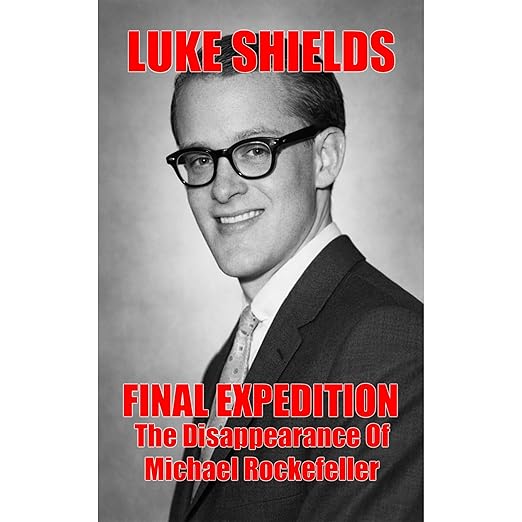
November 1961 is the date this audiobook keeps circling. On the eighteenth of that month, a twenty-three-year-old swam away from an overturned catamaran off the coast of New Guinea and was never seen again. He was Michael Rockefeller, son of New York Governor Nelson Rockefeller and heir to one of the great American fortunes, and he had gone to the Asmat region to collect indigenous art. Luke Shields builds six and a half hours around what happened next and around the decades of theories that followed. The credit line names Virtual Voice as the reader, and that single field is the first thing a prospective listener has to weigh.
Three Generations of Rockefeller Money, Compressed
Michael Rockefeller's disappearance is the hook, but the book being promised here reaches far wider than one afternoon on the water. It starts in the oil fields of nineteenth-century Pennsylvania and follows three generations of Rockefeller money, ambition and influence: Standard Oil, Rockefeller Center, a political machine that reached the vice presidency. Then it puts a young man from inside all of that into a dugout canoe with a camera and a bag of steel axes, moving through what the description calls headhunter territory. The collision between those two worlds is presented as the engine of the whole thing, and as a framing device it earns its keep.
Six and a half hours is a compact container for a dynasty, a disappearance and three competing explanations of a death. Something has to give, and prospective listeners should assume the family history arrives in summary while the Asmat coast gets the close attention. That is probably the right allocation, but it does mean the Standard Oil and Rockefeller Center material functions as background instead of as the subject. Anyone who wants a full account of how that fortune was assembled will need a different book, and the listing does not pretend otherwise.
Holding Three Explanations Open Till the End
The description does something many independently published titles skip, which is to name its own sources. Asmat oral testimony, missionary accounts, declassified Dutch government documents and decades of investigative journalism are all listed as the evidentiary base. Whether that means original archival work or a careful synthesis of published reporting cannot be settled from a product page, and the honest answer is that a listener will find out in chapter three, not before. Still, a book that tells you where it got its material is starting from a better place than one that does not.
The structure laid out for the mystery itself is sound. Three explanations are examined: that Michael Rockefeller drowned in the Arafura Sea, that he was killed and ritually consumed by Asmat warriors avenging a colonial massacre three years earlier, and that he survived and lived among the people he had come to study. Each of those carries very different implications, and a book willing to hold all three open for most of its length is doing the work properly. The description does tip its hand near the end, promising that the evidence points somewhere the family spent half a century declining to discuss, so expect a conclusion rather than a shrug.
One element of the setup deserves more weight than the mystery usually gives it. Michael Rockefeller went to New Guinea to collect art, driven by a passion inherited from his father and sharpened at Harvard, and he was working in one of the most remote and dangerous places on earth when he vanished. That reads as a collector's story before it reads as an adventure, and the difference shapes everything after it. A camera and a bag of steel axes are the kit of someone conducting transactions, not someone testing himself against a coastline, and a listener who holds that in view will hear the final chapters differently from one who arrives expecting a thrill gone wrong.
A Synthesized Voice Meets Asmat and Arafura
Virtual Voice is the decision this listing turns on. No performer stands behind the reading, the delivery is synthesized, and pacing stays uniform whatever the sentence is doing. For some nonfiction that matters little, and a straightforward chronology of dates and places survives synthetic narration reasonably intact. This book is a harder case. A narrative assembled from Asmat oral testimony, quoted missionary accounts and translated Dutch documents depends on a reader who can mark where one source ends and another begins, and a synthetic voice hands all of them the same tone.
The subject compounds it. A young man died, a specific community carries the story of how, and a colonial massacre sits underneath the most discussed theory. Material that grim usually asks a narrator for restraint in places and weight in others, which is exactly the register synthesized reading cannot supply. Names present a smaller but real problem: Asmat, Arafura, the Dutch documentary sources, none of which a machine reader pronounces with any signal of confidence one way or the other.
Two smaller oddities are worth naming. The listing files the book under biographies and memoirs, under history, and also under religion and spirituality, which is a strange third shelf for an account of a disappearance and offers no clue about what the book actually argues. And the publisher field reads Independently Published, with no reader response recorded anywhere on the page, so the description is carrying the entire persuasive load, in the promotional register descriptions are written in.
Skip It if Synthetic Narration Is a Dealbreaker
Anyone drawn to unsolved twentieth-century mysteries, to the anthropology of first contact, or to the specific question of what wealth cannot buy will find the premise well built. The frame the description offers, a famous name meeting a force it could not purchase or negotiate with, is a genuine idea rather than a marketing line, and six and a half hours is a week of commutes. Listeners who already know the outline of this story may still want it for the Dutch document trail and the Asmat testimony.
Skip it if synthetic narration ruins the experience for you, because nothing on the page suggests a human alternative edition exists. Skip it too if you want a book that leaves the question genuinely open, since the closing lines of the description promise a direction. The sourcing it advertises is the strongest argument on the page, and your own tolerance for a machine reading a story about a real death settles the rest.
Before You Press Play
- Performance: Virtual Voice, meaning a synthesized reader with no performer behind it, which is a real cost on material built from oral testimony, missionary accounts and translated documents.
- What it covers: An unsolved 1961 disappearance, dynastic wealth, colonial violence and the limits of privilege.
- Feel: Sober and investigative, flattened by the delivery.
- Our call: The research base is named and the framing is strong; the reading is synthetic, and that trade is the whole decision.
Questions Listeners Ask
What does the Virtual Voice credit mean for this audiobook?
It means a synthesized reader instead of a human performer. Delivery stays even regardless of the material, which costs less on plain chronology and costs more here, where the text moves between Asmat oral testimony, missionary accounts and Dutch documents. No second edition with a human narrator appears anywhere on the listing.
Is the disappearance actually solved by the end?
The description names three explanations, drowning in the Arafura Sea, a killing carried out in revenge for an earlier colonial massacre, and survival among the Asmat, then promises that the evidence points in a direction the family avoided discussing. Expect an argued conclusion, not an open verdict, at the end.
How much Rockefeller family history does the audiobook cover?
Enough that no prior reading is required. The opening chapters run from the Pennsylvania oil fields through Standard Oil, Rockefeller Center and a political career that reached the vice presidency, so the background arrives built in. At six and a half hours the background is necessarily compressed, but a newcomer will not be lost.
Why is this filed under religion and spirituality?
That is a genuine oddity of the listing. Biographies and history both fit the material, and the third category matches nothing the description mentions. Category fields on independently published titles are often set for reach instead of accuracy, so treat the shelf label as noise and go by the summary.






