
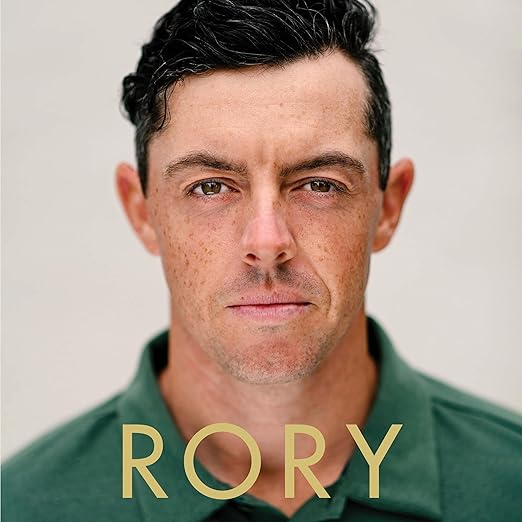
One word is all the title gives you. No subtitle appears on this audiobook listing, no clarifying line, nothing to tell a browser whether the thing being sold is a novel, a memoir or a biography. It is a biography of Rory McIlroy, written by Alan Shipnuck after three decades on the golf beat, and read aloud by Shipnuck across nine hours and twenty minutes. The description calls McIlroy the most important, popular and confounding player of the post-Tiger era, which is a large claim and, unusually for marketing copy, one worth arguing about.
The Contradictions Are the Actual Subject
Rory McIlroy contains multitudes, the description says, and then earns the phrase instead of leaving it as flattery. He can overwhelm a golf course with transcendent talent and turn up at the next tournament looking utterly lost. He is the game's most eloquent ambassador and a trash-talking troll, sometimes inside the same press conference. He came from a working-class family in a small town in a war-torn homeland and now commutes to work in a private jet with billionaires among his confidants. Those contradictions are the subject, not the color.
A single question organizes the whole book, and it is a good one. A dozen years ago, McIlroy asked Shipnuck what Tiger Woods was really like, wanting to understand the player he had modeled himself on. This biography turns that question around and aims it at the person who asked it. That structure gives the material a spine that most sports biographies lack, because it makes the difficulty of ever really knowing someone at that altitude into the actual topic instead of a limitation to apologize for.
Northern Ireland is where the description places the young phenom, and the phrase chosen for the place he came from is a war-torn homeland. That is a considerable amount of history to carry into a sport played largely by the comfortable, and the distance between a small town there and a private jet is the sort of gap biographies either take seriously or gesture at once and abandon. Shipnuck traces the evolution from that phenom into a game-changing force on and off the course, which suggests the intention is to work the whole distance instead of opening with a childhood chapter and never returning to it.
Shipnuck Trades Polish for Reported Authority
Shipnuck reads it, and on a reported book that is a meaningful choice. Thirty years on the beat means the voice on the recording belongs to the person who asked the questions, sat through the press conferences and made the phone calls, and emphasis in a reported narrative tends to fall in the right places when the reader already knows which detail cost the most to get. The counterweight is that beat writers are not trained performers, and nine hours and twenty minutes is a long stretch to hold a listener. Prospective buyers are trading polish for authority.
McIlroy's victory at the 2025 Masters gives the book its emotional center, and the description does not undersell it. The collapse onto the final green at Augusta National, the career Grand Slam finally completed, fans crying along with him because so many of them saw their own struggles in his: that is the payoff a decade of near misses was building toward. The description also explains why it hit so hard, arguing that McIlroy has spent two decades as the anti-Tiger, letting people into his heart and his world instead of sealing them out.
Nine hours and twenty minutes covers an entire career plus everything around it, and the description names its own lineage so you know the register in advance. It places itself in the tradition of the Tiger Woods biography by Jeff Benedict and Armen Keteyian, and alongside Shipnuck's own Phil, with LIV and Let Die also on the shelf behind it. Anyone who has heard those knows what arrives: reported, unauthorized, comfortable with a subject who will not enjoy every chapter.
An Ending That Has Not Happened Yet
April 2026 is an interesting moment to publish this. The description frames the book as arriving while McIlroy enters the last act of a highly eventful career, and that framing is a bet, not a fact. Biographies written while the subject is still competing carry an unavoidable structural problem, which is that the ending has not happened yet. What you get instead is an assessment from a particular vantage point, and a very good one, but the final chapter of this story remains unwritten by anybody.
Tabloid romance, bitter business disputes and divisive politicking are all promised, and a listener who wants nine hours of golf should register that before buying. Substantial parts of this are not about golf at all. The copy also makes claims on its own behalf, describing unparalleled access, thrilling immediacy and the most fearless writer on the beat, which is the publisher's voice rather than a verified account of the reporting. Take those as intent, not evidence.
Nobody has weighed in yet on this listing. No rating appears, no written response, so the only track record available on the page is the list of earlier titles the description names. That puts a buyer in the position of trusting an author's back catalog and a subject's public interest, which is a reasonable basis for a purchase and a thin one for a verdict on the recording specifically.
An Acquired Taste Across Nine Long Hours
Golf followers who watched the 2025 Masters and wanted to understand why it moved them are the core audience, and this is built for exactly that impulse. Sports biography listeners who prefer reporting over authorized tribute get the second reason. Anyone drawn to public figures who behave inconsistently in public, and to the question of what the inconsistency actually means, will find a book more interested in that puzzle than in scorecards.
Anyone hoping for swing analysis, tournament-by-tournament recaps or a career celebration should look somewhere else, and anyone who resents journalists writing about athletes' private lives will find plenty to resent here. The self-narration is an acquired taste at this length. Everyone else gets a book that treats a famous, likable and genuinely confusing athlete as a problem worth solving rather than a personality to celebrate. Taken as reported journalism read aloud by the reporter who did the reporting, the nine hours pay off.






