
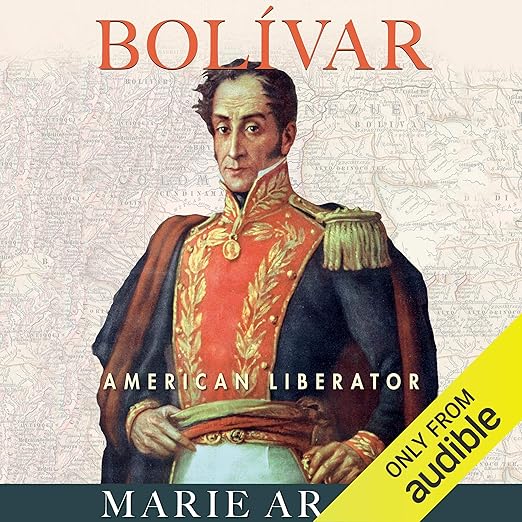
Before You Press Play
- Narration: David Crommett is an unknown quantity here, with the assignment demanding real range across English and Spanish-language names and terminology.
- Themes: Revolutionary ambition, personal tragedy, contested historical legacy
- Mood: Sweeping and dramatic, with real critical friction
- Verdict: Bolívar's contradictions power an ambitious audiobook biography whose warmest reception sits right beside its sharpest dissent.
Simón Bolívar loses his wife within months of marrying her and never remarries, though the synopsis notes a run of mistresses that follows, including one who helped hold up the revolution and another who saved his life outright. This audiobook opens its account of a man who freed six countries from Spanish rule with exactly that kind of personal drama sitting alongside the military campaigns, and Marie Arana keeps returning to both registers across more than twenty hours.
Where This One Lands
Astonishing is the word the synopsis itself reaches for, describing Bolívar, the greatest figure in Latin American history by its own account, as somehow still not well known in the United States. What follows tries to close that gap on a large scale. A campaign launched in 1813 for the independence of Colombia and Venezuela eventually stretches across Amazon jungles and Andes mountains, covering more than seventy-five thousand miles traveled on horseback and six countries freed from Spanish rule along the way. The synopsis frames Bolívar as containing multitudes almost to the point of contradiction: fearless general, brilliant strategist, consummate diplomat, passionate abolitionist, gifted writer, flawed politician. Arana is credited with drawing on a wealth of primary documents to support that many-sided portrait instead of flattening him into a single heroic type.
Personal cost gets equal weight alongside the political sweep. Bolívar forged uncertain coalitions across competing forces and races throughout the campaigns, and the synopsis is direct that his final days were genuinely tragic: he died relatively young, uncertain whether any of it would endure. That combination, sweeping military and political achievement set against a lonely, doubt-filled ending, gives the book its emotional shape as much as its historical one. The closing line of the synopsis calls the whole project a stirring declaration of what it means to be a South American, a claim about the book's ambitions worth knowing before starting.
Reader reaction leans heavily positive. Amid Bennaim calls it the best biography read in years, singling out the writing itself as spectacular enough to recall Gabriel Garcia Marquez, a striking comparison for a work of history rather than fiction. Andrew Mintz's review title makes an even bigger claim outright, describing Bolívar as the South American 'George Washington,' while noting the book does not sand down his rougher edges: it does not hide that he was a womanizer, or that he could act as a de facto autocrat poorly suited to actual governing. William, identifying as a trained historian, calls the book informative and easily digestible while still deducting one star, though the review cuts off before explaining exactly why.
eCid's review places the whole story inside a wider frame worth noting: the Age of Enlightenment at the close of the eighteenth century, a period the review describes as rocking nations across the Americas as they separated from their colonial powers while the monarchies of Europe felt their own tremors. That review adds that most people in the northern Americas were too consumed with their own fledgling country to pay much attention to what was happening farther south, before turning to name John Quincy Adams and James Monroe as figures who did take notice, a thread the review does not finish before cutting off. Even incomplete, it is a useful reminder that Bolívar's campaigns were unfolding alongside, not after, the early United States finding its own footing.
Listeners should also know this praise is not universal. Andrés, reviewing from Spain, offers the most substantive dissent in the entire review set: an account that finds the book plagued by what the review calls false and gross anti-Spanish prejudices, singling out a specific claim about the printing press being forbidden under colonial rule as, in this reviewer's own words, a blatant lie. That review recommends a different book, Madre Patria by Marcelo Gullo, as a corrective. Nothing here resolves which account is right; what is clear is that a book most reviewers praise for its balance has, for at least one reader with direct stake in how Spain's colonial history gets told, landed as one-sided in the opposite direction from what the majority report.
David Crommett carries nothing on record from earlier titles to lean on here, which puts the full weight of judgment on this recording's own specific demands. Twenty hours and eleven minutes of nineteenth-century South American history, moving between English and Spanish-language place names, historical figures, and military terminology, is a real pronunciation and pacing challenge, distinct from a narrator working in a single, familiar linguistic register from start to finish.
Weak Spots in Bolivar
On the rating side, a lone vote cannot by itself resolve into a figure with a decimal point attached, which means the 4.6 shown here works better as a placeholder than a verified consensus, especially with five substantive written reviews, one of them in direct disagreement with the others, sitting underneath it. Listeners weighing that lone Spanish-language dissent should also note it is the only review among the five not written in the United States, which does not settle the disagreement but does mean the sharpest critique comes from the vantage point the book's own subject most directly affected.
At over twenty hours, this asks for a real commitment, and William's docked star is worth remembering even without its full explanation: even reviewers who found the book valuable did not all find it flawless. Anyone expecting an uncomplicated hero's journey should recalibrate before starting, given how directly the synopsis itself flags Bolívar's contradictions.
Recommended For
Readers of Latin American history, and anyone drawn to biography that resists turning its subject into a simple symbol, are the clearest audience. Listeners who appreciated sweeping, primary-source-driven nineteenth-century biography elsewhere should find Arana's approach to Bolívar rewards the same patience, particularly across the sections covering his personal losses alongside the military campaigns.
Readers seeking a single, uncontested account of Spanish colonial history in South America should go in aware that this book's framing is exactly what one reviewer disputes most sharply. Anyone who wants a shorter, more focused introduction to Bolívar specifically, instead of the full sweep of the era around him, may find twenty hours more than the subject requires.
Is this Bolivar audiobook biased against Spain, according to listeners?
One reviewer, writing from Spain, argues strongly that it is, citing specific claims the review calls false and even recommending an alternative book as a corrective. Most other reviewers, all writing from the United States, praise the same book for balance, so listeners should weigh both accounts rather than take either as final.
How long is this audiobook, and does it stay focused on Bolívar himself?
It runs twenty hours and eleven minutes, covering roughly seventy-five thousand miles of campaigning across six countries plus Bolívar's personal life. The scope is genuinely wide, closer to a portrait of an entire revolutionary era than a narrow biographical sketch.
Does this audiobook present Bolívar as a purely heroic figure?
No. The synopsis and multiple reviews describe a flawed politician and a difficult personal life alongside the military achievements, including reviewer mentions of autocratic tendencies and a reputation as a womanizer. It reads as a warts-and-all account rather than a celebration.
What does the 4.6 rating on this audiobook actually reflect?
Very little in isolation. The counter behind that badge holds exactly one vote, and a lone whole-star grade cannot resolve into a figure like 4.6 on its own. Five substantive written reviews, spanning real disagreement about the book's fairness, offer a far more useful picture than the badge alone.







