
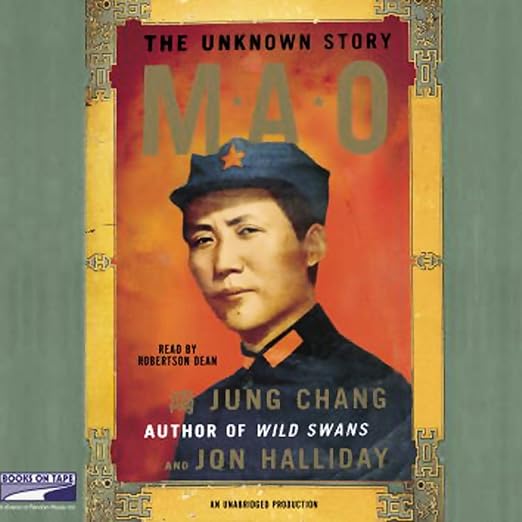
Stalin's shadow falls across the opening chapters of this audiobook long before Mao Zedong ever takes power, and that is precisely the point Jung Chang and her husband and co-researcher Jon Halliday are building toward across twenty-nine hours and fifty minutes: a Mao whose rise depended on Moscow's money and protection from the 1920s onward, not on the romanticized peasant-revolutionary mythology that surrounds the Long March. The author field on this listing credits Chang alone, but the synopsis itself makes the collaboration explicit, describing a decade of joint research and interviews with people in Mao's own circle who had never spoken on the record before. That research base is the book's real claim to authority, and it shows in how granular the narrative gets.
The book's method is forensic rather than impressionistic. Chang and Halliday work chronologically through Mao's early poisoning and blackmail of rivals within the Communist Party, his welcome of Japanese occupation as a tool against the Nationalists, and finally the Great Leap Forward famine that the synopsis states killed thirty-eight million people, part of a total the authors put above seventy million dead under his rule in peacetime. This is the book's own stated framing, built from its cited research rather than asserted casually, and it makes for a genuinely harrowing listen precisely because the detail is so specific rather than abstract.
Jung Chang's own biography is worth knowing before starting this audiobook, since it shapes how the book reads. Born in Sichuan Province in 1952, she lived through the Cultural Revolution herself as a teenager before eventually leaving China for Britain in the late 1970s, where she went on to earn a doctorate, often cited as among the first awarded by a British university to someone from mainland China. That lived experience of the system she is describing is part of what gives the book's harshest passages their particular charge; this is not an outside academic's detached account.
What Stands Out
Chang's prior book, the internationally bestselling family memoir Wild Swans, is referenced directly in a pull-quote from Chris Patten, the last governor of Hong Kong, who calls the wait for this follow-up worthwhile and the finished book a bombshell. That comparison matters for calibrating expectations: this is not a dry academic monograph but narrative history written by someone with real storytelling instincts, applied here to the interior of Mao's court rather than to her own family's story. Readers who found Wild Swans emotionally accessible will recognize the same instinct for scene and character here, redirected toward reconstructing conversations inside Mao's private chambers among his wives, mistresses, and inner circle of advisors.
This is also, by any measure, one of the most exhaustively sourced biographies of a twentieth-century dictator available in English audio, and the sheer scope of who Chang and Halliday interviewed, virtually everyone outside China with significant dealings with Mao plus previously silent members of his own circle, gives the book an evidentiary density that most single-author biographies of authoritarian leaders cannot match. Listeners drawn to modern Chinese history, Cold War history, or the broader genre of dictator biography will find this sits comfortably alongside the more famous Stalin and Hitler biographies as a serious, if unsparing, entry in that shelf.
Weak Spots in Mao
Robertson Dean narrates with the measured, unhurried authority that has made him a reliable choice for dense, research-heavy nonfiction elsewhere in the genre. He does not dramatize the material for effect, matching Chang and Halliday's expository, evidence-forward prose rather than performing outrage on top of it, which is the right instinct for content this disturbing; the facts do the work without vocal embellishment. He also maintains a clean distinction between the book's more documentary passages and its closer, scene-level reconstructions of Mao's private life, so the listener never loses track of which mode a given chapter is working in.
It is worth being direct that this is a revisionist, unsparing interpretation of Mao rather than a neutral survey, a framing the book itself embraces openly rather than hides. Some historians of modern China have debated specific interpretive choices Chang and Halliday make, particularly around Mao's early ideological motivations, even as the book's core historical record, the famine deaths and the purges, remains broadly accepted. Listeners should know they are getting a strong, well-documented point of view rather than a textbook-neutral overview before committing to nearly thirty hours of it.
Reviewer Gwynn B. Owens titles her review Banned in China, and that is not an exaggeration for effect; the book remains prohibited on the mainland, which is itself a useful piece of context for calibrating how the Chinese state has responded to Chang and Halliday's specific claims versus the broader, more measured historical consensus on the famine years. Listeners should understand they are hearing a document that is, by design, unavailable inside the country it describes.
Who Will Get the Most From It
This audiobook rewards listeners who want the fullest possible documentary reconstruction of a major twentieth-century figure and are prepared for a long, unflinching listen; anyone who has already worked through comparable single-volume lives of Stalin or Hitler and wondered where the equivalent treatment of Mao was will find it here, backed by research access that later biographers may not be able to replicate given how many of Chang and Halliday's sources have since died.
Skip it if you want a more sympathetic or ideologically balanced account of Mao's role in twentieth-century Communist theory, or if the runtime itself is the obstacle; at just under thirty hours, this is a genuine multi-week commitment even for a dedicated history listener. Reviewer Gwynn B. Owens, who came to the book already having read widely on World War II and pre-revolutionary Russia, still described being profoundly shocked partway through, a useful signal that prior familiarity with the broader era does not fully prepare a listener for the specifics this book documents.
For a useful comparison point, this sits naturally alongside major single-volume lives of Stalin, such as Robert Service's biography, and of Hitler, such as Ian Kershaw's two-volume study, in terms of scope and ambition; listeners who have already worked through either of those and wondered about the equivalent treatment of Mao now have a direct answer, researched with an intensity that matches or exceeds both.
Given the runtime, it is worth planning the listen in distinct chunks rather than attempting it continuously: the book's own chronological structure, early revolutionary years, the wartime alliance with the Nationalists against Japan, the consolidation of power after 1949, and finally the Great Leap Forward and its famine, offers natural stopping points that make a thirty-hour commitment feel more manageable in practice.
Key Details
- Read by: Robertson Dean brings measured, documentary authority to nearly thirty hours of disturbing material, treating the research as the story rather than reaching for dramatic effect.
- At its heart: Authoritarian power and its human cost, revisionist history, the machinery of totalitarian control
- Vibe: Unflinching and exhaustively researched, demanding but never gratuitous
- Short version: The most thoroughly documented English-language biography of Mao available in audio, best suited to listeners prepared for a long, difficult listen.
Before You Listen
Who actually wrote this audiobook?
The listing credits Jung Chang alone, but the book is a joint project with her husband and co-researcher Jon Halliday, credited together on the print edition.
How long is the Mao audiobook?
This edition runs twenty-nine hours and fifty minutes, one of the longer single-subject biographies available in the genre.







