
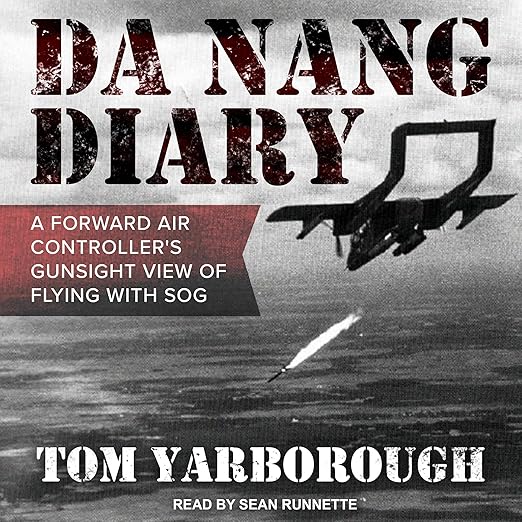
Prairie Fire missions get one clipped paragraph in most general histories of the Vietnam War, a footnote about classified reconnaissance flights over Laos that most readers skim past without registering what they actually cost the men flying them. This audiobook spends its full fifteen hours and fourteen minutes living inside that footnote, and I came away from a week of porch-and-commute listening with a far more granular sense of what a forward air controller's job actually involved than any documentary had given me. Tom Yarborough logged 1,500 hours of combat flying time in the Cessna O-2 and the OV-10 Bronco, prop planes flown low and slow enough that a single rifle round from the ground could end a mission, and Da Nang Diary is his own account of what that math felt like from the cockpit.
Yarborough belonged to the so-called Prairie Fire unit, one of the most classified assignments of the entire war, and his job title, forward air controller, undersells what he actually did. FACs flew unarmed above a battle, found the enemy, and then talked the fast jets in on top of them, all while keeping track of exactly where friendly troops were standing. Get that wrong by a few hundred yards and the story stops being about heroism. The book never lets a listener forget how thin that margin was.
What struck me first is how understated Yarborough's prose stays even when the events themselves are anything but. One listener review calls this out directly, noting that his restraint only sharpens the suspense rather than dulling it, and Sean Runnette's narration honors that choice instead of fighting it. Runnette has no deep track record in Vietnam-era military memoir specifically, but his work narrating Daniel Patrick Moynihan's letters, a twenty-six-hour collection spanning grief, policy argument, and personal warmth without flattening any of it, shows exactly the kind of tonal control this material needs. A book built on technical flying detail and mortal danger in the same paragraph requires a reader who will not oversell either register, and that appears to be Runnette's instinct here too.
The structure itself is mission-driven rather than strictly chronological in feel, moving between rescue operations, direct airstrikes, and the extended, harrowing sorties flown directly over North Vietnamese positions in Laos. Each episode functions almost as its own short, self-contained account of a single decision made in seconds with lives depending on it. That episodic shape works well for audio specifically, since a listener can absorb one mission at a time rather than needing to track a single sustained plot across fifteen hours.
Yarborough was among the most frequently shot-up pilots flying out of Da Nang, and the book does not shy away from what repeated exposure like that does to a person's nerves over time. It resists turning his own survival into a tidy narrative of inevitability. Several close calls read as genuinely arbitrary, which is more honest than the version of this story a Hollywood adaptation would probably tell.
Highlights
The forward air controller role is one of the least understood jobs of the entire Vietnam air war, and this book makes a real case for why it deserves more attention. FACs were the eyes and ears for the fast jets that got all the postwar glory, the ones who actually knew where the enemy was, where the friendlies were, and what a strike would cost either side. Yarborough's account puts a listener inside that decision loop in real time rather than describing it after the fact.
The rescue sequences carry a specific weight. Listening to an account of a downed pilot being located and pulled out under fire, told by someone who flew similar missions himself, lands differently than a secondhand history ever could. One reviewer describes the effect as feeling like riding in the cockpit alongside Yarborough, and that is a fair description of how close the book keeps a listener to the physical experience of the missions themselves.
A quieter throughline about wartime brotherhood also runs under the combat sequences, the trust required between a FAC and the pilots he directed, and the loyalty within a unit operating in near-total secrecy. Reviewers single this out too. One calls it an excellent, highly recommended capture of the emotional, first-hand experience of combat, and another notes the wealth of hair-raising stories Yarborough kept detailed enough to still recall with real clarity years later.
Before You Commit to Da Nang Diary
The technical vocabulary is real and largely unexplained. Bronco, O-2, ordnance types, call signs, radio procedure. Listeners with no background in military aviation will pick up plenty from context, but this is not a book that pauses to define its own jargon for a general audience, and a small amount of outside reading beforehand rewards the listener considerably.
Fifteen hours and fourteen minutes is a genuine commitment, and because the book is one man's memoir rather than a survey of the broader air war, it stays tightly focused on Yarborough's own missions rather than the larger strategic picture. Listeners wanting a wide-lens account of the air war in Southeast Asia should treat this as a deep, narrow addition to that picture rather than a starting point for it.
One review notes the account is well written but sometimes assumes familiarity with aspects of the war that were not widely covered by the American press at the time, meaning newer listeners to Vietnam War history may occasionally feel a step behind the geography and politics driving a given mission. None of that undercuts the value of what Yarborough describes, but pairing this with a broader single-volume history of the war rewards the listener who wants full context.
Is This One for You?
This one is built for readers of pilot memoirs in the Chickenhawk tradition, for anyone who wants Vietnam War history from inside a single cockpit rather than from a general's map table, and for listeners specifically drawn to the classified, under-covered corners of that war. The forward air controller role rarely gets this kind of dedicated treatment, and Prairie Fire's secrecy alone makes it a genuinely under-told piece of the conflict.
Skip it if what you actually want is the wide strategic view: troop movements, political decisions in Washington and Saigon, the war's arc from Tet to withdrawal. Da Nang Diary stays close to Yarborough's own missions by design, and that focus is the book's real strength, not a limitation to work around.







