
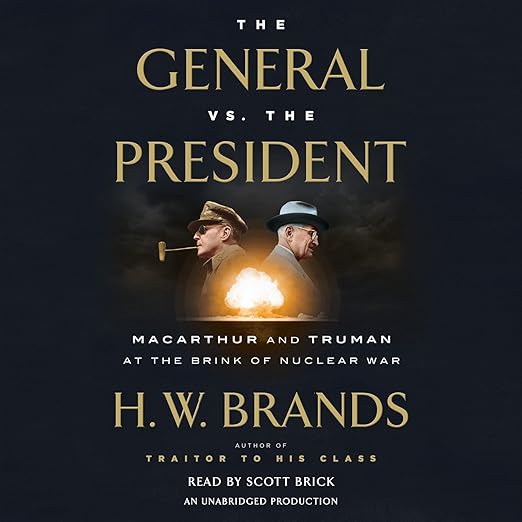
The Short Version
- Read by: Scott Brick is one of the best in narrative nonfiction, and his command of Brands' propulsive prose makes 15 hours feel like a continuous urgent story.
- At its heart: Civilian control of the military, hubris and constitutional order, the Korean War's forgotten lessons
- Vibe: Urgent, authoritative, and genuinely alarming in ways that resonate beyond the 1950s
- Short version: H. W. Brands at his best: rigorous history that reads with the momentum of a political thriller.
There is a moment early in The General vs. the President where H. W. Brands describes Harry Truman's accidental suggestion, in response to a reporter's question, that General Douglas MacArthur might have his finger on the nuclear trigger. The correction came quickly. The damage, Brands writes, had already been done. Reading that passage, I had the particular experience that only the best narrative history produces: the past stops feeling like the past. The conflict between an unpopular, constitutionally committed president and a military icon who believed himself beyond correction feels, in Brands' telling, not like a solved problem but like a recurring condition.
I listen to a lot of military and political history, and Brands is one of a handful of writers in the genre who can tell you what happened and make you feel why it mattered without ever becoming didactic. His books on Andrew Jackson and Franklin Roosevelt did this. The General vs. the President does it again, with perhaps more contemporary urgency than any of his other work.
The book's great achievement is making both men comprehensible in their excess. MacArthur is not simply a villain, though his behavior in the Korean War's later stages crosses into something close to insubordination. His worldview, that appeasement leads to disaster, that a showdown with communist China was inevitable, that the sooner it came the better, was internally consistent and had genuine support in the American military establishment. Brands gives him credit for Inchon, one of the boldest amphibious landings in military history, and for his administration of occupied Japan. He earns the man's achievements before dismantling his pretensions.
Truman is the more sympathetic figure, but Brands avoids hagiography. The man was genuinely unpopular, genuinely limited in his understanding of the broader strategic picture in some areas, and genuinely committed to a constitutional principle, civilian control of the military, that most people around him were willing to bend in MacArthur's favor. That commitment is what makes his eventual decision to relieve MacArthur one of the more significant acts of presidential courage in the 20th century, and Brands makes sure you feel its weight.
Why It Works in Audio
Scott Brick is among the most reliable narrators in narrative nonfiction, and his performance here is exemplary. He manages the book's multiple registers, strategic analysis, biographical detail, congressional testimony, battle reporting, without losing continuity of tone. Brands writes with momentum, and Brick maintains that momentum across 15 hours without visible effort. Listeners who have encountered Brick on other presidential or military histories will know what to expect, and this is among his best work in the genre.
The runtime is substantial but justified. Brands is not a maximalist: everything in this book is load-bearing. The McCarthy subplot, the Berlin blockade, Inchon's daring and its aftermath, these are not tangents but essential context for understanding what the MacArthur-Truman confrontation actually meant.
What to Watch For in The General vs. the President
Listeners coming primarily for the drama of MacArthur's relief should know that Brands spends considerable time building the Korean War's strategic context before the central confrontation becomes unavoidable. This is exactly right structurally, but listeners expecting an immediate clash may need patience in the first few hours.
The book is also careful to locate the conflict in its Cold War context, Soviet expansionism, the Berlin crisis, McCarthy's domestic campaign, which means it asks readers to track several simultaneous storylines. This is a feature, not a bug, but it is worth knowing going in that this is dense history requiring engagement rather than background listening.
Who Will Get the Most From It
Essential for anyone interested in American political and military history, particularly the post-World War II period. Also a strong recommendation for listeners who found books like David McCullough's Truman or Evan Thomas' Ike satisfying: Brands occupies similar narrative territory with comparable scholarly authority.
The book's underlying question, what happens when a wildly popular military figure believes his judgment supersedes civilian authority, has obvious resonance beyond its historical moment. Listeners who come for the 1950s will leave thinking about something much larger.
Common Questions
How does H. W. Brands compare to David McCullough as a narrative historian?
Multiple reviewers draw the comparison explicitly. Both write popular history with strong narrative drive and meticulous research. Brands tends slightly more toward geopolitical and institutional analysis, McCullough slightly more toward personal biography. The General vs. the President blends both approaches effectively.
Is the book balanced in its treatment of MacArthur, or does it take sides?
Brands gives MacArthur significant credit for real achievements, Inchon, the administration of occupied Japan, before examining his failures. The book ultimately endorses Truman's constitutional position but treats MacArthur's worldview as genuinely coherent rather than simply wrong. It is fair in the way good history should be.
Is Scott Brick's narration suitable for listeners unfamiliar with his work?
Brick is one of the most experienced narrators in nonfiction audiobooks, and his style is authoritative without being stentorian. New listeners will find him accessible. His pace suits Brands' analytical prose very well.







