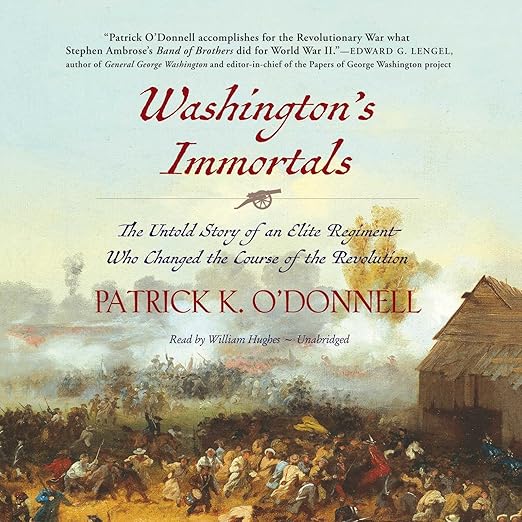
Washington's Immortals earns its title from a single desperate afternoon: the Battle of Brooklyn in August 1776, when a heroic regiment's rear-guard attacks let George Washington evacuate his outmanned army instead of losing it outright. This audiobook runs thirteen hours and twenty-nine minutes, and Patrick K. O'Donnell spends most of that time reconstructing what that unit actually experienced, in camp and in combat, rather than just narrating troop movements from a distance.
O'Donnell builds the book around a specific regiment, famously known as the Immortal 400, and the synopsis credits their rear-guard attacks with saving the nascent Continental Army at a moment when the revolution was, in its own words, on the verge of a sudden and disastrous end. From there the narrative follows the same unit through Trenton, Princeton, Camden, Cowpens, Guilford Courthouse, and Yorktown, using one group's continuity to hold together battles that span years and hundreds of miles.
Sarge's five-star review captures what that structure achieves: a needed story of our founding that stays personal rather than settling for a grand overview of battles, delivering what the review calls a what it was like to be there feeling. MaggieG13's five-star review pushes further, calling the book as riveting as a thriller and crediting O'Donnell's extensive research, drawing on diaries, pension applications, and letters, for setting it apart from other well-known accounts of the same period, including David McCullough's 1776.
Internal culture gets tracked too, the regiment's own, described in the synopsis as gentlemen of honor, family, and fortune, alongside their friendships, loves, defeats, and triumphs, which is a more intimate register than the battle list alone would suggest.
Method gets as much emphasis in the synopsis as O'Donnell's own conclusions do, describing original sources ranging from letters to diaries to pension applications, the kind of granular archival work that lets a book reconstruct individual soldiers' experiences rather than only high-level strategy. That method is presumably what MaggieG13's review is responding to when it calls the book riveting as a thriller despite being, in the reviewer's own words, a history book.
The Best Parts of Washington's Immortals
William Hughes narrates all thirteen hours and twenty-nine minutes, and not a single one of the five written reviews weighs in on the performance directly, so the case for listening rests entirely on the material itself: original sources, primary documents, and a regiment whose story the synopsis says survives today only as a modest, rusted, and scarred metal sign near a dilapidated auto garage. That gap between the physical memorial and the scale of what O'Donnell reconstructs is a large part of the book's appeal.
Ed Sanford's five-star review, titled A Powerful Account, spends real space defending the book against what it calls unwarranted negative reviews from arm chair students overly critical of a popular history aimed at readers who mostly learned about the Revolution in grade school or a required college course rather than as dedicated hobbyists. It is worth noting that no negative review actually appears in the five available here, so Sanford's defense responds to criticism from outside this specific review set.
Blackstone Audio, Inc. released this title in March 2016, and the tags attached to it, Americas and Military, describe the book accurately: this is ground-level war history built around named engagements and a specific chain of command rather than a broader cultural or political history of the Revolution.
Thirteen hours and twenty-nine minutes is a substantial runtime, but it matches the ground the book covers: a regiment's path through Brooklyn, Trenton, Princeton, Camden, Cowpens, Guilford Courthouse, and Yorktown spans most of the Revolutionary War's major engagements in the northern and southern theaters both, a lot of geography and time for any single audiobook to hold together coherently.
Before You Commit to Washington's Immortals
A naming and counting discrepancy is worth flagging. The synopsis describes 256 men, called the Maryland Heroes, who fell during the Battle of Brooklyn, and separately references the regiment as the Immortal 400. MaggieG13's review, meanwhile, refers to the same unit as the Maryland 400. The available material does not reconcile the 256 figure with either the Immortal 400 or the Maryland 400 naming, so treat the exact numbers as something worth double-checking against the book itself rather than a settled figure.
One clearly negative note in the review set comes from the Kindle Customer review, which otherwise calls the book good and praises the regiment's story, but flags that the book is a little long, its only stated criticism. The displayed 4.7 rating is also paired with only a single logged rating despite five full written reviews, a mismatch worth knowing about even without walking through the arithmetic in detail.
Norseman's five-star review, simply titled Excellent, adds little beyond a short endorsement, well done, love it, so it offers agreement without much additional detail to weigh against the more substantial reviews from Sarge, MaggieG13, and Ed Sanford. The listing also shows no formal series name or number attached to this release, so it reads as a standalone military history title rather than one entry in a numbered set.
Should You Listen to Washington's Immortals?
Readers of ground-level military history who want a single regiment's continuity carried across a series of major Revolutionary War engagements will get the most from this one, Trenton, Princeton, Camden, Cowpens, Guilford Courthouse, Yorktown, rather than a broad, general-purpose survey of the war. MaggieG13's comparison to David McCullough's 1776 is a useful anchor point if you have already read that book and want a more tightly focused companion to it.
Listeners specifically drawn to the human-scale details war histories often skip are a fit too, friendships, loves, and personal losses inside a single regiment, rather than only troop movements and dates. Lord Cornwallis appears as the recurring opposing commander across several of these engagements, giving the book a consistent antagonist on the British side to track alongside the regiment's own continuity on the American one.
Skip it if length is a concern, since even a positive, four-star review flags the book's length as its one drawback, or if you need every historical figure and number in a listing to already line up cleanly before you commit. Start here if a boots-on-the-ground account of one overlooked regiment's path through the entire war, built from letters and pension records rather than secondhand summary, sounds like exactly the angle you have been missing.
The Short Version
- Read by: William Hughes carries all thirteen-plus hours solo, a performance the five reviews on file never specifically address.
- At its heart: The Battle of Brooklyn, a single regiment's path through the Revolutionary War, primary-source military history.
- Vibe: Gritty, boots-on-the-ground, reverent.
- Short version: A strong pick for Revolutionary War readers who want one regiment's continuity, though a naming discrepancy in the material is worth double-checking.