The Short Version
- Narration: Stephen Fry narrating his own retelling of Troy is one of the audio format's genuine pleasures; the wit and erudition are fully present, and Fry's voice gives the ancient material both gravity and levity.
- Themes: Pride and its consequences, divine interference in human affairs, the cost of war across a decade
- Mood: Epic in scale, dark in its undercurrents, frequently and wickedly funny
- Verdict: Fry turns one of literature's oldest stories into something that feels urgent and alive, and his narration is inseparable from the pleasure of listening.
I put on Troy during a long drive on a grey November afternoon. I had read the Iliad twice, once in college and once about six years ago, and I came in with the kind of preemptive skepticism a person develops when they have strong feelings about source material. Within the first hour, I had stopped being skeptical. Fry was not trying to compete with Homer; he was doing something else entirely, which is what made it work.
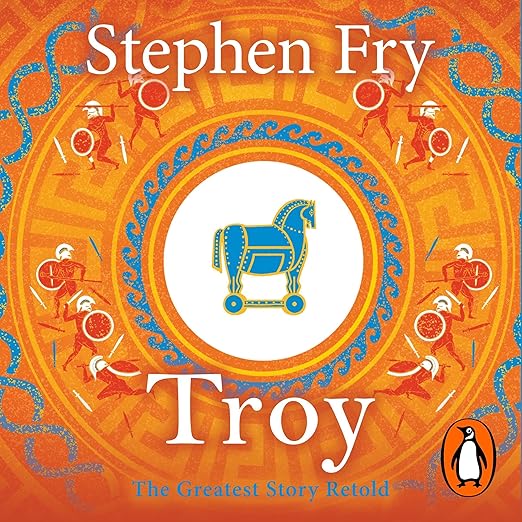
Troy is the third installment in Stephen Fry's Greek mythology series, following Mythos and Heroes. It takes up the war that follows Paris's abduction of Helen and carries through to the wooden horse and the fall of the city. Fry describes his approach as a reimagining rather than a translation, and that distinction is important. He fills in psychological backstory, draws out the divine politics with a satirist's eye, and writes dialogue that sounds genuinely human while remaining faithful to the mythological framework.
First, the Big Picture
What distinguishes this retelling from the many others in print is Fry's refusal to present the Trojan War as simply heroic. The book's wry observation, captured in one reviewer's summary, that you don't know petty until you've read Troy, is accurate. Achilles sulking in his tent because of a wounded ego, gods manipulating human lives out of boredom or jealousy, heroes making decisions that doom thousands because of personal pride: Fry lets all of this breathe without sanitizing it, and the result is a portrait of the ancient world that feels uncomfortably contemporary.
The treatment of divine interference is particularly well handled. Fry does not present the gods as remote or allegorical; they are meddlesome, vain, and often petty in ways that complicate the human drama below. Zeus attempting to maintain some neutrality while Hera, Athena, and Aphrodite pursue their own agendas makes for a kind of celestial comedy that runs beneath the tragedy on the battlefield. Reviewer TraV noted that Fry balances humor with tragedy, never letting you forget that behind the pettiness and betrayals are human costs. That balance is the book's central achievement.
What Makes Troy Worth Hearing
The audiobook format is, frankly, the ideal way to experience this material. Fry's narration is the delivery system the writing was designed for. He has been reading and performing for decades, and his command of pace, emphasis, and tonal variation makes the eleven hours feel considerably shorter than they are. The contrast between his lighter, more comic delivery during scenes of divine squabbling and his quieter gravity during the battle sequences is handled with the instinct of a seasoned performer rather than a narrator simply reading a text.
Reviewer Don Morin described it as a book to immerse yourself in, and that immersion is primarily an auditory experience. Fry's voice, familiar to many listeners from his other narration work and public persona, carries an authority that suits the ancient material without making it feel stuffy. He is clearly having fun, and that enthusiasm is contagious in the best way.
A Few Reservations
Readers expecting strict fidelity to either Homer or the wider mythological tradition should calibrate their expectations. Fry takes liberties, fills gaps, and occasionally introduces modern irony into settings that ancient sources presented with more solemnity. Reviewer J. Baucom notes that this is part of what makes Fry's books enjoyable, but also recommends Edith Hamilton's Mythology for those who want something closer to the original sources. Both recommendations are sound; the two approaches serve different purposes and different readers.
Troy is also the third book in a series, and while it functions as a standalone, listeners who have heard Mythos and Heroes will have richer context for the characters and the divine family dynamics. Fry provides enough orientation that newcomers will not be lost, but the experience is fuller with the earlier books as background.
The Right Listener for Troy
Troy works equally well for listeners approaching Greek mythology for the first time and for those who know the Iliad well enough to appreciate Fry's departures from it. It is a strong starting point for younger adult listeners interested in the ancient world who want something with genuine narrative energy rather than a textbook approach. For long-time mythology enthusiasts, the pleasure is in watching a skilled writer find fresh angles on familiar material, particularly in the treatment of the wooden horse sequence, which Fry handles with the pacing of a thriller. Anyone who listened to and enjoyed Mythos or Heroes should come here directly.
Good to Know
Does Troy work as a standalone or do I need to read Mythos and Heroes first?
It works as a standalone. Fry provides enough context for new readers to follow the story and characters. That said, listeners who have heard Mythos and Heroes will have richer background on the divine politics and character histories that drive the Troy narrative.
Is this the same content as the print edition or does the audiobook have unique elements?
The audiobook is the text as written, narrated by Fry. The print editions include illustrations, which are absent in the audio format. For the narration specifically, the audiobook is the superior experience; for the visual elements, the illustrated hardcover editions are worth seeking out separately.