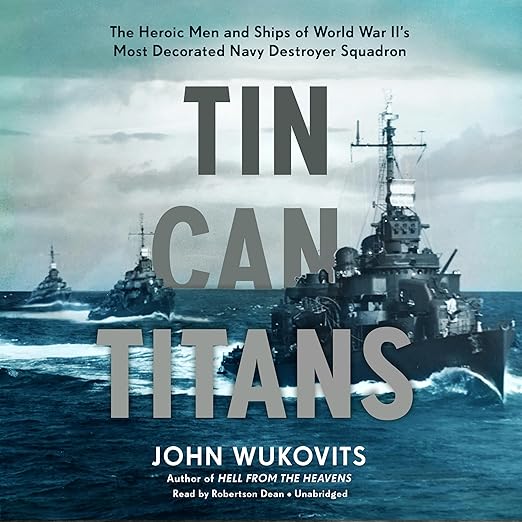
When Admiral William Halsey chose Destroyer Squadron 21 to lead the American fleet into Tokyo Bay on the day of the Japanese surrender, what did it mean for the sailors aboard those tin-can ships to arrive at that moment? John Wukovits answers that question by rebuilding the preceding years of Pacific warfare from below decks, through diaries, survivor interviews, and letters written at sea and on shore, and Robertson Dean's narration brings the accumulated weight of that testimony into the audiobook format with the measured gravitas that serious WWII history demands.
What John Wukovits Delivers
The title refers to the Fletcher-class destroyers of DesRon 21, called 'tin cans' by the men who served on them for the combination of speed, firepower, and relative fragility that defined the class. These were not capital ships. They were fast, versatile, expendable in ways that battleships and carriers were not, and they were present at nearly every major engagement in the Pacific theater from Guadalcanal to the final days of the war. The squadron's battle record is extraordinary. What Wukovits adds is the human account that operational records cannot contain.
The three figures around whom the narrative coheres are carefully chosen to represent different modes of war. Commander Donald MacDonald of the USS O'Bannon became the most decorated naval officer of the entire Pacific war, a credential that requires context to appreciate given the competition, and Wukovits provides that context at length. Lieutenant Hugh Barr Miller survived the sinking of his ship and spent weeks waging a one-man resistance campaign on a Japanese-occupied island before eventual rescue, the kind of survival story that seems almost impossible in retrospect but is fully documented in the primary sources Wukovits draws on. And Doctor Dow 'Doc' Ransom of the USS La Vallette operated as a physician at sea with a combination of technical skill and human warmth that his crewmates remembered for the rest of their lives.
Together these three men give readers a complete picture of what the Pacific campaign required from the people who fought it across its different registers. MacDonald represents command and its accumulated weight. Miller represents survival at its most primitive and resourceful. Ransom represents the maintenance of humanity, medical care, humor, genuine concern for the men around him, in conditions designed to strip all three of those qualities away. The structure is not accidental. Wukovits knows what he is doing.
The broader crew stories are equally well-served. HWH's review specifically notes 'seaman Raines and his love letters to his wife' as an example of how Wukovits weaves highly personal material into the operational history. That love letter thread is one of the audiobook's most affecting passages, an ordinary sailor's correspondence, found and preserved, that carries the full weight of what the Pacific war cost the people who did not become famous for surviving it.
What John Wukovits Gets Right
Robertson Dean is among the most capable narrators currently working in American military and naval history audiobooks. His delivery for long-form nonfiction of this kind has a quality that resists easy description: gravitas without inflation, authority without theatrical performance. He understands that the primary sources Wukovits has assembled, the letters, the diary entries, the survivor testimony recorded decades after the events themselves, carry their own emotional weight and do not need amplification. He reads them with the respect of someone who understands that these are real words from real people in genuine danger.
The passage dealing with seaman Raines' love letters, singled out in reviews as a highlight of the reading experience, demonstrates this approach at its best. Dean delivers those letters with quiet, full attention. The result is one of the more moving sequences in recent WWII audiobook history, and it illustrates exactly why Dean is the right narrator for material like this: he knows when to get out of the way.
Marc L. Tavasci's review notes that Wukovits 'has once again come up with a stirring recollection' and compares this favorably to his earlier 'Hell from the Heavens.' Listeners familiar with Wukovits' work will recognize the structural approach; first-time readers of his will find the same quality of research and human specificity that distinguishes his WWII naval history from campaign overviews.
Where John Wukovits Loses Some Ground
Wukovits opens with a comprehensive introduction to the Fletcher-class destroyers and the technical parameters of the squadron before the human narrative fully asserts itself. History Nut's review notes that the author 'initially makes some issues with this', meaning the book takes time to establish its technical and organizational framework before the individual stories come forward. Listeners who are primarily interested in the human material should be patient through these opening hours; the payoff in personal detail is substantial once it arrives.
The book's historical scope is Pacific-wide. DesRon 21 participated in so many engagements, Guadalcanal, Kula Gulf, Kolombangara, the Leyte Gulf campaign, that the battle chronology can be dense for listeners without prior knowledge of the Pacific theater's geography and sequential logic. A map of the Pacific during the WWII campaign available for reference during listening is not strictly required but will enrich the engagement with the operational chapters considerably.
Who Should Pick Up Tin Can Titans
WWII Pacific history readers who have worked through the major campaign accounts, 'Neptune's Inferno,' 'The Last Stand of the Tin Can Sailors,' 'Shattered Sword', will find Wukovits' squadron-level focus a genuinely different perspective. The squadron history is not a comprehensive campaign account; it is a human account of one unit's war, and that specificity is what makes it valuable alongside the larger histories. It fills in what operational records and campaign overviews necessarily leave out.
Listeners who respond to military history that centers on individuals rather than strategy and command will find this audiobook consistently rewarding from its first hours to its final pages. The story of the men who sailed tin cans across the Pacific, who survived sinkings and occupied islands and years at sea away from everyone they loved, and who ended up in Tokyo Bay, that story needs to be recorded while the primary sources exist and before the last witnesses are gone. Robertson Dean's narration honors the urgency of that recording.