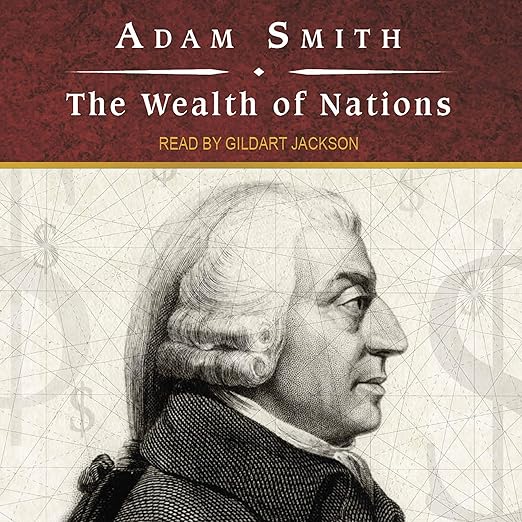
Narrating a 250-year-old economics text without letting thirty-six and a half hours feel like homework is a genuinely tall order, and this audiobook of The Wealth of Nations leans entirely on Gildart Jackson's reading to pull it off, since Adam Smith's original 1776 prose wasn't written with audio pacing anywhere in mind.
Genesis Bustamante's Flying Spaghetti Monster Joke Explained
Released through Tantor Audio in January 2011, this recording has had well over a decade to find its audience, and the fact that it's still turning up new listeners and new reviews today says something about the staying power of the source material itself, independent of any particular narrator's performance.
Structurally, the synopsis lays out five books directly: Book I covers the causes of improvement in the productive power of labor, Book II the nature, accumulation, and employment of stock, Book III the different progress of opulence in different nations, Book IV systems of political economy, and Book V the revenue of the sovereign or commonwealth. It's the foundational text of modern economics and capitalism, an Age of Enlightenment product per the listing's own description.
Smith, per the listing, gets credited with introducing the world to the very idea of economics and capitalism in the modern sense of those words, a claim that sounds sweeping until you consider how many later economic thinkers, across two and a half centuries, still frame their own arguments as either building on or reacting directly against this exact original book.
This Tantor Audio edition runs 36 hours and 43 minutes, released in January 2011. Per Gilligan's review of the Modern Library Classics print version, the complete work spans all five books unabridged, with an introduction from former labor secretary Robert Reich in that particular print edition, useful context even though this audio listing doesn't confirm whether Reich's introduction is included here as well.
Genesis Bustamante's review keeps things blunt: unabridged, just like the Flying Spaghetti Monster intended, a joke that still lands on the actual point, this is the full text rather than a trimmed-down summary dressed up as the genuine article for a listener who wants the real thing.
Korpela Wanted Truman's One-Handed Economists
Asko Korpela's review, from a self-described retired economist, calls out how little has fundamentally changed in the underlying economic ideas despite decades of commentary, invoking a wry story about Truman wanting to employ one handed economists, tired of hearing on the other hand from every expert consulted. That same review name-checks Lenin's most famous statue as a symbol of where one of those hands eventually pointed.
Dave_42's review situates the book historically: originally published under its full title, An Inquiry Into The Nature And Causes Of The Wealth Of Nations, on March 9, 1776, with additional editions following in 1778, 1784, 1786, and 1789, and pairs it as one of two major works from Smith alongside The Theory of Moral Sentiments.
Anonimo's review draws a comparison to Charles Darwin's On the origin of the species as a similarly foundational text worth reading from a historic point of view even outside its own specific field, a comparison that captures how this book gets discussed among readers who take it seriously as more than an academic assignment.
Asko Korpela's review adds a candid admission worth passing along: despite being a retired economist, the reviewer says this book should have been read fifty years earlier, a reminder that even professionals in the field sometimes put off the primary source in favor of later summaries and commentary built on top of it.
Thirty-Six Hours, and Still No Margin Notes
Dave_42's review specifically warns against the free Kindle version of the text, without fully explaining why, a detail worth flagging since it suggests edition quality varies meaningfully for this particular title. Whether that concern carries over to this audio edition isn't something the data here confirms one way or another.
At just over thirty-six and a half hours, this is a genuine commitment even by nonfiction standards, and the rating shown, a 4.5 average, is built on a single counted vote against five visible five-star-heavy written reviews, an arithmetic gap the listing itself can't fully explain.
Gilligan's review offers one more useful data point about the source text itself: to minimize repetition, that review focuses on what makes the Modern Library Classics print version distinct, including small summary notes printed in the margin alongside each paragraph, a navigational aid that obviously has no audio equivalent in a narrated edition like this one.
Skip It If You Want an Easy Primer
Recommended for listeners with a real interest in economic history and the origins of capitalist theory, especially anyone drawn to primary texts rather than modern summaries of the same ideas. Genesis Bustamante's brief but enthusiastic review captures the appeal of having the complete, unabridged work in one single listen.
Anyone approaching this as a supplement to formal study, rather than casual listening, should find the full unabridged structure, all five books in sequence, more useful than an abridged summary would be, even if it demands considerably more total listening time to get there.
Listeners who've enjoyed other primary-source audiobooks of Enlightenment-era texts, rather than modern paraphrases built around them, will likely find the same appeal here that Anonimo's review describes when comparing it to Darwin's foundational work: reading the argument in its original form rather than someone else's summary of it.
Skip it if you're looking for a beginner-friendly introduction to economics rather than the eighteenth-century source text itself. Smith's original prose, however foundational, was not written for a casual audience, and thirty-six hours is a serious amount of time to spend confirming that particular fact for yourself and your own listening habits.
- Performance: Gildart Jackson narrates this Tantor Audio edition across all five books; the reviews here focus on the text's ideas and print editions rather than the audio performance.
- What it covers: Foundational economic theory, labor and capital, the origins of modern capitalism.
- Feel: Dense, historic, and demanding in scale.
- Our call: A serious listen for anyone genuinely interested in economic history, not a casual introduction to the subject.
A Few Questions About The Wealth of Nations
Is this Wealth of Nations audiobook the complete, unabridged text?
The listing itself doesn't state this explicitly, though one review of a related print edition confirms it covers all five books without abridgment, and the audio's 36-hour-plus runtime is consistent with a complete reading of Smith's entire original text from 1776.
Who narrates The Wealth of Nations audiobook?
Gildart Jackson narrates this Tantor Audio edition, which runs 36 hours and 43 minutes covering all five books of Adam Smith's original 1776 economic treatise, released in January 2011 with a 4.5 average rating currently shown on the listing page.