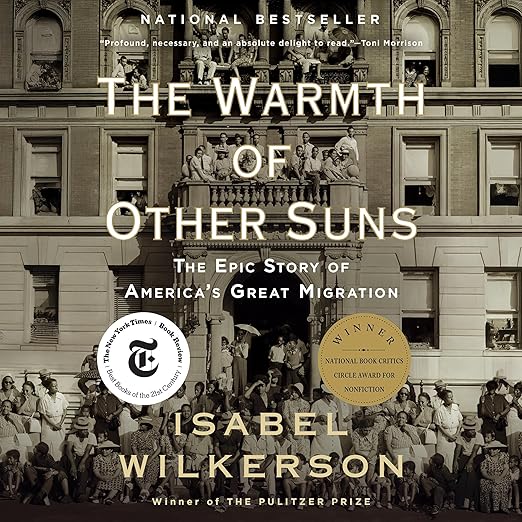
Six million people left the American South between World War I and 1970, and Isabel Wilkerson tells that story through three of them. Twenty-two hours and forty minutes is what the audiobook asks for, which is a real commitment and close to the only reasonable length for what she is attempting: a migration the size of a nation's population, rendered at the scale of individual decisions about which train to take.
Three lives carry the whole book. Ida Mae Gladney, a sharecropper's wife, left Mississippi for Chicago in 1937. George Starling, described as sharp and quick-tempered, left Florida for Harlem in 1945. Robert Foster, a surgeon, left Louisiana in 1953 hoping to make something happen in California. Different decades, different destinations, different reasons for going, and Wilkerson braids them rather than telling each in turn. The effect is that the migration reads as a single long event rather than as three biographies filed next to each other.
Scale created the problem Wilkerson had to solve, and the 18 August 2020 five-star names it. The Great Migration ran for roughly sixty years, so it happened almost imperceptibly, without the single dramatic rupture that historians and readers both prefer. That response describes the three protagonists as stand-ins for the millions who traveled with them, and adds that Wilkerson is a storyteller before she is anything else. Both observations are exactly right, and the second is why the first works.
Method matters here more than in most popular history. Wilkerson built this from oral histories, interviewing people in old age about journeys they had made as young adults, and the description's phrase for what she found is an unrecognized immigration inside a country's own borders. That framing does the analytical work: it lets her treat departure, arrival, hostility and settlement with the vocabulary of migration studies while never leaving the specific kitchen table she is sitting at.
Miles Sustains Three Lives Across Six Decades
Testimony read aloud behaves differently from testimony on a page, and this book is largely testimony. The 31 October 2017 five-star reports feeling like an eyewitness to the events described, then connects the book directly to a grandmother who was the daughter of a sharecropper and cotton picker in North Carolina, and to questions about generational responsibility and sacrifice. That is the reaction the book is engineered to produce, and hearing the material spoken shortens the distance considerably.
Robin Miles takes the reading, across a runtime that would defeat a less disciplined performance. What the material demands is unusual: three protagonists whose lives run in parallel across six decades, each with a home region, a destination city and a set of relatives, all of whom recur hundreds of pages apart. A listener needs to know within a sentence whose chapter this is. Sustaining that recognition for twenty-two hours, without turning any of the three into a caricature of a region, is the whole job.
Proportion is the argument Wilkerson is quietly making, and the 10 May 2025 five-star from the United Kingdom states it more bluntly than the book ever does: this movement was larger in numbers and equal in significance to any other population shift in the country's history, and it has received far less attention than a much smaller seventeenth-century arrival that every schoolchild is taught about. Set that beside the fact that the whole thing unfolded across six decades within living memory, and the case for spending a full listening week on it makes itself. Wilkerson never delivers that comparison as a thesis. She simply gives six million departures the narrative apparatus usually reserved for founding myths, and lets the reader notice which stories have been told at this length before.
Blurbs Bury the Book, Reviews Ignore the Reading
Reading the product description is an ordeal in itself. Prize citations, best-of lists and newspaper quotations occupy the majority of it, and the actual account of what the book contains arrives near the bottom in two short paragraphs. Anyone deciding whether to spend twenty-two hours here has to scroll past a wall of accolades to find the information relevant to that decision. The awards are real; their placement makes the listing considerably less useful than it should be.
Nothing in the five written responses touches the recording. Every one of them evaluates the book as a book, which says a great deal about how widely the title has traveled and nothing at all about the listening experience. On a twenty-two-hour file, where the reader is effectively the entire delivery mechanism, that leaves a sizable gap between what the page tells you and what you are actually buying. Sample the first chapter rather than trusting the average.
Structure is the practical caution. One response praises the way facts arrive folded into anecdote rather than stacked one after another, and that is accurate and also the reason this rewards continuous listening over ten-minute fragments. The braid means a chapter about Florida in 1945 may be followed by Chicago in 1937, and the payoff comes from holding all three timelines at once. Listeners who dip in and out will lose the architecture and keep only the anecdotes.
Family Migration Stories Deserve This Book
Anyone with a family story that runs from a Southern state to a Northern or Western city should treat this as close to required, since it supplies the context in which that story happened. Beyond that, it suits listeners who want narrative history rather than argument-driven history, readers of long-form journalism, and anyone who found American history at school arranged around wars and presidents and suspected something enormous had been left out.
Approach with care if twenty-two hours of interwoven chronology sounds like work rather than pleasure, because the structure asks for attention and gives up its shape slowly. The subject matter is also unsparing: sharecropping, racial terror and the specific humiliations of the journey itself are described in detail through people who lived them. This is not comfort listening, and its emotional weight accumulates rather than arriving all at once.
The Short Version
- Voice: Robin Miles is credited across 22h40, on material that requires three separate lives to stay instantly distinguishable for the whole run.
- Big ideas: the Great Migration, internal exile, what leaving costs across generations
- Atmosphere: Patient and cumulative, oral history given the shape of a novel
- Worth it?: Worth the twenty-two hours if you listen continuously, since the braided structure is where the argument lives.
Before You Listen
Does the audiobook follow the three subjects separately or all at once?
All at once. Wilkerson braids Ida Mae Gladney leaving Mississippi in 1937, George Starling leaving Florida in 1945 and Robert Foster leaving Louisiana in 1953, cutting between them across decades. That interleaving is deliberate, and it is why continuous listening serves the book better than short scattered sessions.
Why does a book with this many awards show only twenty-four ratings?
The counter is almost certainly tied to one edition rather than to the title. This recording dates from December 2010, and a work carrying a National Book Critics Circle Award and a shelf of best-of-the-decade citations has obviously been read far more widely than two dozen times. Treat the count as edition bookkeeping.
Is this a history book or a narrative?
Both, deliberately. Wilkerson reports the demographic scale, roughly six million people over six decades, then delivers it entirely through interviews with three people who made the trip. The analysis is present but embedded in anecdote rather than separated into argument chapters, which is the book's defining formal choice.
Who reads it, and is twenty-two hours realistic as an audiobook commitment?
Robin Miles narrates, and the file runs twenty-two hours and forty minutes. That length covers three life stories from the 1930s through the 1970s plus the historical framing around them, so the pace is unhurried and the recording rewards being treated as a long project rather than a weekend.