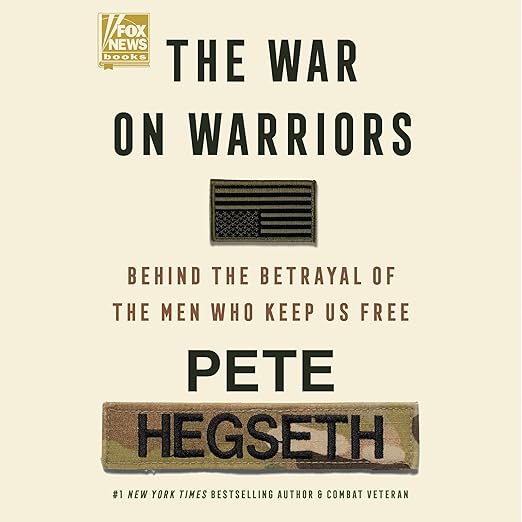
- Voice: The author takes the reading himself, so the memoir passages and the polemic reach you from the same source rather than through a hired voice.
- Big ideas: Meritocracy against diversity policy, military culture, combat service, institutional decline.
- Atmosphere: Blunt, combative, entirely unhedged.
- Worth it?: Effective for listeners already persuaded, and built for nobody else.
Pete Hegseth takes the reading of The War on Warriors himself, and on a book this personal that is the only sensible arrangement. Eight hours and ten minutes of argument, grievance and combat memoir arrive from the person who made the case rather than through a hired reader, which changes what the audiobook is before a word of it has been judged. Broadside Books published the edition on June 4, 2024, a date worth holding on to, because the paragraph a buyer reads first was written for a considerably later moment.
Where This One Lands
Eight hours and ten minutes is the shape of a sustained polemic rather than a history, which the classification on this listing does not quite capture. One five-star response from January 2025 lays out the structure more clearly than the publisher's copy manages, describing three ideas the book holds responsible for undermining the military: the confrontation between meritocracy and diversity, equity and inclusion; the wish to ignore biological difference; and a third that the response begins to name before its text runs out. A thesis with a numbered spine is the best gift a listener can be handed, because a numbered spine survives the loss of the page and a diffuse argument does not.
Hegseth joined the Army to fight extremists and was then called one by that same Army, which is how the copy frames the wound at the center of the book. The argument growing out of it holds that a service organized around lethality, competency and color blindness has been replaced by one following the country off what the copy calls the cliff of cultural chaos. Buyers who share that diagnosis will find it stated with unusual bluntness and unusual confidence. Buyers who do not will find very little designed to move them, because converting opponents is not the project here. This book was written for people already worried, and it says so on the first page of its own description.
Why The War on Warriors Works as an Audiobook
Broadside released the edition in June 2024, and the description now sitting above it opens by identifying the author as President Trump's nominee for Secretary of Defense. That nomination came later. The November 2024 five-star describes hurrying to buy as soon as news of the nomination broke, which places the event months after publication. The marketing paragraph a buyer meets first was therefore written for a different moment than the book was, and it sells eight hours on the strength of a job its author did not hold when the edition appeared. None of that is deceptive. It does mean the framing and the content are pulling in slightly different directions.
Jack Heslin, a two-tour Vietnam combat veteran, left the most striking response on the page in March 2026, and it is not addressed to other buyers at all. It is addressed to the author, in the second person: I recently read your excellent book, I applaud you for what you wrote, I hope many of our citizens will read it. That form identifies the kind of object this is faster than any summary could. The book is received as a letter and answered as a letter, and the people answering are exactly the people it was written to reach. Whatever else it does, it does that with complete success.
What Gives Us Pause
Four is the number of ratings this listing reports. Five written responses sit posted beneath it. The tally and the column disagree, which is worth knowing before anyone reads much into the 4.7 average resting on top of them. More telling than the arithmetic is what those five share: not one disputes the argument. Every criticism anywhere on the page concerns organization and language instead. One response dated February 2025, from a buyer with four years of military service and almost thirty as a law enforcement officer, describes purchasing a 231-page hardcover, which is a quiet reminder that this column is largely discussing a printed object rather than a recording.
Sharker, the lone four-star, is a self-declared fan of the author and still calls the book poorly organized, objecting that numerous vulgar remarks demean its purpose and its Christian witness. The description of the prose matters for anyone choosing between formats: the writing conveys the feeling of talking to a man in a crowded bar who feels no obligation to hold back or observe the civility due a formal written work. Whether that reads as a defect or as the entire appeal depends on which of those two rooms you wanted to be in. It is also the one variable a five-minute sample will settle beyond argument.
Who Should Listen to The War on Warriors
Veterans, serving personnel and buyers already persuaded by the cultural argument are the audience, and every written response here comes from inside that group. Anyone wanting the case for the prosecution laid out at length, with combat service behind it and no hedging anywhere, gets precisely that across eight hours. Self-narration is part of the appeal for that listener, since the arguments arrive from the man who made them rather than through an intermediary. Military-history listeners hoping for institutional analysis will find something narrower, angrier and far more personal than the history label suggests.
Anybody wanting a balanced account of the debates this book joins should look elsewhere, and the book would not claim otherwise. Listeners after military history in the ordinary sense, campaigns, doctrine, institutional record, are in the wrong aisle regardless of where the listing files it. Readers who reject the thesis will find no interlocutor waiting: this is not built to change minds, it is built to supply the ones already made up. That makes it a poor thing to hand across a divide and an effective one to hand to an ally. Eight hours is a long time to spend agreeing, and a longer one to spend arguing back at a recording that cannot hear you.