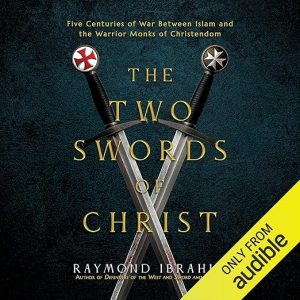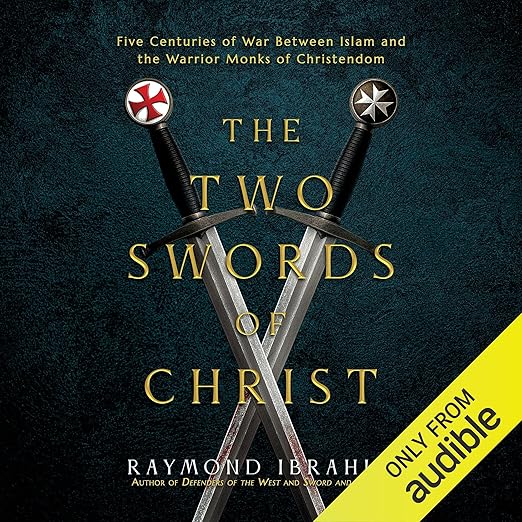
Raymond Ibrahim concludes his crusade trilogy with The Two Swords of Christ, the most detailed and contentious entry in the series. Following Sword and Scimitar and Defenders of the West, this audiobook takes as its subject the Knights Templar and Knights Hospitaller: the medieval military orders whose fusion of religious vocation and martial purpose shaped the trajectory of the Crusades and whose legacy continues to generate historical controversy. John McLain narrates across fifteen hours and fifty-five minutes, and whether or not Ibrahim's framing aligns with your priors, the primary-source depth of the scholarship deserves engagement on its own terms.
Primary Sources Anchor a Suppressed History
Ibrahim's scholarship on the military orders draws on an exhaustive study of primary sources, and reviewers who engaged most seriously with the book highlight this as its most significant contribution. One praised the rarity of seeing primary sources used so thoroughly in accessible history, and another described it as engaging the knights on the terms of their age rather than the terms moderns have prepared for them. The book directly addresses what Ibrahim calls a suppressed or overlooked history: the role of the Templars and Hospitallers in defending Christian civilization against Islamic expansion during the Crusades and beyond. He also dismantles the persistent myth that the Templars evolved into the Freemasons, grounding that rebuttal in historical documentation rather than assertion. The ideological framing in the synopsis reflects Ibrahim's combative rhetorical register and will be a significant barrier for some listeners. This is a book with a defined perspective, and that perspective shapes how the history is selected, framed, and argued. Careful readers already familiar with this conflict's historiography will be able to evaluate Ibrahim's claims against the broader scholarly record. Those new to the period who take the framing at face value without supplementary reading are getting one angle on a genuinely complex history. The strength of the primary-source grounding gives the book more intellectual substance than a polemic would have, and that tension between the solid evidentiary foundation and the combative framing is what makes the book worth engaging while also requiring critical attention from the listener.
McLain Sustains Authority Across Fifteen Hours
John McLain's narration is the right instrument for this material. He handles the battle accounts with appropriate gravitas and maintains the clarity needed to track the dense political and theological context surrounding the military history. At fifteen hours and fifty-five minutes, this is a committed listening investment, and McLain's ability to sustain consistent authority across that duration is a genuine asset. The 4.9 rating across 215 reviews indicates a highly engaged readership. Reviewer Netman 101 described it as offering a clear, engaging look at a long and complicated period of history and specifically noted it does not feel simplified or shallow, which speaks to what Ibrahim manages at his best: making a genuinely complex historical period accessible without flattening its difficulty. The theological dimension, the two swords of the title drawn from Luke 22:38, is developed as the foundational justification for the military orders' existence, and for listeners interested in how medieval Christians reconciled piety and violence, this is substantial ground covered with considerable scholarly care. The series context also matters here: listeners who have worked through Sword and Scimitar and Defenders of the West will find this third volume the most detailed and the most focused on institutional history, with the Templars and Hospitallers receiving the sustained attention that their role in the Crusades warrants.
A Case Argued, Not a Neutral History
This book carries a 4.9 rating and enthusiastic reviews, but listeners should approach it with awareness of its ideological commitments. Ibrahim is not a neutral historian presenting multiple perspectives on the Crusades. He is arguing a case, and his language reflects that consistently throughout the fifteen-hour runtime. The reviewer who called the book inspirational and the one who called it accessible without feeling simplified are reading the same text but taking different things from it. Listeners who engage with the primary-source material on its own terms will find genuine historical value here. Those who need their historical analysis to include sustained engagement with Islamic perspectives on the same events, or who want the broader scholarly debate around the Crusades represented, will need to supplement this audiobook with other sources. The third-installment position in the trilogy also means that listeners unfamiliar with Sword and Scimitar or Defenders of the West may benefit from starting there before arriving here, though The Two Swords of Christ is substantive enough to stand independently for listeners with prior knowledge of the period.
Prior Trilogy Readers Are the Natural Audience
Readers already engaged with Ibrahim's earlier work in this trilogy are the most natural audience, and those who found his previous entries compelling will find this third installment the most detailed and martial of the three. Listeners with a general interest in medieval military orders, particularly the Templars and Hospitallers, who want a primary-source-grounded account of their role in the Crusades will find substantial material here. The fifteen-hour runtime and ideological framing make it a serious commitment, best suited to listeners who come prepared to engage critically with the perspective being argued. Those seeking academic, multi-perspective crusade history should look to scholars whose work explicitly engages the full range of historical views. For those who want a narrative-driven, deeply sourced account from a defined ideological position, this audiobook delivers exactly what it promises. The Two Swords of Christ also sits at the intersection of military history, religious history, and cultural argument in a way that makes it useful for multiple kinds of listeners. Those interested in the institutional history of the Catholic Church and its military orders, students of medieval European history more broadly, and readers engaged with contemporary debates about religion and violence will each find material worth engaging here. Ibrahim's synthesis of theological argument with battlefield narrative gives the book a layered quality that rewards different kinds of attention at different points in the fifteen-hour runtime, and McLain's narration sustains that layered engagement through to the end.
The Short Version
- Narrator: John McLain handles the fifteen-plus-hour history with the clarity and authority the dense primary-source material requires. He gives the battle accounts appropriate gravitas without tipping into dramatization.
- Subjects: Crusader warrior-monks, Christian militarism, the Templars and Hospitallers, Islam-West conflict across centuries
- Tone: Dense and martial, with the cumulative weight of a genuinely comprehensive historical account
- Bottom line: Raymond Ibrahim's third crusade history is his most detailed yet, essential listening for those engaged with medieval military orders, though the ideological framing of the subject requires an informed, critical reader.