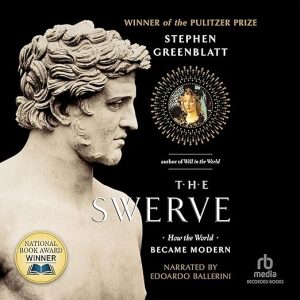
Poggio Bracciolini walked into a German monastery library in 1417 and found a manuscript that changed the course of Western history. Stephen Greenblatt's The Swerve, narrated by Edoardo Ballerini in this audiobook, tells the story of that discovery and of the poem inside the manuscript: Lucretius's On the Nature of Things, a first-century BCE philosophical epic arguing that the universe runs without gods, that fear of death is irrational, and that matter consists of tiny particles in constant collision and swerve. The book won both the Pulitzer Prize and the National Book Award for Nonfiction in 2012, and if those credentials sound imposing, the listening experience is anything but.
I came to this audiobook with some skepticism. Books about Renaissance book-hunting can easily slide into academic self-congratulation, the story of scholars finding other scholars very important. What Greenblatt does instead is write with genuine excitement about ideas, about the specific pleasure of a text surviving against impossible odds, and about the strangeness of the historical claim he is making: that a single rediscovered poem helped push the Western world out of the Middle Ages and into modernity. Whether that claim holds up completely is debatable. That the ride is worth taking is not.
Is The Swerve Worth Your Time?
Greenblatt builds the book in two parallel tracks. The first follows Poggio Bracciolini directly: his career as a papal secretary, his practice of hunting for ancient manuscripts in monastery libraries across Europe, and his discovery of the Lucretius text in 1417. This track is vivid and novelistic, with Greenblatt rendering Poggio as a sharply drawn character whose intelligence and appetite for classical texts drive the narrative forward. One reviewer described the book as 'written so vividly and with such verve, passion, and breadth of ambition,' and that characterization holds especially for the Poggio sections.
The second track moves backward in time to Lucretius himself and to the intellectual world the poem inhabited, then forward through the poem's influence on Botticelli, Giordano Bruno, Montaigne, Shakespeare, and Thomas Jefferson. Greenblatt is a literary critic by training and a scholar of Shakespeare by specialty, and his analysis of how atomist ideas infiltrate Renaissance painting, Elizabethan drama, and Enlightenment political thought is genuinely illuminating.
The caveat raised by one careful reviewer is worth noting: some readers will find the book covers the Renaissance influence of Lucretius more lightly than they expected, while spending considerable space on the medieval world Poggio moved through. The framing around a single manuscript as the pivot of Western modernity is also contested by historians, some of whom find Greenblatt's thesis more elegant than evidentially rigorous. These are real limitations, and knowing them in advance helps set appropriate expectations rather than feeling misled by the book's ambitions.
The Best Parts of The Swerve
Edoardo Ballerini is one of the most reliable narrators working in literary nonfiction, and his performance here is calibrated beautifully to Greenblatt's prose. Ballerini has a warm, slightly formal register that suits the Renaissance material without sounding theatrical, and his pacing through the denser argumentative sections gives the listener time to follow the logic without losing momentum. He handles the Latin titles and Italian names with natural fluency, which matters in a book filled with both.
A particular pleasure arrives when a narrator clearly enjoys the material, and Ballerini's handling of the Poggio sections suggests that engagement. The scenes in monastery libraries, the descriptions of medieval book production, the tension of whether a text will survive or vanish into mold and inattention: these come alive in his reading in a way that rewards the audio format specifically.
At nine hours and forty-one minutes, the runtime is substantial but never feels wasted. Greenblatt writes with enough narrative drive that the book rarely stalls in its argumentative sections, and the Poggio biographical thread gives the listener a human anchor through the more abstract philosophical discussions.
Before You Commit to The Swerve
Historians have pushed back on Greenblatt's central argument: the idea that Lucretius's poem, rediscovered in 1417, served as a direct engine for the Renaissance and the scientific revolution. Critics point out that the influence was more diffuse, and that Greenblatt traces some connections that are associative rather than demonstrated. Listeners who want to engage with the historiographical debate will find the book more thesis-driven than evidentiary, and may want to read critical responses alongside it.
This is also a book for listeners who enjoy intellectual history as a form of literary pleasure rather than strictly as scholarship. Greenblatt writes as a humanist who finds ideas exciting, and his prose reflects that. If what you want is a rigorous academic treatment of Lucretius's reception history, you will want something more technical. But if you want the feeling of following an intelligent, enthusiastic guide through a genuinely strange and consequential moment in the history of ideas, The Swerve delivers that experience with considerable skill.
The three reviewers on this audiobook edition give it five stars across the board, and their enthusiasm is consistent with the broader critical reception. The book is polarizing only among professional historians. For general listeners interested in the history of ideas, Renaissance culture, or the survival of classical texts, the reception has been consistently strong.
Should You Listen to The Swerve?
Listeners who enjoy narrative intellectual history, particularly the kind that treats the survival and transmission of ideas as genuine drama, will find this audiobook absorbing. Fans of other Greenblatt works, including Will in the World or The Rise and Fall of Adam and Eve, will recognize his approach and will likely enjoy this one. Anyone interested in the origins of modern secular thought or the history of atomism will find the philosophical coverage rewarding.
Listeners who want strict historiographical rigor or a more skeptical treatment of the manuscript's influence should approach with the caveat that Greenblatt is making a large argument with genuine verve and some interpretive liberty. Academic historians of the Renaissance may find the thesis overstated. Everyone else will likely find it worth the ten hours of their time, guided by Ballerini's excellent narration throughout.
- Read by: Edoardo Ballerini is an ideal fit, bringing warmth and formal elegance to Greenblatt's Renaissance prose while handling Latin and Italian terminology with natural fluency.
- At its heart: The survival of dangerous ideas, Renaissance humanism, the chain from ancient philosophy to modernity
- Vibe: Intellectually charged and novelistic, with a genuine sense of discovery animating every chapter
- Short version: An enthusiastic, beautifully narrated intellectual adventure that earns its Pulitzer, so long as you arrive knowing its central argument is more seductive than airtight.
Before You Listen
Is the historical argument in The Swerve audiobook contested by scholars?
Yes. Several historians of the Renaissance have argued that Greenblatt overstates the direct influence of the rediscovered Lucretius manuscript on the cultural changes of the period, and that he connects some dots associatively rather than demonstrably. The book reads as a confident thesis rather than a hedged academic argument. Listeners who want the debate should seek out critical responses alongside the audiobook.
How does Edoardo Ballerini's narration compare to other literary nonfiction audiobooks?
Ballerini is one of the most consistent performers in the literary nonfiction space, and this performance is among his stronger work. His warm, slightly formal register suits Greenblatt's prose exactly, and he brings genuine engagement to both the narrative Poggio sections and the more argumentative philosophical passages.
Who was Poggio Bracciolini, and why does the audiobook spend so much time on him?
Poggio Bracciolini was a fifteenth-century Italian humanist and papal secretary who made a career of hunting for ancient manuscripts in European monastery libraries. The audiobook centers on him because the discovery of the Lucretius text was his achievement, and Greenblatt uses his biography as the human vessel for the book's larger argument about how lost ancient ideas returned to reshape the modern world.