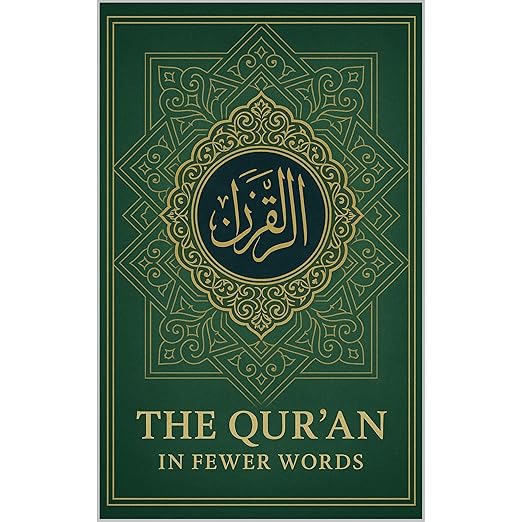
Gregory Bullock's The Quran in Fewer Words occupies an unusual position in the religion and spirituality audiobook catalog. The title is direct about what it offers: summaries of each of the 114 surahs of the Quran, organized sequentially, and generated with AI assistance as the synopsis explicitly discloses. The audiobook, narrated by Virtual Voice and running 3 hours and 48 minutes, is part of the "In Fewer Words" series, which applies this summary approach to major texts. The result is a reference tool rather than a translation, a devotional text, or a scholarly commentary. Approaching it as any of those things would be a misapplication of what Bullock has assembled, and understanding the distinction before purchase is the most useful service a review of this audiobook can provide.
The transparent disclosure of AI involvement in generating the summaries is worth dwelling on. Bullock has not obscured this; the synopsis states it plainly. For listeners who come to the Quran from a Muslim faith tradition, the question of whether AI-generated summaries of sacred scripture constitute an appropriate engagement with the text is a genuinely substantive one, and one the audiobook itself does not address. For listeners approaching the Quran from outside the tradition, the disclosure may be less theologically loaded but still raises questions about interpretive authority: whose reading of the surahs is reflected in the summaries, and how were the AI-generation parameters set? The "In Fewer Words" series format does not provide apparatus for these questions, and prospective listeners should weigh this absence against the book's stated utility purpose.
A Structural Overview With Real Interpretive Limits
The book's utility case rests on a real need: the Quran is a substantial text with a complex surah structure, and many people approaching it for the first time, whether as students, scholars of comparative religion, or individuals exploring Islam, benefit from having a structural overview before engaging with full translation. Chapter-summary approaches have existed in Quranic studies for centuries, and the project of making the text's architecture visible and navigable is a legitimate scholarly and pedagogical one. Bullock is working in that tradition, however imperfectly and with unconventional tools.
The limitations of the approach are worth being clear about. Summaries necessarily involve choices about what matters in a given surah, and those choices embed interpretation. AI-generated summaries embed the interpretive patterns of the training data, which may not reflect any single coherent hermeneutic tradition within Islamic scholarship. Listeners who want to understand how classical scholars read particular surahs, or how different interpretive traditions have diverged in their understanding of specific passages, will need commentaries and full translations rather than this audiobook. What this offers is a rapid structural orientation to the text as a whole, and that utility is real even if the method is novel.
Virtual Voice Narration Suits Study, Not Devotion
The 3-hour-48-minute runtime is the audiobook's most significant practical feature. For students or educators who need a broad overview of the Quran's surah structure as preparation for more detailed study, a single listening session covers the full 114 surahs at a pace that makes the whole navigable rather than overwhelming. Academic listeners preparing for comparative religion coursework, readers who have encountered Quranic references in literature or history and want contextual grounding, and journalists or researchers seeking baseline familiarity with the text's structure will find the format useful for this specific purpose, provided they approach it as a first step rather than a destination.
The Virtual Voice AI narration is functional rather than atmospheric. For a reference text intended for structured study, this is arguably acceptable; the narration's job is to deliver the summaries clearly rather than to create a devotional experience. Listeners whose engagement with sacred text requires a certain quality of voice and care in delivery will find the AI narration insufficient, and that is a legitimate response to the format choice. The pairing of AI-generated content with AI narration creates a consistent register of textual utility that either serves your purpose or does not, with little middle ground between these positions.
Canonical Order Skips the Meccan-Medinan Timeline
The rating of 3.0 out of 5 with a small review pool indicates a divided or cautious reception. The "In Fewer Words" series approach, which applies AI-generated summaries to major texts, is likely to produce stronger responses from listeners with strong prior relationships to the original material, since they will be in a position to evaluate whether the summaries capture what actually matters in each surah. For listeners without that prior relationship, the audiobook's value is proportional to how much structural orientation to the Quran they specifically need before engaging with the full text in a proper translation.
One structural note for prospective listeners: the surahs of the Quran are not arranged in chronological order of revelation, and the summaries in this audiobook follow the canonical order rather than the historical sequence. Listeners interested in the developmental arc of the Quranic revelation across the Meccan and Medinan periods will need to supplement with a commentary that addresses this dimension. The audiobook's format does not distinguish between Meccan and Medinan surahs or address the significance of the canonical ordering, which are foundational questions in Quranic studies that this overview leaves unaddressed.
Utility Reference, Not a Devotional Listen
This audiobook is for listeners with a specific orientation need: an overview of all 114 surahs as preparation for further study, a rapid structural survey for academic or comparative purposes, or a basic reference for non-Muslim listeners who encounter Quranic material in other contexts and want systematic familiarity. It is not for devotional listening, for deep Quranic study, or for listeners from Muslim traditions who want engagement with the text that honors its sacred character. The AI narration and AI-generated summaries place this firmly in the utility reference category. Listeners who need that utility will find it functional; those seeking something else should look to full translations with scholarly commentary instead.