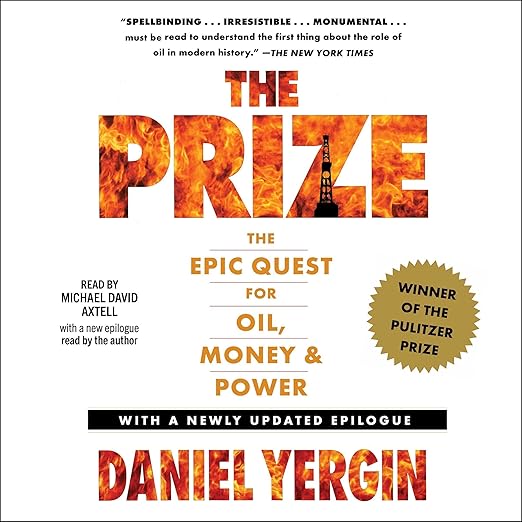
The first oil well in Pennsylvania is barely a paragraph in most general histories, and Daniel Yergin gives it a running start across this audiobook's forty-six hours instead, tracing a continuous line from that one well through two world wars to the Iraqi invasion of Kuwait and beyond.
This is a Pulitzer Prize winner, and the synopsis backs that up with a specific outside claim: Business Week called it the best history of oil ever written. The scope matches that billing, moving from the earliest drilling in Pennsylvania through the twentieth century's major conflicts to the Iraqi invasion of Kuwait, Operation Desert Storm, and the Iraq War, with a newly added epilogue connecting all of it to the current energy crisis directly.
Reviewer Tom Brody supplies the print scale behind that scope: an eight hundred eighty four page history covering discoveries across Pennsylvania, Texas, Baku, Sumatra, Iran, and offshore locations, alongside the corporate maneuvering between Standard Oil of California, Standard Oil of New Jersey, Texaco, and Socony. That kind of multi-company, multi-continent detail is what fills forty-six hours of narration rather than padding. Brody also singles out the book's high points around discovery moments specifically, suggesting Yergin builds the narrative around a series of concrete breakthroughs rather than a dry chronological survey of production statistics.
Brody's review also supplies a specific historical detail worth passing along: Baku, now the capital of Azerbaijan, was once an independent duchy before Russia annexed it in 1813 under the Treaty of Gulistan. Small regional histories like that one, threaded through a much larger global narrative, are apparently where the book's density pays off rather than becoming a slog.
Oil as the Hidden Hand Behind Two World Wars
Simon & Schuster Audio released this edition in December 2024, decades after the book's original publication and Pulitzer win, which places the current energy-crisis epilogue in genuinely recent context rather than as a dated afterthought tacked onto an older text. Listeners familiar with the book's reputation from the print era are getting a specifically updated audio edition rather than a straight re-recording of the original.
The synopsis quotes The New York Times directly, calling Yergin's account both spellbinding and irresistible, a specific pairing of praise that lines up with the Business Week quote rather than standing alone as an isolated blurb. Two separate outside publications making comparably strong claims is a stronger signal than either alone.
Reviewer CJA frames the book's actual argument in a single memorable line: oil functions as the hidden hand behind why the United States and Russia became the twentieth century's great powers in the first place, both having been early leaders in oil production before anything else. CJA also traces the shift from coal to oil during World War I specifically, and credits French and British forces with pioneering the military use of automobiles and tanks during that same shift, framing World War II as, in CJA's phrase, all about oil. That thesis, that access to oil rather than ideology or territory alone shaped which nations could actually fight and win modern wars, is presented as the throughline connecting the book's early chapters on Pennsylvania and Baku to its later chapters on Kuwait and Iraq.
Density is the obvious concern for a book this size, and two reviewers speak to it directly from different angles. Kevin H admits not usually enjoying long, dense history books, typically finding them boring and overloaded with facts, but says this one captures attention throughout regardless. A reviewer posting from India adds that no prior knowledge of the oil industry is needed going in, since the book is written for a general audience rather than specialists.
Axtell's Narration Goes Unmentioned in Every Review
Forty-six hours and eleven minutes is an enormous runtime by any standard, roughly matching what an eight-hundred-plus-page print history would demand in audio form. Listeners should treat this as a multi-week project rather than something to finish in a handful of sittings, and should not mistake the length for padding given how specifically sourced the detail apparently runs throughout.
Two votes and 4.7 stars do not belong in the same sentence mathematically, yet that is exactly what this listing shows, alongside five separate five-star reviews sitting in plain view beneath that number. No rounding convention turns two whole-star ratings into a decimal average, and the fact that every visible review still outscores the badge next to it suggests the counter itself, not reader sentiment, is what is broken here.
None of the five reviews mention narration, audio pacing, or how Michael David Axtell handles a forty-six-hour nonfiction narration specifically; Brody's review even cites a print page count directly, a strong sign these reactions may have originated with the print or e-book edition rather than this audio production. That leaves Axtell's actual performance, across what is a genuinely demanding vocal undertaking at this length, undocumented by the available review record.
A single-word review from Saudi Arabia, reading simply excellent, adds one more data point to the international spread already visible from the reviewer posting out of India, suggesting the book's reach extends well past an English-language or Western-focused readership for a subject that is, after all, inherently global in scope.
Energy Politics Fans Are the Ideal Audience Here
Serious interest in energy politics, twentieth-century great-power conflict, or corporate history is really what this rewards, particularly listeners drawn to a single continuous narrative connecting Pennsylvania's first well to today's headlines rather than a series of disconnected essays. Kevin H's account, describing being pulled in despite not normally enjoying the genre, suggests the writing itself carries real momentum even at this length.
Both the runtime and the subject's apparent density may intimidate some listeners, who should weigh the Amazon Customer's review specifically, which states plainly that no specialized industry knowledge is assumed. The narration's specific quality remains an open question the current review set does not answer, worth knowing before committing forty-six hours on that basis alone.
Do I need prior knowledge of the oil industry to follow this audiobook?
No. One reviewer, posting from India, states directly that no previous industry knowledge is required and that the book is written for a general audience. Another reviewer who does not normally enjoy dense history books still describes staying engaged throughout, which points the same direction.
Why does The Prize audiobook show a 4.7 rating from only two votes when five reviews are visible?
The two figures conflict directly. A pair of whole-star votes has no mathematical path to a 4.7 average, and every one of the five written reviews on this same listing happens to be a perfect five stars, well above what the badge displays. That gap points to an error in how the vote counter is tracking responses, not actual reader sentiment.
Does this audiobook include updated material on the current energy crisis?
Yes. The synopsis specifically describes a new epilogue addressing the ongoing energy crisis directly, connecting the book's historical narrative to present-day events. This suggests the audiobook reflects an updated edition rather than a straight narration of the original text alone.
How long is The Prize audiobook, and is that length justified by the content?
It runs forty-six hours and eleven minutes, roughly matching an eight-hundred-plus-page print history. Reviewers describe genuinely specific, multi-continent detail throughout rather than padding, so the length reflects real scope covering a century of oil history rather than an artificially stretched narrative.