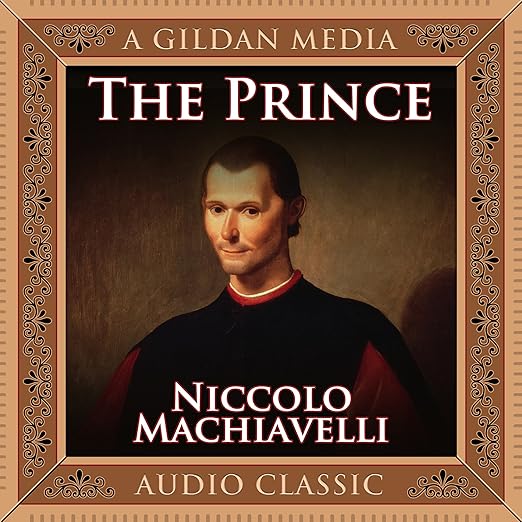
Before You Press Play
- Narrator: Grover Gardner reads Machiavelli with scholarly restraint, preserving the intimate advisory register rather than inflating it into drama.
- Subjects: Power acquisition and maintenance, the gap between political idealism and political reality, the ethics of necessity
- Tone: Cool and precise, with a candor that still surprises five centuries after composition
- Bottom line: The standard by which all political realism is measured; at under five hours, this audiobook is the most efficient way to encounter Machiavelli directly.
Grover Gardner has narrated a library's worth of significant texts over a long career, but listening to him work through Machiavelli in this audiobook, I kept thinking about what the correct tone for The Prince actually is. It is not academic lecture. It is not political speech. It is something more intimate than either: a dethroned civil servant writing to a prince he is trying to impress, with the urgency of someone who needs to demonstrate his usefulness before the window closes. Gardner catches that register more precisely than most narrators of classical political texts, and it changes how the advice lands.
Machiavellian Shorthand Versus a Four-Hour Original
The Prince occupies an unusual position in the history of political thought. It is simultaneously one of the most cited and most misunderstood texts in the Western canon. The word 'Machiavellian' has become shorthand for cynical political manipulation, which obscures what Machiavelli was actually doing: writing a practical manual for a specific prince in a specific political crisis, grounded not in moral idealism but in his observation of how power actually operates. The synopsis notes that he 'based his insights on the way people really are rather than an ideal of how they should be,' which remains the correct framing. At four hours and forty-seven minutes, this audiobook covers the complete text and does not linger beyond it.
Reviewer FrKurt Messick, approaching the text from political science training in the realpolitik tradition, identifies the book as 'incomplete' without Machiavelli's companionship, which is the right professional assessment. For general listeners, The Prince functions as an argument for why a prince who cannot be consistently good must know when not to be, which is a more precise and more disturbing claim than the casual shorthand suggests. The advice on whether it is better to be loved or feared, on how to treat conquered territories, on the relationship between fortune and virtue: these arguments remain astonishing in their candor five hundred years after their composition.
Gardner's Restraint Suits a Private Letter
Gardner's reading benefits from his long experience with classical and historical texts. He does not over-perform; he reads with intelligence and lets Machiavelli's cadences arrive at their natural speed. For a text this dense with argument, that restraint is essential. A more theatrical narrator might make the book feel like a self-help manual or a villain's handbook; Gardner keeps it where it belongs, which is somewhere between a political philosophy lecture and a private letter.
Reviewer P.H. describes this translation as reading 'like modern poetry,' which points to something real about the quality of the translation behind this recording. Not all translations of The Prince are equal; the worst flatten Machiavelli's sardonic intelligence into bureaucratic prose. The translation used here preserves enough of the original's rhetorical texture to make the argument feel like argument rather than summary. Listeners should note that some editions pair The Prince with other Machiavelli works; this recording focuses on The Prince itself, which is the correct choice for a first encounter.
Categories Instead of a Narrative Through-Line
The book is short by contemporary nonfiction standards, and its argument structure is not linear in the contemporary sense. Machiavelli proceeds by category: different types of principalities, different ways of acquiring them, different challenges they present. The accumulation of these categories is the method, not a deficiency. Listeners trained by narrative nonfiction to expect through-lines and building-block arguments will need to adjust. The Prince rewards attention at the sentence level more than the chapter level.
Political Reality Outweighs Private Morality for Rulers
The contemporary relevance that the synopsis describes as making this 'essential listening for every student of government' remains genuinely striking. The passages on how new rulers should treat former allies of the prince they displaced, on the relationship between military power and political stability, on what happens when a leader relies exclusively on mercenaries: these are not historical curiosities. They describe structural problems that have not changed. Reviewer Shivam Rajendra Thokal describes the text as written 'in such a way that not only the words used but also the place where they are placed' carry meaning, which is an accurate description of a rhetorically self-conscious text.
What makes Machiavelli's text so persistently relevant is not the individual pieces of advice but the analytical framework beneath them. His argument is not that rulers should be cruel or deceptive as ends in themselves, but that the demands of political reality are not the same as the demands of private morality, and that a ruler who does not understand this distinction will be destroyed by those who do. This is a structural observation about power, not a moral permission slip for cruelty. The audiobook format strips away some of the scholarly apparatus that often surrounds The Prince in classroom editions, returning the text to something closer to the private letter Machiavelli intended, addressed to a specific prince about specific problems that have not, in their structural form, changed.
Five Centuries of Relevance, Under Five Hours
Anyone with an interest in political philosophy, Western canon reading, or the history of political thought should own this audiobook. It is one of the foundational texts of Western political science and one of the few classical works that remains genuinely readable to non-specialist ears. Students of government, political science, and history will find it indispensable as a primary text. General listeners curious about why Machiavelli's name has survived five centuries will find the text does most of the explaining itself. At under five hours, the time investment is minimal relative to the intellectual return.
Questions Listeners Ask
Does this audiobook include a translator's introduction or is it the text alone?
Based on the runtime alone, this recording appears to be the text of The Prince itself, without a separate scholarly introduction bundled in. Some editions include introductions; listeners who want scholarly context may want to pair this with a secondary source on Renaissance Italian political history.
Which translation is used in this audiobook of The Prince?
The specific translation is not named anywhere on the listing, but reviewer comments describe it as reading with poetic quality and rhetorical clarity. Multiple translations of The Prince exist; listeners who want to compare should note that translation quality varies considerably for this text.
Is The Prince audiobook appropriate for listeners with no background in political philosophy?
Yes. Machiavelli writes for a non-specialist audience by design. The political philosophy tradition around the text is helpful context but not required. A general listener with interest in history and politics will find the argument accessible on first encounter.