At a Glance
- Narration: Barrett Whitener delivers the polemic with authoritative clarity and no editorial flourish, which is the right call for a book that already announces its position loudly.
- Themes: Revisionist American history, libertarian constitutionalism, consensus versus dissent in historiography
- Mood: Combative and confident, pitched as a corrective to received wisdom
- Verdict: A pointed libertarian-conservative reading of American history that is most valuable as a participant in a debate rather than a comprehensive survey; best paired with mainstream accounts of the same events.
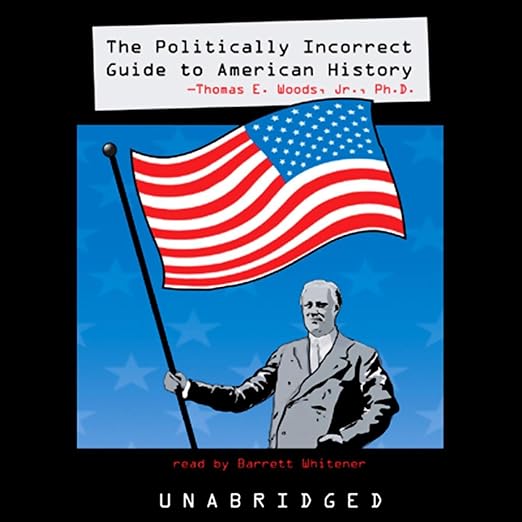
Professor Thomas E. Woods Jr. is not writing as a neutral party, and The Politically Incorrect Guide to American History does not pretend otherwise. The audiobook opens with the explicit premise that most textbooks present left-wing academic bias as objective fact, and that most Americans have been misled about their own history as a result. This framing is part of the book's identity and part of what you are choosing when you listen to it. Narrated by Barrett Whitener across eight hours and four minutes, the production delivers a revisionist tour through American history from a libertarian-conservative perspective that has earned both devoted admirers and fierce critics since its 2004 publication.
The series context matters here. The Politically Incorrect Guides are explicitly designed as counterweight texts, positioned against what their authors characterize as mainstream academic consensus. Woods belongs to the Austrian economics and paleoconservative intellectual tradition, and his historical readings reflect those commitments: skeptical of federal power, sympathetic to decentralization and state sovereignty, and critical of progressive readings of events like the New Deal, the Civil War, and the growth of the administrative state. The audiobook is best approached as a participant in an ongoing historiographical debate rather than as a replacement for a comprehensive survey.
Why The Politically Incorrect Guide to American History Works as an Audiobook
The genuine value of this audiobook lies in its willingness to name specific historical disputes that mainstream textbooks often resolve through omission rather than argument. Woods raises questions about the constitutional status of nullification, about the economic causes and consequences of the Civil War, about the efficacy of New Deal programs during the Depression, and about the origins of American foreign policy interventionism. These are not fringe questions: they are live debates in academic history that introductory survey courses frequently flatten into a single received narrative.
For listeners who have consumed only mainstream American history and are encountering these dissenting interpretations for the first time, the effect can be genuinely disorienting in a productive way. One reviewer who gave the audiobook five stars described finding that 'most of what I thought I knew was either lies or misleading information,' and while that phrasing overstates the case, the underlying experience of encountering serious counter-readings of familiar events is real. Woods is a credentialed scholar, not a conspiracy theorist, and his arguments deserve engagement on their merits even where they strain credibility.
The 'fast-paced, politically incorrect tour' the synopsis promises is exactly what the audiobook delivers. Woods does not linger or qualify. The arguments come rapidly and are stated with confidence. For listeners who share his priors, this is exhilarating. For listeners approaching from different assumptions, the pace makes it harder to identify where to push back. This is worth knowing: the audiobook rewards engagement with its claims rather than passive listening, and having a passing familiarity with the mainstream accounts it contests makes the listening experience far more productive.
Weak Spots in The Politically Incorrect Guide to American History
Barrett Whitener's narration suits the material with practiced efficiency. He handles academic content clearly and does not dramatize the more polemical passages in a way that would feel editorializing. The performance is clean and appropriately authoritative, which serves a book making serious historical claims. At eight hours, the production moves through a significant span of American history without feeling padded.
The book's original publication in 2004 means that some of the most recent scholarship, particularly in areas like Civil War causation and twentieth-century economic history, is not reflected. Woods's interpretations have themselves generated substantial academic response in the years since publication. Listeners who want to engage seriously with the arguments will find it useful to read at least one critical response alongside the audiobook, not because Woods is wrong across the board, but because the most productive engagement with any revisionist text comes from understanding both what it challenges and what its critics have said in reply.
The framing of the 'Books You're Not Supposed to Read' sections throughout the audiobook is worth noting as a pedagogical device. Rather than simply asserting that mainstream textbooks are wrong, Woods points listeners toward specific primary sources and revisionist scholars that support his interpretations. This serves two purposes. For listeners who agree with his starting position, it provides a reading list that extends the argument considerably. For listeners who are skeptical, it provides specific claims that can be checked against alternative sources, making the book more useful as a starting point for genuine inquiry than a simple polemic would be. The willingness to name specific counter-reading recommendations rather than just asserting the mainstream is biased gives the book more intellectual credibility than the provocative title might suggest, and it reflects Woods's genuine scholarly background rather than performative contrarianism.
The Right Listener for The Politically Incorrect Guide to American History
Listeners who find themselves skeptical of consensus narratives in American political history and want to hear a coherent, scholarly alternative framing will find this audiobook substantive and pointed. It works well for those already familiar with Austrian economics or libertarian constitutional theory who want a historical companion to those intellectual commitments.
Listeners expecting a balanced survey of American history, or those who primarily want the mainstream account with minor corrections, will be disappointed. The book wears its revisionist identity openly. Listeners who approach it as one voice in a historiographical debate rather than as a corrective final word will get the most from it. Pairing it with mainstream accounts of the same events produces the kind of productive tension that genuinely improves historical literacy.
Frequently Asked Questions
Is this audiobook suitable as an introduction to American history?
Not as a standalone introduction. The audiobook assumes enough baseline familiarity with the mainstream account to understand what it is arguing against. Listeners who already know the traditional narratives around events like the Civil War, the New Deal, and American foreign policy will get more from the revisionist framing than those encountering these subjects for the first time.
What is Professor Thomas Woods's academic background?
Thomas E. Woods Jr. holds a PhD in history from Columbia University and works within the libertarian-conservative and Austrian economics intellectual tradition. He has written extensively on American constitutional history and political economy. His views place him outside the academic mainstream, which is part of the book's explicit identity.
Does this audiobook present both sides of the historical debates it covers?
No. The book is designed as a counterweight to what Woods characterizes as mainstream left-wing bias, and it argues its position rather than presenting opposing views sympathetically. Listeners should approach it as one perspective in an ongoing historiographical debate and consult additional sources to understand the full range of scholarly opinion on the events covered.
How does Barrett Whitener's narration handle the more polemical passages of this audiobook?
Whitener maintains a consistent, authoritative register throughout without amplifying the polemical moments into something that sounds more combative than the text itself. He treats the content as serious historical argument rather than political performance, which keeps the listener focused on the substance of Woods's claims rather than the delivery.