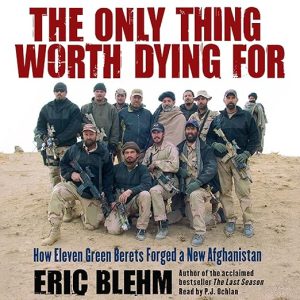
Afghanistan was in the news again when a friend pressed this book on me and said I would not put it down. He was right, though I should clarify that in audio this means not taking off my headphones. I listened over three days of commuting and a long walk, finishing the final chapters while standing in a park because I did not want to go inside before the account reached its conclusion. The account of ODA 574 and Captain Jason Amerine's mission in the southern Afghan mountains in the weeks after September 11, 2001 is the kind of narrative nonfiction that reads, as one reviewer puts it, better than most fictional accounts.
Eric Blehm had already established his credentials with The Last Season, his account of a National Park Service ranger's disappearance. Here he turns his meticulous researcher's attention to the Green Berets of ODA 574 and their mission to partner with a little-known Pashtun statesman named Hamid Karzai, who was attempting to foment a tribal revolt against the Taliban in their southern heartland. The mission is framed in the synopsis as the most important in the early days of the Global War on Terror, and Blehm has the access to make that claim stick.
First, the Big Picture
The book's greatest strength is its specificity. Blehm had unprecedented access to surviving members of ODA 574, key war planners, and Karzai himself. The result is a ground-level account of what it actually meant to conduct unconventional warfare in a country where American commanders in Washington, by the book's own acknowledgment, knew even less than the men on the ground. The gap between strategic thinking at the top and operational reality at the bottom is one of the book's sustained themes, and it is more illuminating than most policy analyses of the same period.
Captain Amerine and his ten men are rendered as individuals with specific personalities, specific skills, and specific fears. This is not a generic special forces account where the protagonists are interchangeable professionals. The relationships within ODA 574, and between the team and Karzai's growing militia of Pashtun fighters, develop with enough detail that the eventual tragedy of the mission lands with real weight. One reviewer describes feeling like a member of the A-team while reading, and Blehm's ground-level narration earns that immersive quality.
What Makes The Only Thing Worth Dying For Worth Hearing
P.J. Ochlan is well-suited to this material. He has a clear, controlled voice that handles the tactical complexity of the mission without losing emotional texture when the account demands it. The nearly thirteen hours of listening include detailed reconstructions of firefights, diplomatic negotiations conducted through interpreters, and the logistics of supplying a guerrilla operation by helicopter in the Afghan winter. Ochlan navigates all of this with consistent authority. Several reviewers noted that Blehm manages to weave together details from so many sources into a compelling, engrossing, and evocative story, and Ochlan's pacing is a key part of why that complexity remains followable in audio.
Former Congressman Charlie Wilson's endorsement, quoted in the synopsis as the one book you must read if you have any hope of understanding what American soldiers are up against in Afghanistan, arrives with obvious political context but is not wrong about the book's scope. Blehm is providing something that journalism rarely can: the full arc of a mission from planning to aftermath, with enough human detail to make the strategic picture legible through individual experience.
A Few Reservations
The book's focus on ODA 574 means that the larger strategic and political picture surrounding their mission receives less attention than some listeners might want. Blehm is explicitly cutting through the noise of politicians and high-level military officials, as the synopsis frames it, to tell the story from the ground up. That is both the book's strength and its limitation. Listeners who want a comprehensive analysis of the early Afghan war will need to supplement this with other accounts. What Blehm delivers is a deeply human story that illuminates the specific experience of this specific team.
Some of the international reviewers in the source material mention the book primarily in terms of delivery and background on Afghanistan without engaging the detail of Blehm's arguments. Listeners approaching this without context on US special operations may find some cultural and institutional background useful before starting.
Who Should Listen to The Only Thing Worth Dying For
Military history readers, students of the early Global War on Terror, and anyone who wants to understand the gap between policy and ground reality in Afghanistan will find this invaluable. It pairs naturally with Greg Mortenson's Three Cups of Tea for a civilian-focused Afghanistan perspective, or with Sebastian Junger's Restrepo for a later-war complement. Listeners who want a more critical examination of the Afghan mission's strategic failures, rather than a ground-level account of individual bravery, will find Blehm's sympathetic focus limiting but should still consider this essential foundation material.
The Short Version
- Performance: P.J. Ochlan brings controlled intensity to Blehm's account, matching the material's combination of tactical precision and human stakes.
- What it covers: Unconventional warfare in its earliest hours, trust between unlikely allies, the gap between Washington strategy and ground reality
- Feel: Tense and immersive, with the pace of well-researched narrative nonfiction
- Our call: One of the definitive early-war Afghanistan accounts, and Ochlan's narration makes the twelve hours feel like a thriller built from documented fact.