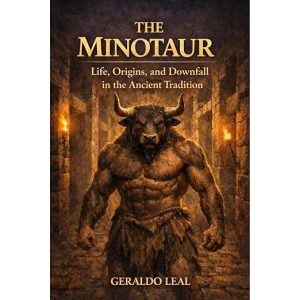
Geraldo Leal starts the story long before the Labyrinth, and that decision is the entire pitch of this audiobook. The Minotaur, the description argues, was the consequence of a broken oath, a divine punishment, and a disorder that entered the very heart of Cretan kingship. Nothing here opens with a hero and a sword. It opens at an altar, with a promise made to the god of the sea and then not honored, which is a considerably better starting point than the maze.
Minos's Broken Vow Turns the Monster Into a Verdict
Minos makes a vow to the god of the sea, the vow is broken, and every later disaster follows from that one failure. The copy lays the chain out deliberately: the religious context of the promise, the cultic guilt falling on the house, the divine intervention imposed upon Pasiphae, and the role of Daedalus in the artifice that made the creature's birth possible. Told in that order, the monster stops being a villain and becomes a verdict. The description calls this the complete history of the Cretan creature, an ambitious phrase for a book this short and a defensible one for a myth this compact.
Labyrinth construction gets framed as an oracular response rather than as an engineering commission, which is the most interesting claim in the whole description and the one a listener will most want to see supported. The subjugation of Athens and the tribute of blood follow it, then the arrival of Theseus and the final confrontation inside the structure. That is a complete arc, and three hours and twenty-four minutes is a sensible size for it. The tribute of blood is the stretch most listeners will already know in outline, and the copy treats it as a consequence of the vow rather than as a runway for the hero.
Antiquity does heavy lifting in this sales copy. The book claims to reconstruct the history as it was transmitted in the sources of Antiquity, and calls itself a reconstruction grounded in ancient tradition. Both are strong claims about provenance. The page supports them with nothing at all: no ancient author is named, no edition or translation is cited, and no bibliography turns up anywhere on the page or in the fields around it.
Pasiphae and Daedalus Test a Synthetic Narrator
Synthetic narration is credited here under the Virtual Voice label, and for this particular text that creates a practical problem rather than a philosophical one. Pasiphae, Daedalus, Ariadne, Poseidon, Theseus, and Cretan kingship all have to be pronounced, repeatedly, across three and a half hours of continuous prose. Machine readers handle ordinary English cleanly and classical proper nouns unpredictably, and any listener who already knows these names will hear every stumble. A short sample settles it inside a minute, and it is the only test on this page that genuinely matters.
Greek Myths: The Original Stories is the series name, and this turns up as the third entry with no trace of the first two anywhere on the page. Whether they exist, what they cover, and whether this volume assumes them are all left open. The myth itself is self-contained, running from the vow through to the confrontation, so the numbering ends up as a curiosity rather than an obstacle to starting here. A third volume arriving with no visible predecessor does say something about the speed at which these entries are being produced.
Pasiphae is where the copy turns delicate, and a buyer should know why. The description speaks of a divine intervention imposed upon Pasiphae and of an artifice that made the creature's birth possible, which is careful language for an episode that the ancient tradition does not handle carefully at all. Any retelling grounded in that tradition has to pass through the material. Anyone considering this for a younger listener should read the line twice.
Zero Sources Named Behind the Reconstruction
Anyone shopping for a retelling should adjust expectations before pressing play. This is not a novelization. The copy addresses readers who want to understand the Minotaur not as an isolated symbol but as part of a chain of events involving cult, power, guilt, punishment, and memory. Expect explanation rather than scene, argument rather than dialogue, and a narrator's account rather than a character's experience. The description is honest about that, at least. Explanation carries a real advantage over drama when the myth is this familiar, since the plot holds no surprises for anybody and the causes very much do.
Three hours and twenty-four minutes with no rating, no votes, and no written responses leaves the description as the only evidence in the room. The publisher field reads Independently Published and the date reads March 14, 2026, which explains the silence without repairing it. Nothing here has been weighed by anybody whose opinion you can actually read, so the sample is the only genuine due diligence available to you.
Sources are the entire question with a book like this one, and the honest position is agnostic. The material may well be sound, and nothing in the summary announces itself as invention. The difficulty is that a listener cannot verify a word of it from this page, and the book's own claim to fidelity is precisely what makes verification matter. A single named edition would have settled the whole issue. Publishing independently is not the problem in itself. The absence of any visible check on the claims is what leaves a listener exposed.
Explanation Over Drama, Built for First Encounters
Students meeting the myth properly for the first time, and listeners who prefer their mythology explained rather than dramatized, are the natural audience. It also suits anyone who has read a novelized Theseus and now wants the older frame sitting underneath it. At this length it works well as background before a class, a museum, or a longer book about the ancient world, and it asks very little of your afternoon.
Not the place to come for the story told as a story, with Theseus in the dark and Ariadne's thread paying out behind. This is a reconstruction, delivered by software, on a page that names no sources and carries no listener reports whatsoever. For three hours and twenty-four minutes, even so, the frame it builds is the frame that makes the myth cohere, and that has value even on an unverified listing.
Before You Listen
Is this audiobook read by a person?
No. The credit line says Virtual Voice, the label used when software generates the reading instead of a person. This text is thick with classical names, from Pasiphae and Daedalus through to Poseidon and Theseus, and machine pronunciation of those is the first thing worth testing in a sample.
How long is the audiobook, and what ground does it cover?
Three hours and twenty-four minutes, taking in the vow to the god of the sea, the guilt that falls on the house of Minos, the role of Daedalus, the building of the Labyrinth, the tribute demanded of Athens, and the arrival of Theseus. A full arc rather than an episode.
Does it cite the ancient sources it claims to follow?
Not on this page. The copy promises a reconstruction grounded in ancient tradition and transmitted in the sources of Antiquity, then names no ancient author, no edition, and no translation. For a book selling fidelity as its main feature, that omission is the one thing worth weighing beforehand.