The Short Version
- Voice: Kate Levy brings measured authority to Susan Page's biography, her pacing suits the material's combination of political history and personal revelation, and she handles the emotional passages without veering into sentimentality.
- Big ideas: Women's political influence and invisibility, grief and resilience, the cost of relentless pragmatism
- Atmosphere: Absorbing and quietly revelatory
- Worth it?: An essential political biography that revises the standard account of Barbara Bush's role in American history, made compelling by Page's extraordinary access and Levy's controlled narration.
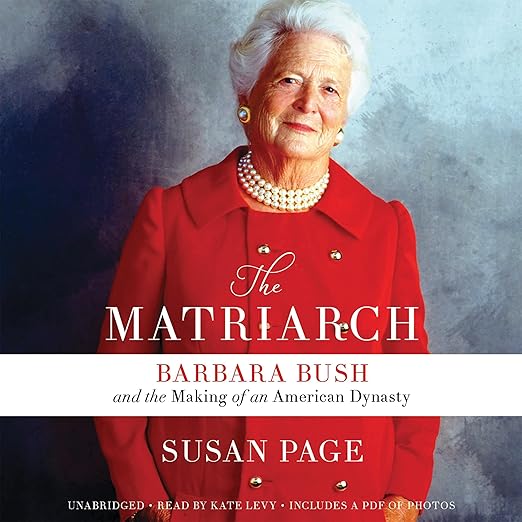
Barbara Bush was underestimated most of her life. That is the central argument of Susan Page's The Matriarch, and it is one she makes with the kind of evidence that does not allow for dismissal. This biography arrived as an Instant New York Times Bestseller and was called by The Atlantic a rare biography that is both carefully constructed and shockingly revelatory. Having spent 12 hours and 46 minutes with Kate Levy's narration of this audiobook, I find both halves of that description accurate. The revelatory quality is the rarer achievement; a great many political biographies produce nothing that genuinely surprises. This one does.
Page's access is the foundation of everything. More than a hundred interviews with Bush family members and friends, hours of direct conversation with Barbara Bush in the final six months of her life, and access to diaries spanning decades, this is not a biography assembled from secondhand sources and public record. It is the authorized account, which carries both the advantages of proximity and the implicit negotiation that authorization requires. The resulting portrait is fuller than anything previously published about this particular First Lady, and more honest than many authorized biographies achieve.
How The Matriarch Holds Up
The personal material is where this biography most exceeds expectations. A childhood in Rye, New York defined partly by her mother's criticism of her weight, barbs Page characterizes as leaving lifelong scars. The death of Barbara Bush's three-year-old daughter from leukemia, a loss that permanently altered the arc of her life. Depression serious enough in middle age that she contemplated suicide. None of this is sensationalized; Page reports it with the care of a Washington Bureau chief who has covered this family for decades. But none of it is minimized, either. The private person who emerges is considerably more complex than the publicly warm grandmother figure.
The reviewer who described this as a "3-D portrait", "Love, Hope, Sadness, Despair", is not exaggerating for effect. George H.W. Bush, notably, comes out of several passages looking considerably more self-interested than the public record suggests, while Barbara emerges as sharper, more strategically minded, and more central to both her husband's and her son's political operations than her careful public persona ever revealed. Page treats the complexity honestly rather than flattening it in either direction.
Why The Matriarch Works as an Audiobook
Kate Levy's narration is well-matched to this material. Page writes with the precision of political journalism and the attentiveness of a biographer who knows she has a subject deserving of careful handling, and Levy maintains that register throughout. She does not perform the emotional passages; she reads them with the kind of controlled empathy that allows the listener to respond rather than being directed toward a feeling. The 12-hour-46-minute runtime is substantial, but the combination of historical scope and personal revelation sustains attention across the full length.
The political dimensions are where the audiobook's contemporary relevance is sharpest. Barbara Bush's role in expanding literacy programs, her public compassion toward people with HIV/AIDS at a time when such compassion was politically costly, her influence on the end of the Cold War as a trusted adviser in her husband's White House, these are contributions that were routinely undervalued precisely because they were exercised through the informal channels available to women in politics rather than through formal power. Page documents them with the thoroughness of a reporter who has spent years examining how political influence actually operates.
Weak Spots in The Matriarch
Page also includes Barbara Bush's "last words for history" on several contested subjects: the evolution of the Republican Party, the role of women in American politics, Donald Trump, and her family's legacy. These sections are among the most candid passages in the book, and they will land differently depending on where you sit politically. Page's framing is journalistic rather than partisan, but the content itself is pointed. Readers who expect a purely hagiographic account of a beloved First Lady should know that this biography does not deliver that. It delivers something considerably more honest.
One reviewer noted that George H.W. Bush "comes off as a bit selfish" in several passages, that framing is accurate to what Page reports, and it is worth knowing that the biography does not simply celebrate the family it chronicles. Barbara Bush authorized this account with apparent awareness that full honesty required uncomfortable disclosure, and Page honors that trust.
The Right Listener for The Matriarch
This audiobook is the right choice for readers interested in political biography that goes beyond public record, the private dimensions of public lives, and specifically the often-invisible work that women do within political institutions. You do not need to be a Bush partisan or even politically sympathetic to find the biography compelling; the story of how Barbara Bush navigated grief, depression, political scrutiny, and institutional sexism is a human story before it is a political one.
The literacy campaign material is worth noting specifically because it represents a policy contribution that is easy to overlook in the context of the more dramatic political events of the Bush years. Barbara Bush's investment in expanding adult literacy programs was both genuinely her own and strategically significant in ways that went beyond soft politics. Page documents this work with the same evidentiary care she brings to the more controversial material, and the result is a portrait of policy engagement that challenges the standard narrative of First Ladies as primarily ceremonial figures.
Listeners who want a straightforward celebratory account of a beloved First Lady may find the candor uncomfortable. But for anyone who wants to understand how American political power actually operated across four decades, and who wielded it informally, behind the formal structures, this is a genuinely important audiobook.