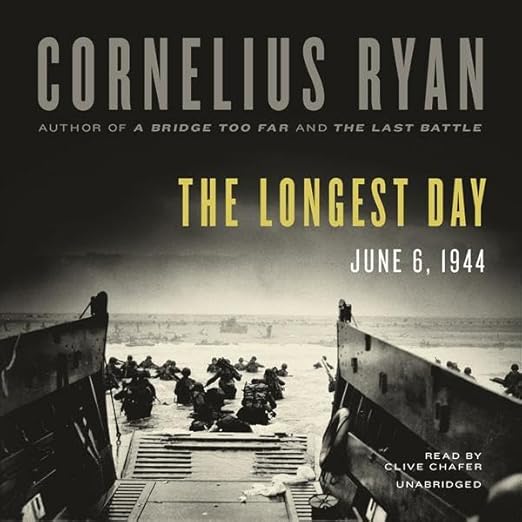
This audiobook of The Longest Day earns its reputation before you even factor in the narration: Cornelius Ryan's 1959 account of the Normandy invasion still reads, more than six decades on, as the account other D-Day histories get measured against, and Blackstone Audio's edition gives that reputation a faithful home for eight hours and forty-six minutes. This is not a book that needs to argue for its own significance; the synopsis calls it a masterpiece of military history, and the handful of reader reactions attached to the page back that framing up almost unanimously.
The Review
Martin R. Kealey called this the best written account of the Normandy invasion published, and the review backs that claim up with specifics rather than just enthusiasm, praising how Ryan takes listeners through the storming of Utah, Omaha, Gold, Sword, and Juno beaches while carrying them through shot and shell as the beachhead gets secured. That both the Allied and German points of view get real space, often through detailed character descriptions, is what separates this from a purely triumphalist account. Carolyn Heimendinger's review adds a detail worth sitting with: Ryan wrote this in 1959, close enough to the event that he was able to interview hundreds of the actual survivors, which explains why the book reads less like a military summary and more like an oral history stitched into a single narrative. Heimendinger goes so far as to call it probably the best recount of D-Day ever written, a claim that lines up with Barron Laycock's assessment of it as the single best book on D-Day yet written, a review posted back in 2000, a quarter century before Heimendinger's own.
MZ's review is the most useful reality check here. Going in expecting a dry, boring history lesson before a trip to Normandy, MZ instead found the book well written, fascinating, and easy to follow, unable to put it down. That reaction matters for an audiobook whose reputation as a classic can make it sound more like homework than listening entertainment. It is neither. Amy's review reinforces the same point from a different angle, noting that the book integrates human interest stories from the soldiers and civilians involved, American, English, and German alike, rather than sticking to troop movements and dates. Amy's own review mentions standing on Omaha Beach in person, and credits the book with making the environs come alive once that ground had actually been walked, which suggests the book rewards being paired with the physical place rather than experienced in isolation from it.
The five-beach structure that Martin R. Kealey outlines is the book's real backbone, and it is rare for a single account to give Utah, Omaha, Gold, Sword, and Juno each their own weight rather than collapsing the invasion into a single American-centric narrative. Barron Laycock's review places this book at the start of what the review calls a brilliant trilogy on the war in Europe, framing the June 6, 1944 assault and its total cost in human life as a deliberate opening chapter to a larger project rather than a standalone curiosity. That context is useful for anyone deciding whether to commit to this book alone or treat it as the first of several.
What keeps the book from reading as a dry troop-movement ledger is the balance Ryan strikes between the scale of the invasion and the individual experiences inside it. Amy's point about American, English, and German voices sharing space applies just as much to Kealey's description of moving vignettes of intimate experiences drawn from both sides of the beach. For listeners who already know the broad outline of D-Day from documentaries or textbooks, that ground-level material is where this audiobook earns its keep rather than simply restating dates most listeners already have memorized.
Before You Commit to The Longest Day
Not a single reader reaction on this page brings up Clive Chafer's narration by name, so there is no way to say from what is available whether the delivery leans brisk or measured, only that the source material asks a lot of whoever is narrating it: five beaches, two sides of a war, and hundreds of individual survivor accounts woven together. Listeners who want a narration-focused breakdown before committing will not find one here.
Worth knowing going in: this is a 1959 book, and the synopsis itself frames it as a must for anyone who loves history rather than a work of recent scholarship. That is not a knock on accuracy so much as a note that Ryan's research reflects what was available and interview-able in the 1950s, not decades of subsequent historiography. Readers chasing the newest academic take on Normandy will find this classic account is a different kind of read than that. The five-beach, two-sided structure that makes the book comprehensive also means it introduces a large cast of named units, commanders, and individual soldiers across both the Allied and German sides, and listeners who prefer to track a single throughline rather than a wide ensemble should go in aware of that scope.
Who It's For
This audiobook is for listeners who want the multi-perspective, ground-level version of D-Day rather than a highlight reel, and especially for anyone planning to walk the beaches themselves. Both MZ and amy describe listening to or reading this book around trips to Normandy, and both came away saying it made the physical landscape make sense in a way it had not before. If Barron Laycock's read on the book as the opening chapter of a wider war-in-Europe trilogy appeals to you, this is also a reasonable place to start that longer project. It is worth adding that the reviews backing this book span a genuinely wide window, from Laycock's 2000 assessment through Kealey's and Heimendinger's from 2025, which suggests a listening audience that keeps rediscovering the book rather than one tied to a single publicity cycle.
Skip it if you specifically want a narration-forward listening experience, since nothing in the visible reviews says anything at all about Clive Chafer's delivery, or if you are after cutting-edge D-Day scholarship rather than the account against which later books get compared. For anyone else drawn to WWII history told through both Allied and German eyes, this remains a foundational listen.
Before You Listen
Does this audiobook cover both the Allied and German perspectives of D-Day?
Yes. Martin R. Kealey's review specifically notes that both the Allied and German points of view are shown, often through detailed character descriptions, which several other reviewers echo when describing the book's human interest stories drawn from American, English, and German participants alike.
Is this audiobook accessible to someone without much prior WWII history knowledge?
MZ's review suggests yes. Expecting a dry, boring history lesson, MZ instead found the book well written, fascinating, and easy to follow, and could not put it down, which points to an account built for general listeners rather than specialists.