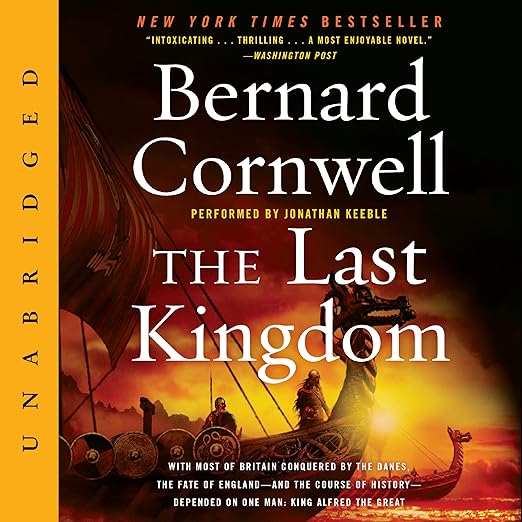
Uhtred is the reason this saga outlived its own screen adaptation, and the audiobook had him first. Bernard Cornwell sets the ninth century running as the Danes storm onto British soil hungry for spoils and conquest, taking kingdom after kingdom until a single realm is left standing and the whole course of English history rests on one king. The telling reaches us through a young warrior who straddled two worlds, belonging entirely to neither and useful to both, and thirteen hours and twenty-eight minutes is what the first installment asks.
Uhtred Fights for Both Sides at Once
Divided loyalty is the engine, and it never runs dry. A February 2014 response describes the arrangement precisely, calling this gritty heroic historic fantasy and noting that the story comes from the perspective of a young warrior "who ends up fighting for both sides in the wars." That single structural decision solves the problem every long historical series eventually faces, which is how to keep a reader present at battles fought by people they have no reason to care about. Give the narrator a foot in each camp and every engagement costs him something.
Cornwell's second decision is to hide the making of a nation behind a personal grievance. The stated subject is England coming into existence, which is the kind of premise that turns novels into pageants, and the actual plot is a boy who lost an inheritance and wants it back. Kings, treaties and shield walls all arrive on that private errand. It is an old trick and it works here better than it works in most of the books that borrowed it afterward.
Keeble Tackles Uhtred, Alfred, and Ninth-Century Names
Arriving from the adaptation is a common route to this one, and an April 2017 response documents the trip honestly. That listener came in after watching the screen version through an injury, went looking for something more in the source, and reports having "liked the novel much more" while never having tried this author before. Anyone who watched first and wondered whether the books justify the detour has a straightforward answer in the column, filed by somebody with no prior investment either way.
History is genuinely present rather than decorative, and the most detailed response on the page is also the oldest. Filed in October 2005, more than nine years before this recording was published, it praises the rendition of the period when the Danes were overrunning England, names Alfred as king of the holdout English kingdom of Wessex, and lists Northumbria, Mercia and East Anglia among the realms already fallen. It also gets in the sharpest character note available, describing Alfred as "a somewhat prissy churchman" who seemed the least likely of English kings to hold the invaders off.
Jonathan Keeble carries all thirteen and a half hours, and the material sets a specific technical problem. Uhtred, Northumbria, Mercia, East Anglia, Wessex and the Danish names arrive constantly, most of them unfamiliar to modern ears, and several of them have to stay distinguishable from each other across a battle sequence where the listener has no map. A reader who settles those pronunciations early and holds them consistently makes the political geography followable; one who does not turns the ninth century into noise.
Shelved as History, Marketed Like Fantasy
Series naming is doubled here, and this page acknowledges only one version. The record files it as The Last Kingdom, book one, while a July 2017 response filed in Canada refers throughout to "The Saxon Stories" telling the tale of Alfred the Great and his descendants through Uhtred's eyes. The same response adds the most useful warning available, flagging what it calls Cornwell's usual, perhaps excessively detailed violence, which is worth knowing before you commit thirteen hours to a book about shield walls.
Twenty-one ratings is a strikingly thin count for a novel with a screen adaptation attached, and that number tells you something about this particular listing rather than about the book. Two of the five written responses were filed outside the United States, one from Brazil and one from Canada, so the column pools territories and editions into a single 4.6 average. Treat the badge as a fragment of a much larger consensus that lives on other pages.
Two Series Names, Twenty-One Thin Ratings
Genre filing is simply wrong. The record shelves this under history with a Military tag, and it is a novel, described by readers in the column as historical fiction and as historic fantasy. Listeners browsing history expecting an account of the Danish invasions will get a story with invented interiority in it, and listeners browsing fiction will not find this page at all. The distinction matters more than usual on a book whose selling point is accuracy.
Marketing sets expectations the novel does not quite share. The copy leans on a comparison to a famous fantasy franchise, borrowed from The Observer in London and offered as "like Game of Thrones, but real," and on the screen adaptation that followed years later. Both are true enough as signposts and both point slightly wrong, because this is a slower, drier and more geographical book than either comparison suggests, and the pleasures are closer to campaign history than to intrigue.
Terrain and Logistics Beat Costume Drama Comparisons
Anyone who wants the ninth century rendered as terrain, weather and logistics rather than as costume drama should start here, along with listeners who came from the adaptation and want the fuller version. Accessibility is better than the subject suggests: a September 2025 response filed in Brazil reports finding it "super involving and easy to read" despite English not being that reader's first language, and finishing it inside a week. The prose does not obstruct.
Look elsewhere if detailed combat violence is a problem for you, or if you want the invasions from the Danish side rather than through a warrior raised between camps. Series-averse listeners should also know that thirteen hours buys the opening movement of something much longer, and the satisfactions here are the satisfactions of a beginning: a world established, a grievance planted, a boy turned useful to the wrong people.
The Short Version
- Narration: Jonathan Keeble is credited solo for Harper Perennial across a book whose place names change hands every few chapters.
- Themes: Divided loyalty, the making of England, Danish invasion, stolen inheritance.
- Mood: Cold, muddy, momentum-driven.
- Verdict: The best possible entry point to the saga, sitting on a listing that files a novel as history.
Frequently Asked Questions
Does The Last Kingdom audiobook cover the same events as the television adaptation?
It supplies the beginning of them. The description presents this as the first installment of the saga the screen version was based on, so the early arc of Uhtred and the Danish invasions is shared ground. Later seasons draw on subsequent books, which this thirteen-hour recording does not reach.
Who narrates The Last Kingdom?
Jonathan Keeble reads the Harper Perennial edition, running thirteen hours and twenty-eight minutes and published in December 2014. A single reader handles the whole book, which matters given how many Old English and Danish names have to stay distinct from one another across long battle sequences.
Do I need background in early English history to follow this audiobook?
None at all. Kingdoms, kings and shifting borders are introduced as the story needs them, and one response reports finishing it easily despite English not being a first language. Knowing that Wessex, Mercia, Northumbria and East Anglia were separate realms helps, but the book supplies that as it goes.