
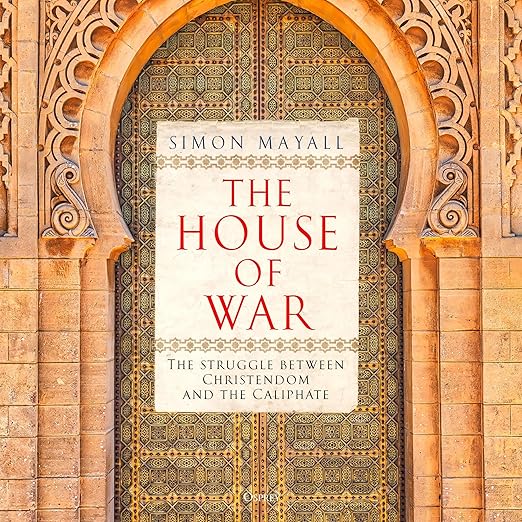
Covering thirteen centuries of military conflict between Christendom and the Islamic caliphate in a single audiobook is a project that invites failure at multiple levels: too broad to be rigorous, too long to sustain momentum, too politically charged to navigate without collapsing into polemic. Sir Simon Mayall's The House of War avoids all three pitfalls, and the craft of that avoidance is what makes this audiobook worth the nearly sixteen hours it asks of you. I came to this one with a degree of wariness about military histories that reduce complexity to pageant, but Mayall's approach is recognizably that of someone who has spent his working life in the region, not just in its archives.
Mayall is a former senior British Army officer and acknowledged expert on Middle Eastern military history. He narrates his own work, and that decision reverberates through every hour of the audiobook. When he describes the siege of Malta or the fall of Constantinople, the analysis carries the weight of someone who has thought about these engagements operationally as well as historically. It is a different register from the polished delivery of a professional narrator, and it takes a few chapters to settle into, but once you do, the authority it lends the material is irreplaceable and worth the adjustment period.
Mayall Builds His History Around Great Sieges
The book's organizing principle is chronological and geographic: from Caliph Umar's taking of Jerusalem in the seventh century through the fall of the Ottoman Empire after World War I, Mayall traces the arc of a 1,300-year contest for political, military, ideological, and religious supremacy. The structure is built around pivotal sieges and battles: the Crusader states, Rhodes and Malta, Vienna, and the Allied capture of Jerusalem. Each serves as a lens through which broader historical and religious forces become visible. This is a wiser structure than strict chronological survey, because it keeps the listening experience grounded in specific human events even when the analysis reaches toward wider historical conclusions.
One reviewer described Mayall as achieving something they would have deemed impossible: making several thousand years of history with names and dates genuinely engaging. That is apt. The prose is neither academic in a distancing way nor populist in a simplifying one. Mayall writes at the level of a serious reader who respects their audience's intelligence, and the result is a history that can be absorbed in audio form without constantly needing to pause and reorient yourself in the timeline. Another reviewer who received the book directly from the publisher described it as covering a vast sweep of history without becoming boring, and that judgment holds throughout the full fifteen-plus hours.
Popes, Sultans and Emperors Get Actual Weight
The subject of Christian-Muslim military conflict across the medieval and early modern period generates significant contemporary resonance, and Mayall handles that resonance with notable care. He is writing history rather than a political argument for our moment, but the historical analysis is rich enough that listeners will find their own connections without the author needing to force them. The section on the collapse of the Ottoman Empire and the formation of modern Europe and the modern Middle East is particularly valuable for understanding how the present came to look the way it does after thirteen centuries of contest.
The audiobook's length allows Mayall to develop his protagonists, papal, imperial, caliphal, and sultanate, with enough biographical context that the battles feel populated by human beings rather than historical forces. The figures who determined the conclusions and consequences of each major engagement get actual weight. For history listeners who have burned out on military history that treats human actors as chess pieces, Mayall's attention to the political and personal dimensions is welcome and consistent throughout. The wide, sweeping narrative the synopsis promises is genuinely delivered.
Mayall's Delivery Trades Polish for Real Expertise
Mayall's narration is authoritative but not always dynamically varied. Listeners who need a professional narrator's full toolkit, including pacing shifts, tonal inflection, and dramatic register changes, may find his delivery occasionally flat in the longer expository sections. This is a genuine trade-off: you gain expertise and lose some of the performance technique that makes sixteen hours feel shorter. Choosing this audiobook means accepting that exchange consciously rather than being surprised by it mid-listen.
The scope is genuinely ambitious, and some periods receive fuller treatment than others. The Crusades and the sieges of Rhodes and Malta get substantial attention; other significant engagements receive comparatively compressed treatment. This is an inherent challenge in any single-volume history of this breadth, and Mayall makes defensible choices about what to develop at length, but listeners seeking exhaustive coverage of specific campaigns will want additional specialist reading alongside the audiobook.
Understanding the Modern Middle East's Military Roots
History listeners who want a serious, wide-arc overview of Christian-Muslim military conflict told with military expertise and genuine historical rigor will find this audiobook exceptional. Those with prior interest in the Crusades, the Ottoman Empire, or the early modern Mediterranean will find familiar events reframed with unusual clarity. Listeners who have been put off by military history that lacks intellectual depth will find Mayall's approach refreshingly analytical. If you want a single audiobook that illuminates why the modern Middle East looks the way it does, with roots in military and religious contests stretching back to the seventh century, this is the audiobook for that purpose. The subtitle, The Struggle between Christendom and the Caliphate, precisely frames what Mayall delivers: not a cultural or theological comparison but a focused account of military and political struggle across 1,300 years of contested territory.







