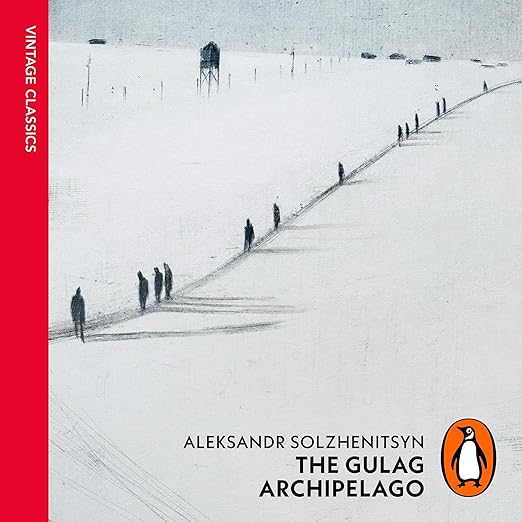
Ignat Solzhenitsyn's voice carries something unusual into this audiobook: the inherited weight of his father's specific experience. The Gulag Archipelago, Aleksandr Solzhenitsyn's testimony-driven account of the Soviet labor camp system, was first published in the West in 1973. This abridged edition, covering all three volumes in a single audiobook with Ignat reading the main text, draws on the testimony of some two hundred survivors and on Solzhenitsyn's own eleven years in the camps and in exile. Jordan B. Peterson contributes a foreword read aloud, plus an exclusive Q&A conversation with Ignat. At twenty-three and a half hours, it is a sustained commitment, and it earns one.
I should acknowledge the unusual narration structure before anything else. Jordan B. Peterson's foreword frames what follows in his characteristic register: urgent, morally weighted, concerned with the lessons of totalitarianism for the present. Ignat Solzhenitsyn then carries the body of the text. The contrast between these two voices is striking and worth considering before you start. Peterson's sections are those of an advocate; Ignat's are those of a reader who grew up with this material as a familial inheritance.
What Aleksandr I. Solzhenitsyn Delivers
The Gulag Archipelago resists ordinary critical categories. It is a historical document, a literary achievement, a political testament, and a work of memorial literature all at once. Solzhenitsyn was explicit that the book could not be written the way an academic history is written; its form, part testimony, part narrative, part essay, part confession, is inseparable from its argument. The camps were designed to make individual experience invisible and collective, and the book's method of weaving together hundreds of specific voices was a deliberate counter to that design.
The abridgement, made with the author's full cooperation and approval, necessarily compresses material from three substantial volumes. For readers already familiar with The Gulag Archipelago in its full form, the question of what the abridgement retains and what it loses will be central. For first-time readers of this magnitude, the abridged single volume is the standard recommended entry point, and it has served that function well for decades. What matters most in the text, the specific texture of the camps, the psychology of interrogation, the particular cruelty of the transit system, the dark comedy of bureaucratic persecution, all survive the abridgement.
One reviewer described it as 'one of the most eye opening books I have ever read,' noting it made them reconsider the political systems they had previously found defensible. That response is common among first-time readers and is worth taking seriously as a data point about the book's actual effect on people who come to it without prior strong views on Soviet history.
Ignat Solzhenitsyn's narration is the central reason to choose this audiobook over reading the print edition. He is not a professional audiobook narrator, and that shows in occasional passages, but what he brings instead is something irreplaceable: a lived relationship with the material. His father wrote this book in secret, passed it hand-to-hand in samizdat copies, knew that its discovery could mean death. Ignat read it growing up and has lived with its implications throughout his professional life as a conductor and musician. His reading does not perform this history; it inhabits it.
The Q&A between Peterson and Ignat is an unexpected addition that works better than it might sound on paper. They discuss the book's composition, its reception in the Soviet Union, and its ongoing relevance. For listeners new to the material, it functions as a useful supplement to the main text. For listeners already familiar with the book, it offers perspective on how the Solzhenitsyn family has understood its afterlife.
Where Aleksandr I. Solzhenitsyn Loses Some Ground
Jordan B. Peterson's association with this edition is worth thinking about carefully. He is a polarizing public intellectual, and listeners who find his general commentary on political systems off-putting may find his foreword a challenging entry point to the main text. The foreword is brief relative to the full runtime, but his framing does direct the listener toward a particular interpretive emphasis: the book as moral warning about leftist totalitarianism specifically. Solzhenitsyn's actual politics were considerably more complex, including his Russian nationalism and his skepticism of Western liberal democracy, and that complexity is somewhat submerged by Peterson's particular framing.
The abridgement decision is the other consideration. Some material in the full three volumes has no equivalent in the single-volume edition. The texture of the full work is different from the abridgement, not inferior in any absolute sense, but different. If you have the capacity to eventually read the complete unabridged text, the abridged audiobook functions well as an entry point. If this is your only encounter with the work, know that you are encountering something genuinely important but in a shorter form than the author originally envisioned.
The Q&A between Peterson and Ignat Solzhenitsyn is worth treating as a genuine supplement rather than a perfunctory add-on. Ignat speaks with the knowledge of someone who has spent his life as a musician and conductor living with his father's legacy, not as a literary critic or a political commentator. His relationship to the book is familial and inherited rather than analytical, and that quality surfaces in the conversation in ways that add something the foreword alone cannot provide. The exchange about how the book circulated in samizdat and what the family knew about its risks is particularly illuminating.
Who Should Pick Up The Gulag Archipelago Volume 3
This audiobook is a strong choice for listeners who have been meaning to engage with Solzhenitsyn's masterwork and find the full three-volume length daunting. At twenty-three hours with Ignat's narration and Peterson's supplement, it is a serious commitment but not an impossible one, and the material justifies every hour. History readers, students of political philosophy, and anyone interested in how totalitarian systems operate on individual lives will find it essential.
If you are already deeply familiar with the full Gulag Archipelago and want the abridged version primarily for Peterson's commentary, be aware that his contribution is relatively brief. The value here is primarily Ignat's narration of his father's work, which is genuinely remarkable and irreplaceable.
Quick Take
- Voice: Ignat Solzhenitsyn reading his father's text brings an irreplaceable familial weight; Jordan B. Peterson's foreword frames the material with his characteristic urgency.
- Big ideas: Soviet totalitarianism, individual testimony against state erasure, survival and moral resilience.
- Atmosphere: Dense, harrowing, and morally serious.
- Worth it?: The standard-setting abridged entry point to one of the twentieth century's most important books, worth every hour of the commitment it requires.
Frequently Asked Questions
Is this audiobook the full Gulag Archipelago or an abridged version?
It is the officially approved abridgement of all three volumes, condensed into a single audiobook. The abridgement was made with Solzhenitsyn's full cooperation. It is the standard recommended entry point for readers new to the work, though the full three-volume text contains material not present here.
How large a role does Jordan B. Peterson play in this audiobook?
Peterson contributes a foreword, read by him, and participates in an exclusive Q&A conversation with Ignat Solzhenitsyn. The body of the text is read by Ignat. Peterson's sections are a supplement to rather than a replacement for the main narration.