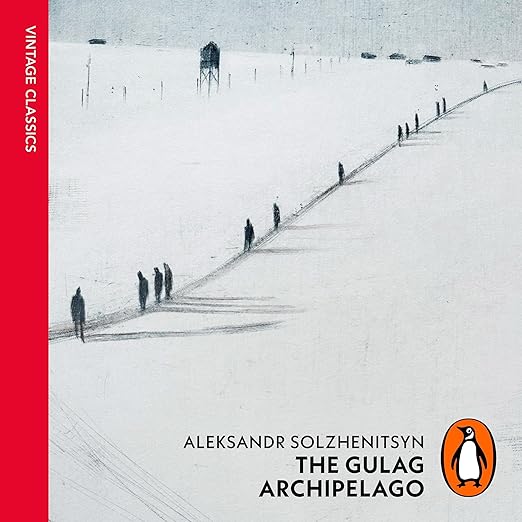
Somewhere between archive and elegy, The Gulag Archipelago sits in a category of literature that does not quite have a name. This audiobook edition presents the officially approved abridgement of all three volumes, with the primary narration by Ignat Solzhenitsyn, the author's son, and a foreword written and read by Jordan B. Peterson, plus a Q&A conversation between the two. Running to twenty-three and a half hours, it is a major commitment for any listener, and it justifies that commitment fully.
Aleksandr Solzhenitsyn spent eleven years in the Soviet camp and exile system. He then spent years collecting testimony from some two hundred survivors, synthesizing their accounts with his own experience, and writing a book that he knew could cost him his life. The Gulag Archipelago was smuggled out of the Soviet Union and published in the West in 1973. Within a year, Solzhenitsyn was stripped of his citizenship and expelled. The book's existence was an act of witness against a system designed to erase individual testimony, and that origin shapes every page.
How The Gulag Archipelago Volume 2 Holds Up
The Gulag Archipelago is not a conventional history and does not behave like one. Solzhenitsyn's method is deliberately hybrid: part documentary, part memoir, part literary essay, part dark comedy. He interrupts chronological narrative with direct address to the reader, with extended meditations on the psychology of informers and interrogators, with searing irony about the bureaucratic language the Soviet system used to process human beings as administrative categories. The formal eclecticism is the argument: a system that turned people into file numbers demanded a form of witness that refused those categories.
The abridgement, made with the author's full cooperation and approval, is the standard single-volume edition that has served English-language readers for decades. What it preserves is the essential testimony and the essential argument. What it necessarily compresses is some of the texture and repetition that gives the full three volumes their cumulative, crushing weight. The abridged edition is a genuinely powerful reading experience; the full work is a different kind of experience, and both are worth knowing about.
The Æren Wa'ter review quoted in the source material captures something important about the text: it approaches the Gulag system not as a single institution but as a network of related systems, the transit centers, the interrogation rooms, the labor camps proper, the exile settlements, the layers of bureaucratic infrastructure that together constituted the archipelago of the title. The metaphor is Solzhenitsyn's own and it is precise: islands of coercion scattered across a vast geography, connected by the current of state violence.
Ignat Solzhenitsyn brings to the narration a quality that no professional audiobook narrator could provide: biographical intimacy with the material that extends across a lifetime. He grew up knowing this book, knowing what it cost his father to write it, knowing what it represented to the survivors whose testimony it preserved. His reading of the text is not performance; it is obligation and honor. Where a professional narrator might bring dramatic technique to the most harrowing passages, Ignat brings the weight of someone who has carried this material as a family inheritance.
Jordan B. Peterson's foreword frames the book as a moral corrective to political systems he finds insufficiently honest about Soviet history. His perspective is specific and his reading of Solzhenitsyn is earnest, but listeners should be aware that it represents one interpretive entry point rather than the only one. Solzhenitsyn's own politics, which included strong Russian nationalist commitments and skepticism about Western liberal democracy, were more complex than the foreword's framing fully conveys. The book itself, in Ignat's narration, opens up into those complexities far more than any foreword can capture.
Weak Spots in The Gulag Archipelago Volume 2
The psychology of collaboration and complicity is one of Solzhenitsyn's central subjects, and it remains one of the most challenging aspects of the book to sit with. He is relentless in asking why people informed on their neighbors, why guards participated in cruelties they could have mitigated, why ordinary Soviet citizens navigated the system in the ways they did. His answers are not comfortable, and they are not designed to be. The political clarity of the text is accompanied by a moral seriousness that implicates systems, ideologies, and individual human choices simultaneously.
The dark comedy that surfaces in certain passages is worth noting because it can catch a listener off-guard in material this serious. Solzhenitsyn was a skilled literary writer before he became the author of The Gulag Archipelago, and his capacity for irony and satirical observation does not disappear in a documentary work. Some of the most memorable passages are the ones where the administrative absurdity of the camp system is rendered in a register close to farce, which is itself a kind of argument about the banality of institutionalized cruelty.
At twenty-three and a half hours, the audiobook rewards session-based listening rather than marathon listening. The material is dense and emotionally heavy in ways that benefit from pauses. Having a companion volume, even a reference guide to Solzhenitsyn's life and the historical context, can enrich the experience, though the text provides significant self-contextualizing material throughout.
The Right Listener for The Gulag Archipelago Volume 2
This audiobook belongs in the library of any serious reader of modern European history, political philosophy, or documentary literature. It is essential for listeners interested in twentieth-century Russia and the Soviet system specifically. It is also valuable for anyone working through questions about how ordinary people participate in extraordinary systemic violence, a question Solzhenitsyn addresses with more precision and less comfort than most historians manage.
It is not an easy listen, and it should not be approached as one. But the twenty-three hours it requires are repaid many times over in a text that has changed how readers understand the Soviet century and the political ideologies that produced it. Ignat Solzhenitsyn's narration makes this particular edition the authoritative audio version of one of the most important books written in the twentieth century.
Is this audiobook a different edition than The Gulag Archipelago Volume 3 on this site?
Both entries appear to present the same abridged one-volume audiobook of The Gulag Archipelago, narrated by Ignat Solzhenitsyn with a foreword by Jordan B. Peterson. The synopses are identical. Prospective listeners should verify the specific product details with the current retailer listing before purchasing to ensure they are not duplicating the same title.
How does Jordan B. Peterson's involvement affect the audiobook for listeners who are unfamiliar with his work?
His contribution is a foreword and a Q&A conversation with Ignat Solzhenitsyn. The foreword is brief relative to the full runtime and frames the book as a moral warning about leftist totalitarianism. Listeners who are neutral about Peterson will find his sections useful supplemental material. The body of the text, read by Ignat, stands entirely on its own.