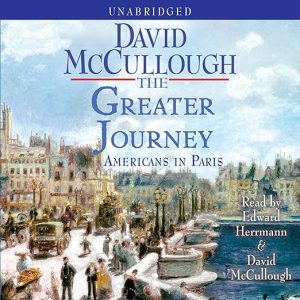
In Brief
- Voice: Edward Herrmann brings McCullough's prose to life with measured authority - his deep, warm baritone suits the grandeur of the subject without ever turning pompous.
- Big ideas: American ambition abroad, artistic and intellectual self-improvement, the transatlantic exchange of ideas
- Atmosphere: Expansive and elegiac, like a long Sunday with a very good book
- Worth it?: Essential listening for anyone drawn to the hidden tributaries of American cultural history - McCullough at his most intimate and surprising.
I came to The Greater Journey late on a rainy November afternoon, somewhere around the two-hour mark of a flight delay, and I did not stop until the gate agent was practically pulling the headphones from my ears. David McCullough has a gift that is genuinely rare in popular history: he makes you feel the texture of a moment, the cold of a Paris morning, the exhaustion of a six-week Atlantic crossing, the particular humiliation of arriving in a foreign city with no money and no French. I had known the broad outlines of many of these figures - Morse, Harriet Beecher Stowe, Mary Cassatt, John Singer Sargent - but I had never quite understood what drove them across an ocean toward a city that had no particular reason to welcome them.
What McCullough illuminates is something that gets lost in the triumphalist telling of American history: the hunger. These were men and women who understood that America in the early nineteenth century could not yet provide what they needed - the teachers, the models, the standards of excellence that Paris alone could offer. Elizabeth Blackwell, who would become the first female doctor in America, traveled to Paris because there was nowhere in her own country willing to educate her. Charles Sumner, who would become the most powerful abolitionist voice in the Senate, encountered Black students studying at the Sorbonne as equals and returned home transformed. The France they experienced was not just backdrop. It was a crucible.
A Closer Look at The Greater Journey
McCullough's great achievement here is structural. He weaves individual biographies into a coherent narrative without ever making the connective tissue feel forced. The chapter devoted to Elihu Washburne - almost forgotten today - is one of the most gripping things I have heard in any audiobook this year. Washburne remained at his post as American ambassador through the Franco-Prussian War, through the Siege of Paris, and through the nightmarish violence of the Commune, all while keeping a vivid diary that McCullough draws on extensively. His decision to include this material as the book's emotional climax is a masterstroke. By the time you reach those pages, Paris has become as real to you as any city you have ever visited, and the suffering of its people lands with genuine weight.
The portraits of the three artists - sculptor Augustus Saint-Gaudens, painters Mary Cassatt and John Singer Sargent - are handled with particular care. McCullough is not a critic in the technical sense, but he has a fine eye for the human dimension of artistic ambition, for what it costs to decide, at twenty-two, to give your life to something that may never pay and that your country does not yet know it needs.
What Makes The Greater Journey Worth Hearing
Edward Herrmann's narration is a near-perfect match for this material. His voice has the gravity that McCullough's sentences require without tipping into self-importance. He handles the long historical passages with ease and the intimate biographical moments with real warmth. At sixteen hours and fifty minutes, this is a substantial commitment - but it never feels like one. The chapters are well-proportioned and the book's momentum carries you through the philosophical passages that might feel slower in print.
There is also something specifically suited about this as listening rather than reading. McCullough writes in scenes - dialogue reconstructed from letters, from diaries, from the detailed accounts that nineteenth-century people left of their lives - and Herrmann's delivery turns those scenes cinematic. The dinner conversations, the arguments in studios, the first sight of Notre-Dame through a carriage window: they play in the imagination the way a film plays on a screen.
Things to Know Before Starting The Greater Journey
The book is organized loosely chronologically but moves between subjects in ways that reward patience. If you find yourself frustrated that the story has moved away from Morse and Cooper in the early chapters, stay with it. The threads come back together in ways that feel genuinely earned. Also worth noting: the synopsis includes the Elihu Washburne diary material being published for the first time, and McCullough treats it as the primary source it is, which gives those chapters an almost documentary quality. Pay attention to those sections - they contain some of the most extraordinary writing in the book.
Who David McCullough Is Writing For
This is a book for listeners who love history that feels like literature, and literature that feels true. If you have read McCullough's John Adams or 1776 and found yourself wanting to spend more time in his company, this is the natural next step - in some ways his most personal work, the one that most clearly reflects what he thinks greatness looks like and where it comes from. Listeners who want pure narrative drive without philosophical digression may find some passages slow. But those who want to understand not just what Americans did but why they felt they had to do it will find it one of the richest listens of the year.
A Few Questions About The Greater Journey
Do I need to know the history of the people featured before listening?
Not at all. McCullough assumes no prior knowledge and introduces each figure with enough biographical context that the names build meaning as you go. Familiarity with figures like Morse or Harriet Beecher Stowe enriches the experience, but is not required.
Is Edward Herrmann's narration well-suited to a history this long?
Yes. Herrmann was a natural fit for McCullough's prose - warm, authoritative, and patient with long sentences. His pacing suits both the dramatic biographical passages and the slower philosophical sections.
Who is Elihu Washburne and why does he matter to the book?
Washburne was the American ambassador who remained in Paris through some of the most violent years in the city's modern history, including the Siege and the Commune. McCullough draws on his unpublished diary, and his story provides the book's emotional and historical climax.