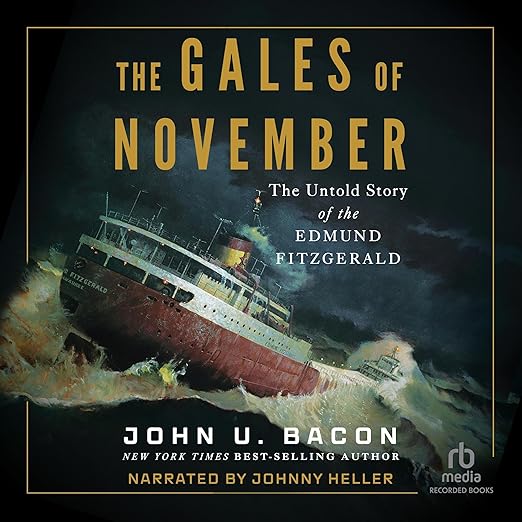
The Gales of November is a nonfiction audiobook timed to the fiftieth anniversary of the Edmund Fitzgerald's sinking, and it tries to do two things at once: explain why the Great Lakes mattered so much to the American economy in the decades after World War II, and tell the story of the 29 men who went down with the Mighty Fitz on November 10, 1975.
John U. Bacon is credited as the bestselling author of The Great Halifax Explosion, and this book aims for the same territory: a specific disaster used as a lens onto a larger economic and human story. The synopsis frames the Great Lakes region as having once held the kind of prestige Silicon Valley carries today, and the Edmund Fitzgerald, a 729-foot ship, as the biggest and most profitable vessel on the water. Bacon reportedly draws on more than 100 interviews with the families, friends, and former crewmates of the men lost that night, which lines up with what the visible reviews describe: a book more interested in the people left behind than in ship mechanics for their own sake, even though the mechanics get real attention too.
One reviewer, writing as bison_burger, offers the most specific structural note among the five visible reviews: the first third covers the physics of the Great Lakes and the logistics of mining, transporting, and shipping iron ore, material this reviewer calls fascinating, before the book shifts into the lives of the sailors for what this same reader felt was a disproportionate share of the remaining pages, repetitive at points. That kind of two-part shape, procedural setup followed by a long human aftermath, is worth knowing going in if you prefer one mode over the other. Gordon Lightfoot's ballad about the wreck gets a direct nod in the synopsis, a reminder of how much cultural memory already surrounds this ship before Bacon adds this account to it. The synopsis is specific about the storm itself: 100 mile-per-hour winds and 50-foot waves on Lake Superior on the night of November 10, 1975, described as the worst possible combination of place and timing for a ship already near the end of its shipping season. Bacon is also described as addressing the sinking's most likely causes, language that suggests the book treats the exact mechanics of how the Fitzgerald went down as still somewhat unsettled a half century later, rather than a fully closed case.
Heller Narrates Eleven Hours Without a Marathon Feel
The historical stakes here are larger than one shipwreck. The synopsis argues that for three decades after World War II, the Great Lakes functioned as the economic engine of the country, and that the Edmund Fitzgerald's loss marked something closer to the end of an era than an isolated accident. Reviewer Katie calls it fast-moving and compelling despite already knowing the outcome, and credits Bacon with treating the crew and their families with care rather than turning the tragedy into spectacle. A pull quote from filmmaker Ken Burns, included in the synopsis, praises Bacon for distilling the story's essence into what Burns calls a monument to those lost.
One of the more distinctive reactions comes from reviewer Francis O Walker, who compares the book to Robert Travers's Anatomy of a Murder, the novel later adapted into the James Stewart film, on the grounds that both dissect a tragedy in a Great Lakes setting with a similarly no-nonsense approach, one focused on legal process, the other on nautical mechanics. That is the reviewer's comparison, not a claim about the book's literary company, but it points at something real: several of these reviews single out Bacon's restraint, a willingness to let the facts and the interviews carry the weight rather than reaching for drama. Johnny Heller narrates, and at just under eleven hours the audiobook covers a lot of ground without becoming a marathon listen. The synopsis also promises attention to the aftermath for the families left behind, "the wives, the sons, and the daughters," language it borrows directly from the Lightfoot lyric, which suggests Bacon is treating the song itself as part of the historical record rather than just background trivia to gesture at once and move past.
One Rating Cannot Explain a 4.7 Badge
Before you weigh the star rating, look closely at how it is built. The listing displays 4.7 stars against a rating count of exactly 1, yet the reviews sitting underneath that badge, five of them, each carry their own star mark, four fives and one four. A single vote can only land on a whole number, so nothing traces a decimal figure like 4.7 back to just one rating; something in how this listing counts its ratings has broken down, whether it's the count field itself or its sync with the review section. I cannot tell you which number is wrong, only that they contradict each other, and that the reviews themselves, Camper's five-star praise, Katie's, bison_burger's more mixed take, Francis O Walker's, and a fifth from a reviewer signing as Januari M Works, are a better guide to actual reader response than the badge on its own.
None of the five reviews comments directly on Heller's reading, focusing instead on Bacon's research, pacing, and structure, which is worth knowing if audio performance specifically is what you're shopping for. What they do agree on, almost unanimously, is that the book earns its length through research rather than padding, even where bison_burger felt the back half repeats itself.
Lightfoot Fans Get the Fuller Footnoted Version
This is a strong match for listeners drawn to maritime disaster history, WWII-era American industrial decline, or the kind of deeply reported nonfiction that leans on firsthand interviews rather than secondhand summary. If The Great Halifax Explosion already worked for you, the synopsis positions this as Bacon working the same vein again, a specific catastrophe as the entry point into a bigger economic and human story. Anyone who already knows the Gordon Lightfoot ballad and wants the fuller, footnoted version of that story is squarely the audience here, and the same goes for listeners who like their history built from firsthand interviews rather than archival summary alone.
Look elsewhere if you want a book that stays tightly focused on the sinking itself without the broader economic scaffolding, bison_burger's review suggests the middle stretch on shipping logistics runs long for readers who came mainly for the disaster narrative. And if the star rating matters to your buying decision, treat the displayed 4.7 with some skepticism given how poorly it squares with the one rating officially on record.
A Few Questions About The Gales of November
How accurate is the star rating on the Gales of November audiobook listing?
Not very reliable as displayed. The badge shows 4.7 stars tied to a rating count of 1, but beneath it sit five reviews, each with its own score attached, four at 5.0 and one at 4.0. A single rating cannot produce a decimal average, so the count and the review section contradict each other.
Does the Gales of November audiobook cover the Gordon Lightfoot song about the wreck?
The synopsis references Lightfoot's ballad directly, framing the book as filling in the fuller, researched account behind that cultural memory. It is not a book about the song itself, but Bacon clearly writes with an awareness of how familiar the tragedy already is to many listeners.
Is this a sequel or companion to John U. Bacon's other books?
It stands alone as a subject but shares an author and approach with The Great Halifax Explosion, named in the synopsis as Bacon's prior bestseller. Both apply the same method: a single disaster used to tell a wider historical and human story.