
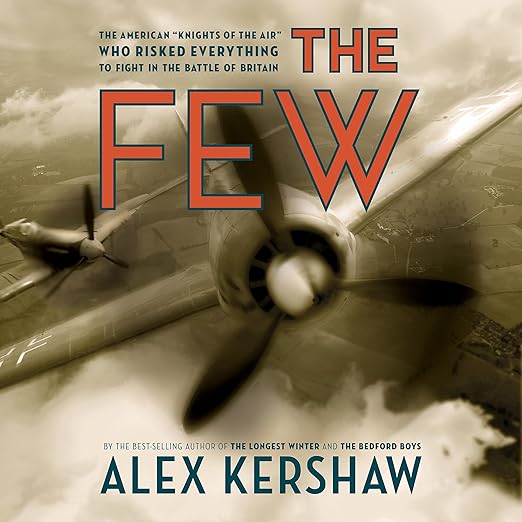
Alex Kershaw built his reputation on narrative WWII history with The Bedford Boys and The Longest Winter, and The Few continues that tradition by focusing on a corner of the war that most American listeners will know almost nothing about. The audiobook, narrated by Scott Brick across nine hours, follows eight young Americans who defied their country's neutrality laws and risked their citizenship to fly with Britain's Royal Air Force in the summer of 1940, more than a year before Pearl Harbor brought the United States officially into the conflict.
Kershaw's particular skill is making historical figures legible without fictionalizing them. Each of the eight Americans he profiles comes with a specific personality, a distinct reason for being in England, a different relationship to the danger ahead. Some had come over to fly for France first. Some had lied about their nationality or their civilian status to get into a cockpit. All of them were operating in a legal gray zone that could have cost them their American citizenship if they survived, which is not a small thing when you are twenty-two and have already signed away the protections of your own government. This context - the particular kind of courage required to fight for a country not your own, in a war your own country was officially neutral about - is something Kershaw returns to repeatedly, and it gives the book a dimension that a straightforward Battle of Britain narrative would lack.
The aerial combat is handled with the precision that longtime readers of WWII aviation history will appreciate. Kershaw is careful about aircraft characteristics - the Spitfire's lethal elegance, the tactical sophistication of the Luftwaffe's experienced pilots, the terrifying speed at which engagements began and ended - and he does not paper over the lopsided skill gap between the RAF's veterans and the Americans who arrived with enthusiasm and very limited actual combat experience. That gap, and how quickly some of them closed it and how fatally others could not, is one of the book's most compelling threads.
Brick's Momentum and Churchill's Few Among the Few
Scott Brick is the specific reason this works so well as an audiobook. His narration has always excelled at sustaining tension across long passages of narrative nonfiction, and Kershaw's structure - alternating between individual pilot profiles and chronological battle narrative - requires a reader who can maintain momentum through the transitions. Brick does. His handling of the combat sequences has a controlled urgency that keeps the listener oriented and forward rather than retrospective, which matters in a book where you often already know the broad outcome but are invested in how it arrives for each specific pilot.
Reviewer Rick Spell, a lifelong reader of Greatest Generation history, noted that this particular corner of the Battle of Britain was almost entirely new to him. That observation is what Kershaw appears to be specifically addressing. Most histories of the Battle of Britain treat the American volunteers as footnote material at best. By centering them and telling their individual stories, Kershaw rescues a chapter that has been overlooked not because it is unimportant but because it has never had its own dedicated account.
Churchill's famous line - Never in the field of human conflict was so much owed by so many to so few - was delivered about the entire RAF contingent. Kershaw uses it to reclaim something specific: these eight Americans were the few among the few, and the book's emotional argument is that they deserve to be remembered by name rather than aggregated into a statistic about Allied air power.
One Camm Error, and a Story That Stops Early
One reviewer with deep RAF background noted factual inaccuracies in some supporting details - specifically a claim about Hurricane designer Sydney Camm's lifespan that does not withstand scrutiny. These errors are minor within the scope of the full narrative, but listeners with specialist aviation history knowledge may find other points of friction. Kershaw's research is generally solid, but the book is oriented toward general readers rather than aviation specialists, and it reads accordingly. The human story is the priority, not comprehensive technical accuracy.
The book also ends at October 1940, when the Battle of Britain effectively concludes. It does not follow all eight Americans through the rest of the war. Listeners wanting complete biographical arcs will need to look elsewhere; Kershaw's scope is deliberately bounded around a specific summer rather than full lives. For the story he chose to tell, this is the right call, but it is worth knowing before you invest nine hours.
Biography-Driven Military History in an Efficient Nine Hours
This audiobook is well suited to listeners who enjoy narrative military history with a biographical focus, particularly those interested in the pre-Pearl Harbor period when American involvement in the war was still both illegal and deeply contested at home. Fans of Kershaw's earlier books will find the same approach here: heavy on individual character, strong on narrative momentum, unafraid of the emotional weight of loss. Aviation history enthusiasts should note that this is accessible rather than technical - it celebrates and humanizes the flying rather than dissecting it mechanically. At nine hours it is an efficient entry into a corner of WWII history that most American listeners have never encountered. Reviewer Rick L., a lifelong reader of WWII history, called it one of the best books he had read about the Blitz and the finest devoted specifically to the Americans who fought in it - a judgment that reflects both the quality of Kershaw's research and the skill Brick brings to keeping that research alive across nine hours of audio.
At a Glance
- Read by: Scott Brick is one of the premier narrators in narrative nonfiction, and he gives Kershaw's propulsive prose exactly the forward momentum it needs - his pacing on the aerial combat sequences is particularly sharp.
- At its heart: American neutrality versus conscience, the Battle of Britain, sacrifice and legal jeopardy
- Vibe: Urgent and cinematic, with the weight of documented loss underneath the momentum
- Short version: Alex Kershaw's account of the eight American volunteers who flew for the RAF in 1940 is one of the more compelling entries in the overlooked corners of WWII history, and Scott Brick makes it feel immediate throughout.
Common Questions
Is Scott Brick's narration a good fit for this kind of military history audiobook?
Brick is an excellent choice. He has a long track record with narrative nonfiction and handles Kershaw's shifts between biographical portrait and combat chronicle without losing momentum. His pacing on the aerial sequences is notably strong - he builds and releases tension in a way that makes the engagements feel present rather than historical.
Does this audiobook cover what happened to all eight Americans after the Battle of Britain?
No - Kershaw's scope is deliberately limited to the summer and early autumn of 1940. The book ends when the battle ends in October 1940. Listeners wanting to follow all eight men through the rest of the war will need to look elsewhere; the book is a portrait of a specific moment rather than a complete biographical account of any individual pilot.







