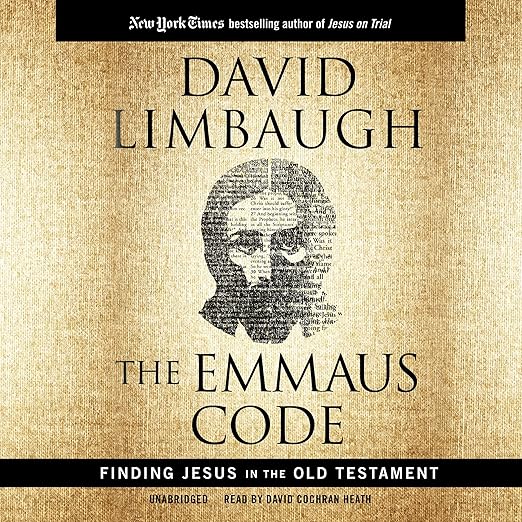
- Voice: David Cochran Heath reads Limbaugh's close scriptural analysis across nearly thirteen hours.
- Big ideas: faith and scripture, Gospel interpretation, the historical Jesus
- Atmosphere: Studious and devotional, built for repeat listening
- Worth it?: Worth the time for readers already committed to Bible study, less so if you want a single sitting.
Can an audiobook built on close reading of scripture hold a listener's attention for nearly thirteen hours? The Emmaus Code bets that it can, and David Limbaugh spends that time building a case for who Jesus Christ was by working outward from the text itself rather than from doctrine handed down secondhand. It is a long listen with a narrow, deliberate focus, and it earns that length by staying disciplined about what it is actually arguing.
Jesus on Trial Gets a Deeper Sequel
This is a follow-up of sorts. The synopsis notes that in the 2014 book Jesus on Trial, Limbaugh made the case for the Gospels as evidence of God's existence, drawing on his own move from skeptic to believer to give the argument some personal weight. The Emmaus Code goes a layer deeper, reading the sacred texts closely to argue that Christ's identity as man, savior, and son of God reveals itself in the details of the writing rather than needing to be asserted from outside it, which puts the emphasis on close reading over broad apologetics.
Twelve hours and fifty-eight minutes make up this audiobook's runtime, and reviewer Carolyn Fulton describes using it "as commentator for daily Bible study," which matches the pacing: this seems built for return visits rather than one straight-through session. That kind of structure, dense enough to reward rereading a chapter rather than racing to the end, is common in devotional nonfiction but still worth flagging for a listener expecting a faster narrative arc.
Blackstone Audio, Inc. produced this recording. The synopsis calls the whole project "a powerful, intimate journey," language that signals Limbaugh is working from close textual detail outward rather than building a general survey of Christian belief from the top down, one scripture passage at a time rather than one doctrine at a time.
Readers Return to Mine It Again and Again
D A Gibbs offers the most personal endorsement here, describing using the book to help write a Christmas devotional years after first reading it and calling it "a gem" that still holds up, adding that the material helped shape reflection on "the birth of Jesus" as what the review calls "our greatest gift." CS's short review backs that staying power up too, saying the book "helped me understand the Bible more fully" and specifically credits it with renewing interest in the Old Testament, material CS suggests gets less attention than the more familiar parts of scripture most readers already know well.
Roger Woodrome's more recent review, from February 2026, calls it simply the best book on the subject, full stop, which suggests the material has kept finding new listeners well over a decade after its original release. Carolyn Fulton's own review adds a similar note of longevity, describing the book as something to keep returning to for "daily Bible study" rather than a one-time listen to shelve once finished.
D A Gibbs's review also gives a sense of how the book gets used in practice: written to help compose a Christmas devotional, it treats Limbaugh's close reading as raw material for the reviewer's own reflection rather than a finished argument to simply accept. That kind of active, working relationship with the text, cited across several of these reviews, says something about how the book is built: less a lecture to sit through than a resource meant to be mined repeatedly.
One Vote, Five Reviews, and a Reader's Caution
Reviewer TLW offers the most useful caution here, rating the book four stars and reminding readers that this is "the writer's interpretation of the word," not the only valid reading of the text, and suggesting listeners weigh Limbaugh's conclusions against their own study rather than taking them as settled. TLW still credits the book with "some good correlations" and useful insight, so the caution reads as a call for critical listening rather than a dismissal of the material itself, and it is worth taking seriously precisely because the rest of the review is largely favorable.
A 4.7 average cannot come from a single whole-star vote under any standard rounding, full stop, yet that is precisely what this listing claims: one counted vote behind the badge, next to five separate written reviews a reader can actually open and read. Whatever the real reception looks like, the displayed number and the visible evidence simply do not square with each other, and a listener would be right to treat the 4.7 figure as unverifiable rather than definitive. None of the five written reviews carries a rating below four stars, which at least suggests the underlying reception is genuinely positive, even if the specific badge number cannot be reconstructed from what the page actually shows.
Committing Thirteen Hours to One Writer's Reading
Listeners already invested in Bible study, particularly readers coming from Limbaugh's earlier Jesus on Trial, are the natural audience here, along with anyone using this as a companion for a longer devotional practice the way Carolyn Fulton and D A Gibbs both describe doing. The nearly thirteen-hour runtime suits someone building a study habit around it rather than someone looking for a single evening's listen, and the repeat-use pattern described by both Carolyn Fulton and D A Gibbs suggests the material rewards that kind of ongoing relationship rather than a single pass through.
A purely historical or secular treatment of the Gospels this is not; TLW's own caution about treating any one writer's interpretation as definitive is worth remembering before committing thirteen hours to one author's reading of the text, especially for listeners who prefer to weigh multiple perspectives before settling on a conclusion of their own.
Good to Know
How long is The Emmaus Code audiobook?
Twelve hours and fifty-eight minutes make up the runtime. Reviewer Carolyn Fulton describes using it as a running commentary for daily Bible study rather than a single sitting, and the pacing supports that use: this is built more like a course than a quick devotional listen.
Is this audiobook a sequel to David Limbaugh's Jesus on Trial?
It follows the same author's earlier argument. The synopsis notes that in Jesus on Trial, Limbaugh made a case for the Gospels as evidence of God's existence; The Emmaus Code goes further, reading scripture closely to explore who Christ was as man, savior, and son of God.
Does this audiobook take a single, definitive reading of scripture?
Not according to reviewer TLW, who rates it four stars and explicitly cautions that this is the writer's interpretation of the word, urging listeners to weigh Limbaugh's conclusions against their own study rather than treating any one author's reading as the only correct one.