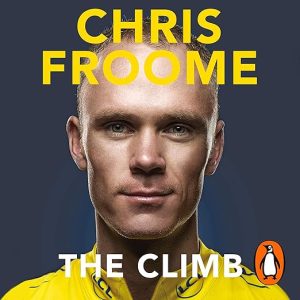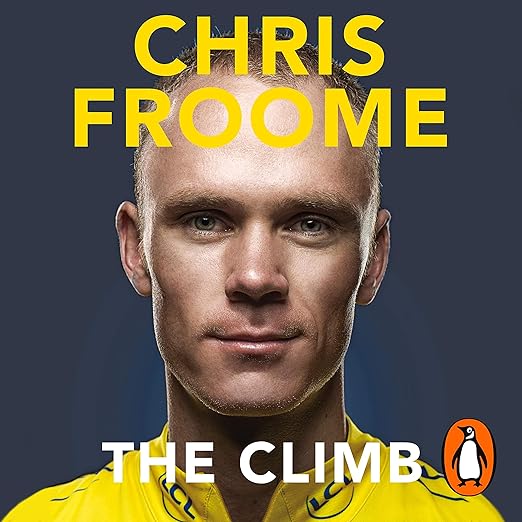
Townships in Kenya, wild animals at the roadside, and almost no opportunity for a boy who wants to race bicycles: that is the image the description opens on, and it is the part of this audiobook the response column keeps returning to, rather than the yellow jersey it builds toward. Fourteen hours and thirty-three minutes is a substantial running time for a career that, at the point the memoir closes, had produced exactly one Tour de France win. The imbalance is the appeal rather than the flaw.
Chris Froome's account arrives with the publisher's own framing stamped across the top of the description: Penguin presents the unabridged, downloadable edition of the revealing, inspirational memoir from the British winner of the Tour de France. Retail copy, but the word unabridged earns its place, since fourteen and a half hours for a book of this kind confirms nothing was trimmed for the recording. What follows in the description is a straight line from a boy riding through townships and past wild animals to the yellow jersey in 2013. The line is too straight, of course; the interest lies in everything the summary compresses, and fourteen and a half hours implies a great deal of compression.
Kenya is what the column keeps returning to, and not because anyone expected it. SM Nelson calls the upbringing in Africa engrossing and the foundation of who Froome became, then asks the obvious question: who knew anything at all about cycling in Africa before this book? Brian B goes further, describing those chapters as the meat and potatoes of the whole thing, and does so while arguing with a reviewer who is not on this page. Somewhere in a larger column, someone disliked the childhood material. Here, two responses defend it unprompted, which is worth weighing against the assumption that a cycling memoir is only interesting once the racing starts.
Patrick Doherty reads the book, and Froome does not. For a first-person sporting memoir that is a real decision rather than a formality, because the voice saying I throughout fourteen hours belongs to someone who was not on the mountain. Plenty of memoirs work this way and some work better for it, since a professional reader will handle the structure more evenly than an athlete would. Which of those happened here, the listing does not say, and the responses below it are silent on the recording entirely. All five talk about reading, the ordinary fate of a column carried over from a printed edition.
Doherty Reads While Reviewers Fight Over Wiggins
Bradley Wiggins is the argument at the center of the book, and the column splits cleanly over it. SM Nelson says Froome clearly had an ax to grind with Team Sky and Brad Wiggins and goes on about it a bit too much. Kendall R wishes he had spent less time speaking poorly of Wiggins while conceding the experiences were necessary to mention. Brian B, by contrast, found hearing what was going on inside that Tour among the most interesting parts and wanted to read the other side afterward.
Stephen T. Porter raises the question this page never answers. Writing in August 2016, having bought the book after Froome took a third consecutive Tour title, Porter says the writing is authentic and well done, then wonders openly whether the author had help producing it. No collaborator appears in the credits on this record. That same response also illustrates a wider problem with the column: parts of it react to a career that continued for years after the recording ended, praising a rider the book itself leaves in 2013.
Cycling's credibility problem hangs over all of it, and the description names the source directly, listing the pressures of Lance Armstrong's legacy alongside the illness and the rivalry. Gary P. Olson, a fan since the late 1960s, gives the fullest version of that context, describing a sport whose code of silence has been broken and a readership left with no antidote to cynicism. Read as a document from inside that atmosphere, the memoir becomes more interesting than a straightforward victory account. Kendall R also singles out the warmth toward Richie Porte as the counterweight to the Wiggins material.
Only Two Ratings, Yet Five Written Reviews
Nine points out of a possible ten is what the two logged votes on this page must total, given a 4.5 average and whole-star voting: one five and one four, a single star short of a clean sweep. That is unusually legible arithmetic for a listing this old. Less legible is the gap underneath it, where five written responses sit below a ratings counter that stops at two, which means the average and the commentary are drawn from different pools altogether.
Memoirs age against their subjects, and this one ends in 2014 while its subject kept racing. Anyone arriving now should expect nothing about the later victories, the later controversies or the later teams. The genre filing compounds the confusion by sorting a sports memoir under history, sports and outdoors, and travel and tourism at once, with a single Africa tag on top; the travel classification is the least defensible of the three, though the Kenya chapters make it slightly less absurd than it first looks.
Even Neutral Listeners End Up Rooting for Froome
Fans of professional cycling need no persuading, and Kendall R states the case plainly: if you like cycling, you will like this book. The race writing is specific enough to satisfy people who watch grand tours, and SM Nelson comes away finally understanding why Froome makes such a point of thanking his teammates, which is the kind of small mystery only insiders think to resolve. Anyone who followed the 2013 season will find the internal account worth the running time on its own.
Neutral listeners can also come to this, which is the more surprising recommendation. Brian B arrived indifferent to Froome and left rooting for him, and the childhood chapters do most of that work. The listeners who should hesitate are those with no patience for score-settling, since two independent responses flag the Wiggins passages as excessive, and those hoping for a doping reckoning, since the description promises inspiration rather than investigation. Fourteen hours is a long time to spend disagreeing with a book's premise, and this one states its premise on the first page of the description.
Quick Take
- Narrator: The memoir is read by Patrick Doherty rather than by Froome, so the first person you hear belongs to a professional reader.
- Subjects: a Kenyan childhood, the 2013 Tour, team rivalry and grievance, cycling after its credibility collapsed
- Tone: Earnest, aggrieved in places, genuinely warm about the early years
- Bottom line: Strong for cycling followers and better than expected for outsiders, provided you tolerate the score-settling.