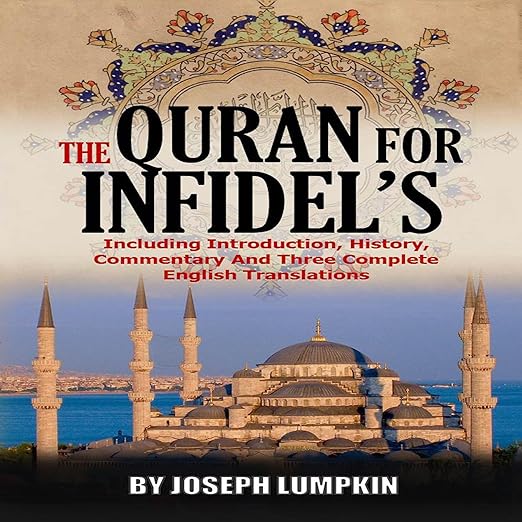
This is one of the longer audiobooks I've sat down to evaluate for this site, and also one where the listing itself tells you exactly what stance the book is taking before you've pressed play, which is worth laying out plainly here.
Joseph Lumpkin's project, according to the synopsis, presents the history of the Prophet Mohammad, the development of Islam, the implementation of Shariah Law, and views on Quranic interpretation, alongside three separate classical translations of the Holy Quran itself. The organizing method is what the listing calls abrogation: the idea that the Quran functions as an unfolding revelation, so that a later statement on a given subject supersedes an earlier one. On that basis, Lumpkin lists verses in chronological order and examines the last word on each subject to determine, in the book's own framing, what instructions are meant to be followed by Islam today. It's worth being direct about the tone here rather than dressing it up: the synopsis closes by asking what Islam is, what the Quran really says, how Islam has become so violent, and why Islamic terrorism is flooding the world today. Those are the book's own words, not a neutral academic summary, and listeners should know going in that this is an argumentative, polemical take on its subject rather than a detached historical or comparative religion text. This is published by Fifth Estate and released in February 2026, and it's filed here under history, politics and social sciences, and religion and spirituality all at once, which reflects how much ground it's attempting to cover in a single production.
Three Translations, One Rating, No Reviews
There isn't a review trail to draw on here, so I can't point to other listeners' experiences with the content or the structure the way I normally would. What the listing does offer is scope: three separate classical translations of the Quran presented in full, organized chronologically by Lumpkin's abrogation method, which is a substantial undertaking for anyone wanting to compare translations side by side or trace how a given subject is treated across the text over time. For a listener specifically interested in Lumpkin's chronological, abrogation-based approach to reading the Quran, or in having three translations gathered into a single listen rather than sourced separately, that structural ambition is the main thing this audiobook has going for it on paper. The single rating attached to the listing, a five-star vote with no written comment behind it, doesn't give us a second data point to weigh against that structural pitch, so the case for listening rests almost entirely on whether Lumpkin's chronological, abrogation-based method sounds useful to you specifically, rather than on any accumulated listener consensus.
Ed Fairbanks's Voice Replica Fills the Narrator Field
A few things stand out before committing to this one. First, the runtime: at eighty-five hours and twenty-eight minutes, this is an enormous listen, likely reflecting the inclusion of three full classical translations alongside Lumpkin's own historical and interpretive material, so budget accordingly. Second, the narrator field lists Ed Fairbanks's voice replica rather than a credited human narrator, which points to a synthetic or cloned voice reading this material rather than a live performance, worth knowing upfront since it will shape how eighty-five-plus hours actually sound. Third, the review count here sits at zero, with only a single rating on file, which comes out to five stars and no accompanying comment to explain what that listener valued or objected to. And as covered above, the synopsis itself frames Islam and Islamic terrorism in loaded, argumentative terms rather than neutral historical description, so anyone expecting an evenhanded academic survey of Quranic scholarship should know that isn't the pitch being made here. Given all of that, this is a title where the listing's own framing does most of the work of telling you what you're getting. It's also worth repeating that the abrogation method, reordering scripture chronologically to identify a final word on each subject, is presented here as Lumpkin's own interpretive framework and the organizing principle of the whole production, so treat it as this author's particular lens on the material rather than as a feature that's incidental to the listen.
Best Absorbed Piece by Piece, Subject by Subject
This audiobook is aimed at listeners specifically seeking out Lumpkin's chronological, abrogation-based reading of the Quran alongside three classical translations gathered in one place, and who are comfortable with a synthetic narrator carrying that material across an eighty-five-hour-plus runtime. It is not the audiobook to reach for if you're looking for a neutral introduction to Islamic history or Quranic scholarship, since the synopsis frames its central questions in explicitly polemical terms rather than academic ones. With no written reviews and only a single rating on record, there also isn't much of a community track record here to lean on, so anyone considering it should weigh the stated framing and scope carefully before committing the time. Given the size of the undertaking, three full classical translations plus commentary organized around one author's abrogation method, this reads more as a reference work to dip into piece by piece than a single continuous sit-down listen, and approaching it that way, subject by subject, translation by translation, may suit the material better than trying to take all eighty-five hours in sequence from start to finish.
- Voice: credited as Ed Fairbanks's voice replica, meaning a synthetic or cloned voice reads this rather than a live human narrator.
- Big ideas: Quranic history, Shariah Law, chronological abrogation of scripture
- Atmosphere: argumentative and polemical rather than academic or neutral
- Worth it?: a narrow pick for listeners specifically seeking Lumpkin's abrogation-based approach; skip it if you want a neutral history of Islam.
Questions Listeners Ask
Is this audiobook a neutral academic introduction to Islam?
No. The synopsis frames its central questions in openly argumentative terms, asking how Islam became violent and why Islamic terrorism is spreading, so listeners should expect a polemical take on the subject rather than a detached historical survey of Islam or the Quran.
Who narrates this audiobook?
The listing credits Ed Fairbanks's voice replica, which indicates a synthetic or voice-cloned narration rather than a traditionally recorded human performance carrying the material, start to finish, across this unusually long, eighty-five-hour-plus production covering three separate translations and extensive commentary.