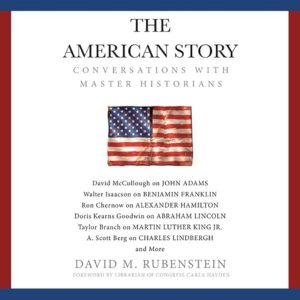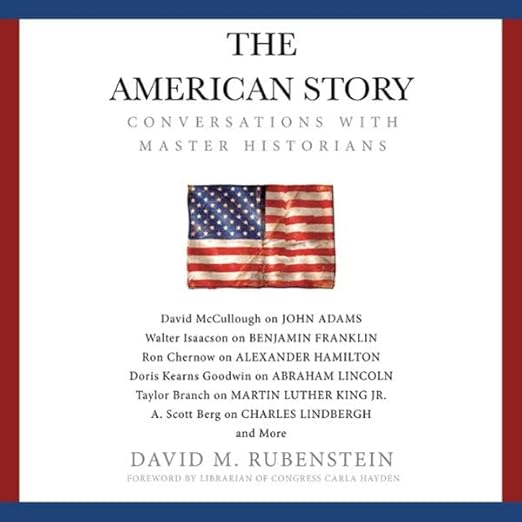
What would you get if you gathered the leading historians of the modern era into one room, asked them the questions their life's work had prepared them to answer, and recorded every exchange? David M. Rubenstein's audiobook is the closest thing we have to that experiment. This production collects live recordings of Rubenstein's congressional dialogues from the Library of Congress, featuring scholars including David McCullough on John Adams, Ron Chernow on Alexander Hamilton, Doris Kearns Goodwin on Abraham Lincoln, Bob Woodward on Richard Nixon, and H.W. Brands on Ronald Reagan, among others. The cast alone makes this an exceptional document.
Rubenstein, co-founder of The Carlyle Group and one of Washington's most prominent philanthropists, has built a second identity as an interviewer over the past decade, and this audiobook consolidates the best of that work. The format is conversational, the exchanges are live, and the historians are in their element. For listeners who consume history through narrative nonfiction, this offers something different: not the finished argument of a polished book, but the thinking process of scholars who have spent years with their subjects and can speak to them with an intimacy that is difficult to access any other way.
The Strengths
The audio format is native to this material in a way it rarely is for adapted books. These conversations were designed to be heard. Rubenstein's interviewees are not reading from scripts but responding, riffing, and occasionally surprising themselves with what they say under the pressure of live dialogue. Walter Isaacson on Benjamin Franklin, for instance, is a different experience when heard rather than read: you get the rhythm of his thinking, the moments where a question genuinely makes him pause. Cokie Roberts on the Founding Mothers covers ground that has been underrepresented in traditional historical surveys, and hearing her speak with evident affection for her subjects adds a dimension that the page alone cannot replicate.
Listeners who have read the major biographies referenced here, Chernow's Hamilton, McCullough's Adams, Kearns Goodwin's Lincoln, will find this a valuable complement. Rubenstein's questions often press his guests to go beyond the biography into assessment: what does this figure's legacy look like now? What did they get wrong? What would they make of the present? These are not softballs. One reviewer described the conversations as covering 'the most knowledgeable subjects' at a standard of historical work that is genuinely high, and that assessment holds up. Another noted that it 'will inspire you to read more deeply on the subject,' which is a reliable mark of good historical broadcasting: it functions as an entry point, not an endpoint.
What to Watch For in The American Story
Rubenstein's political perspectives surface at moments, as one reviewer pointed out with a four-star caveat about visible bias. That reviewer still recommended the audiobook warmly, which suggests the bias registers but does not derail the broader value. Listeners with strong priors about the figures covered, particularly on the Nixon conversation with Bob Woodward, should expect the framing to reflect the cultural consensus these historians largely share rather than offering revisionist counterarguments.
The new introductions recorded by Rubenstein for the audiobook give each conversation useful context, and Librarian of Congress Carla Hayden's foreword grounds the enterprise in the civic mission of the Library itself. These additions are substantive rather than ceremonial, and they reward the listener who comes to the production without prior familiarity with Rubenstein's interview series.
At nearly ten hours, the audiobook covers a significant arc of American history from the Founding Era through the late twentieth century. The episodic structure means you can approach it sequentially or dip in at the figure who interests you most. The live recording quality varies slightly across sessions, as you would expect from archival material, but the overall audio experience is clean and well-produced for a collection of this kind.
What separates this audiobook from a standard historical survey is the format's inherent ability to show the historians as thinking people rather than authorities delivering verdicts. When David McCullough pauses on a Rubenstein question about John Adams's relationship with Jefferson, the pause itself is information. When Ron Chernow qualifies a claim about Hamilton's motives, the qualification reveals the interpretive work that goes into writing biography at the level these scholars practice it. These moments are invisible in the finished books. Hearing the scholars in dialogue with a skilled interviewer makes the process of historical interpretation visible in a way that is both instructive and genuinely fascinating. One reviewer with deep historical knowledge described the conversations as reflecting 'the most knowledgeable subjects' in American historiography, and that assessment understates the collection's value as a document of how today's leading historians actually think about the American past.
Recommended For
History enthusiasts who already have some familiarity with the major figures covered will get the most from this production. The conversations assume a baseline literacy about Hamilton, Lincoln, and Roosevelt rather than starting from scratch. Listeners who come in cold may find some exchanges harder to contextualize without the biographical grounding the historians take as given.
For anyone interested in how professional historians think about their subjects rather than just what they conclude, this audiobook is a rare opportunity. The Chief Justice John Roberts conversation, included as a special addition, adds a contemporary legal dimension that expands the scope beyond the historical mainstream. Listeners inspired to read the underlying biographies after this will find their subsequent reading considerably enriched by having heard the authors speak at length about their work.
The Short Version
- Performance: David M. Rubenstein self-narrates introductions and conducts all interviews; the live archival format gives the production an authority and spontaneity that scripted narration cannot replicate.
- What it covers: American historical biography, civic leadership, the making of national memory
- Feel: Intellectually engaged and conversational, with the warmth of live dialogue
- Our call: A landmark collection of historian interviews that functions best as a companion to the major biographies referenced, offering unscripted insight that no single-author audiobook can match.
A Few Questions About The American Story
Do I need to have read the biographies being discussed before listening to this audiobook?
Prior reading enriches the experience significantly but is not required. Rubenstein's questions provide enough context for each conversation to follow the broad themes. Listeners who have read Chernow's Hamilton or McCullough's Adams will recognize and appreciate the depth the historians bring, but newcomers can still engage with the exchanges meaningfully.
How is this audiobook structured? Can I listen to individual conversations out of order?
The production is organized as a collection of distinct interviews rather than a linear narrative. You can absolutely listen to individual conversations based on your interest in specific historical figures, from John Adams through Ronald Reagan and Chief Justice John Roberts. The new introductions Rubenstein recorded help orient each session.
Does this audiobook present balanced political perspectives on the figures covered?
Reviewers have noted that Rubenstein's selections reflect the cultural and scholarly consensus of mainstream American historiography. One reviewer flagged visible political leanings in the framing. Listeners expecting revisionist or strongly contrarian takes will find this a fairly centrist-to-liberal survey of American history, consistent with the institutional setting of the Library of Congress.
Is the audio quality consistent across an audiobook built from archival recordings?
The live recordings were made at the Library of Congress and the audio quality is generally strong, though slight variation between sessions is expected in archival material. Rubenstein's new introductions are clearly recorded in a studio setting. The overall listening experience is well-produced for a collection spanning multiple live events.