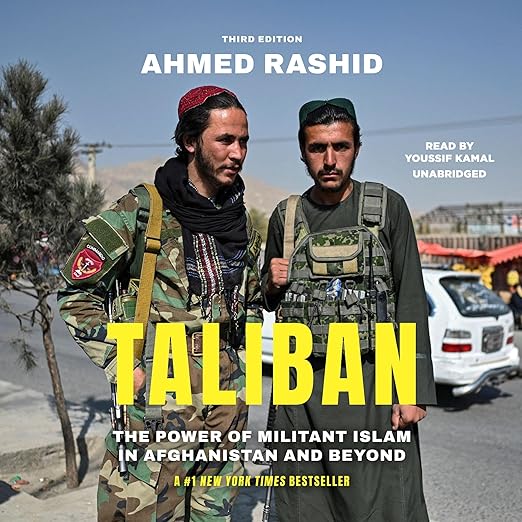
Rashid's third edition reaches audio with two publishers on the same page, and only one of them appears in the fields. Blackstone Publishing sits in the publisher slot for this March 2022 audiobook, which runs fourteen hours, twenty-five minutes, with Youssif Kamal credited as the reader. The three-star response, filed in September 2022, calls the journalism professional and the editing amateur, then names Yale as the party that ought to be embarrassed by the numerous and obvious errors in the text, adding with visible exasperation that this is a third edition. Whichever house is answerable for it, the complaint concerns a printed object, and it remains the most substantive thing anybody has written on this record.
Youssif Kamal Keeps Dense Reporting Easy to Follow
Kamal is the voice on this file, and the practical question with a book like this is whether a long stretch of dense reporting can be followed by ear at all. The April 2023 four-star, filed in the United Kingdom, answers it directly: dense with information and fairly easy to follow. That sentence is worth more than its length suggests. This is a book of factions, provinces, dates and acronyms, and plenty of comparable histories fall apart in audio because a listener loses track of who is fighting whom and why. The record also ships a companion PDF, flagged in a publisher's note at the foot of the description, which is an open admission that some of this material was built for the eye.
Afghanistan is the center, and the argument reaches a long way past it. The description sets out the movement's rise to power, its part in decisions taken by oil and gas companies, and the effect of changing American attitudes toward it. It then promises an explanation of why the country became the world center for international terrorism, which is the claim that made the book a fixture on reading lists. Rashid is introduced through a line from Christopher Hitchens naming him Pakistan's best and bravest reporter, and the copy leads with a number one bestseller credit. Both of those are blurbs. What justifies them is the reporting underneath, which is the one thing this column does not dispute.
Pipelines Recast the Movement as Commercial
Pipelines are where this book parts company with most accounts of the period. The description flags the movement's role in oil and gas company decisions, which puts commercial interest at the center of a story usually told as ideology and warfare, and that framing is a large part of why it still gets assigned. For a listener it also sets expectations: this is reportage with economics and diplomacy in it rather than a battlefield narrative. The register is analytic and the material is cumulative, so drifting for ten minutes means going back ten minutes. A listen of that size asks for real attention, and the reward is a structure you can use on the news afterward.
Updates are what a third edition sells, and the description is specific about them: how the movement regained its strength, how and why it spread across Central Asia, and how it helped move a wider network into Europe, North Africa, the Middle East and the Far East. That is a substantial expansion of a book first written about a single country. What the record never states is where the update stops. No cutoff, no preface date and no edition note is given, which matters more here than it would on most histories, because the situation being described changed drastically in the period immediately before this recording was published.
Ten Silent Ratings Outscore the Two Reviews
Counting this column takes a moment and the result repays it. Twelve ratings produce the 4.2, which requires fifty stars in total. The two visible grades, a three and a four, account for seven of them, leaving forty-three stars spread across ten votes that nobody explained. Those ten average above four and a quarter, comfortably higher than either person who took the trouble to write anything. So the only two readers who said a word rate this below the badge, while everybody holding the badge up stayed silent. That is a rare configuration on a product page, and it argues for weighing those two short paragraphs more heavily rather than less.
Editions are the practical problem this record hands a buyer. The title says third edition, and no publication date for the text appears anywhere on the page, only the March 2022 date of the recording itself. You cannot tell how recent the analysis is without buying it and listening for the seams. The shelving does not help either. The record is filed under history and under religion and spirituality, with a Middle East tag, and a work of political journalism about a movement, an economy and a war does not belong in a spirituality category. Anyone browsing that shelf meets the wrong book, and anyone hunting this one will never think to look there.
Verify the Edition Before You Buy
Beginners can start here, which is not true of most books on this subject. The copy assumes no background and moves chronologically from the movement's rise, which is the structure a newcomer needs. Students, journalists and anyone who watched the events of recent years and realized they could not explain how any of it started are the audience, along with a listener who wants the commercial history rather than the military one. What this is not is a personal narrative or a war memoir. The description promises an authoritative account, and authoritative accounts are structural rather than intimate, which is exactly what makes them useful and exactly what makes them work.
Verify the edition before buying, because this record makes that harder than it needs to be. Check the edition number against whatever your course or your shelf already holds, treat the March 2022 date as the date of the recording rather than of the text, and download the companion PDF the moment you start, since a book at this density loses more than most when the reference material sits unopened in a library folder. Do those three things and what you have is the reporting that made this account standard, read straight through, on a page that could have told you a great deal more than it does.
At a Glance
- Narration: Youssif Kamal reads it straight, which is the right call for reportage that has to keep dozens of factions, provinces and dates distinct.
- Themes: The rise of a movement, oil and gas politics, shifting American policy, the roots of transnational terrorism.
- Mood: Dense, analytic and unsparing.
- Verdict: The standard account, read straight, on a page that never tells you how current the text is.
What comes in the audiobook's companion PDF?
The description closes with a line promising that the PDF reaches your library alongside the audio, and then says nothing whatsoever about what it holds. On a book of provinces, factions and dates, that blank is worth noting. Open the file first and see what it covers before planning how to listen.
Does the number one bestseller line refer to this edition?
The copy opens with that credit and follows it with a quotation from Christopher Hitchens praising the author, and neither is dated or tied to a printing. Both are author-level credits carried forward. Nothing on the page says which edition earned the ranking or when it was earned.
How much background does this audiobook assume?
Very little. The account begins with the movement's rise and builds forward chronologically, defining its terms as it goes. What it does assume is sustained attention, since the material is analytic and cumulative and full of names, so it rewards long sessions far more than a chapter grabbed here and there.
Why is a work of political journalism filed under religion and spirituality?
Two categories carry this record, one of them spirituality, and the tag beneath them points at the Middle East. The actual subject is a movement's finances, foreign backing and military campaigns. A browser on the spirituality shelf will meet the wrong book, and anyone looking for this one should search the author's name instead of the category.