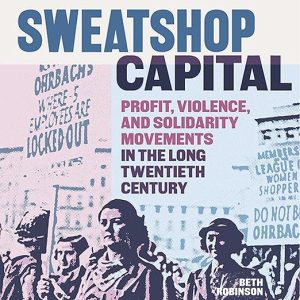
Before You Press Play
- Narration: Sheree Galpert narrates Robinson's academic labor history with precision and a seriousness that suits the subject without making the material feel remote or abstract.
- Themes: Labor exploitation and worker resistance, capitalism and regulatory evasion, feminism and labor history
- Mood: Rigorous and politically engaged, occasionally dense but consistently purposeful
- Verdict: A serious academic labor history covering more than a century of sweatshop conditions and the movements that contested them, published by Duke University Press and narrated with care.
Beth Robinson's Sweatshop Capital audiobook, narrated by Sheree Galpert and published by University Press Audiobooks, opens at the Progressive Era and does not let up until it reaches the gig economy of the twenty-first century. This scholarly labor history covers more than a century of American garment and manufacturing exploitation: the tenement sweatshops of the 1890s and 1900s, the activist campaigns of the Popular Front era, the outsourcing that followed postwar labor victories, the global supply chain scandals of the 1990s, and the algorithmic labor precarity of today. Robinson's central argument, that sweatshop labor is not an aberration or a historical phase but a persistent structural feature of capitalism, constantly resurrected wherever regulatory pressure is low enough to permit it, is the thread that runs from first chapter to last.
At eight hours and two minutes, this is a dense production for a dense book. Robinson draws on activists' literature, news accounts, archival sources, and oral histories to build her case, and the breadth of that evidentiary base is both the book's strength and the source of its occasional difficulty. The oral histories in particular, first-person accounts from garment workers, organizers, and community advocates across the century, are where the labor history becomes genuinely vivid. Galpert handles the shift between analytical prose and quoted voices with clear register differentiation that keeps the attribution clean even when transitions are fast.
From Triangle Shirtwaist to Rana Plaza's Echo
Robinson's framing of sweatshop labor as a gendered and racialized phenomenon is one of the book's most important contributions. The sweatshop labor force across her century-spanning study is disproportionately female, immigrant, and non-white, and Robinson is careful to show how that demographic concentration was not accidental. Manufacturers specifically sought workers with limited legal protection, language barriers, and social marginalization, because those conditions reduced the cost and risk of exploitation. The feminist historians Eileen Boris and Mary Margaret Fonow, whose endorsements accompany the book, are the right comparative frame: Robinson works in a tradition that insists on the intersection of gender, race, and class as the actual structure of labor history rather than as additive categories layered onto an economic base.
The section on the free trade globalization of the 1990s is the most analytically sharp in the book. Robinson traces how NAFTA and the dismantling of trade barriers enabled American manufacturers to relocate production to zones designed to evade the labor protections domestic workers had won over the previous century. The garment industry's move to maquiladoras along the US-Mexico border, the Triangle Shirtwaist fire's long echo in the 2013 Bangladesh Rana Plaza collapse, the continuity between different eras of sweatshop geography: these are not separate episodes but the same pattern expressed in different regulatory environments. Robinson makes this continuity felt rather than simply argued.
Galpert's Voice Shift for Oral History
The audio format works well for Robinson's method because her prose alternates between the analytical and the testimonial in ways that benefit from a narrator who can hold both registers. Galpert's reading does not flatten the oral history passages into the same tone as the regulatory analysis. When a garment worker's account from 1909 or 1992 enters the text, the shift in voice is audible without being theatrical. This matters for a book whose argument about worker resistance depends on individual workers being heard as specific people rather than statistical inputs.
The chapter on the early twentieth-century antisweatshop movements, the cross-racial and cross-class solidarities that made the garment workers' strikes of 1909 and 1910 possible, the Women's Trade Union League's alliances with immigrant workers, the creative protest tactics developed by women who had no institutional power, is worth extended attention. Robinson shows why those coalitions were difficult to build and why they succeeded when they did, providing historical tools for evaluating contemporary organizing in similar conditions. The gig economy chapters explicitly draw that comparison: the solidarity networks built across race and national lines in the Progressive Era have direct analytical relevance to the algorithmic labor platforms fragmenting worker organization today.
Political Influence Paired with Geographic Mobility
The most important thread to track is Robinson's account of how manufacturers used political influence and geographic mobility together, not separately, to evade regulatory accountability. Political influence alone cannot protect a business model that photographs badly; geographic relocation alone does not solve the domestic political problem of visible exploitation. The combination, repeatedly deployed across the century Robinson covers, is the mechanism that keeps sweatshop labor alive through every reform cycle. Understanding this dual strategy is necessary for following Robinson's argument about why antisweatshop movements, despite their periodic victories, have never produced durable structural change.
Watch also for the treatment of the antisweatshop activism of the 1990s and early 2000s. The college campus campaigns against university-licensed sweatshop apparel, the formation of the Worker Rights Consortium, the legal challenges to import practices: these are recent enough that many listeners will have lived through them, and Robinson's account gives them historical depth and analytical context they often lacked at the time. The book's final chapters on digital labor are the thinnest in terms of archival density, which is inevitable given their recency, but they are also the most directly applicable to present conditions.
Written as a Scholar, Not a Journalist
This audiobook is for listeners with a serious interest in labor history, political economy, or the history of feminist activism in the United States. It works well for academic contexts, including undergraduate courses in labor history, women's studies, and American history, and for self-directed readers who want a rigorous account of where the clothes in their closet come from historically and structurally. Robinson writes as a scholar, not a journalist, and the density reflects that orientation.
Listeners looking for a narrative history in the popular mold, event-driven, character-centered, and light on analytical framework, will find the book more demanding than expected. The oral history sections are vivid and human, but they serve an argument, and that argument requires sustained intellectual engagement. For the listener willing to make that investment across eight hours, Sweatshop Capital provides a genuinely illuminating account of a phenomenon that shapes contemporary life in ways most consumer culture makes invisible.
Does the Sweatshop Capital audiobook cover only US labor conditions, or does it address the global supply chain?
The book is primarily focused on American consumer goods and US labor law, but its later chapters address the globalization of production, particularly the maquiladora system and overseas manufacturing that emerged after NAFTA, as an extension of the same domestic pattern of regulatory evasion Robinson traces from the Progressive Era onward.
Is the Sweatshop Capital audiobook suitable for listeners without a background in labor history?
It is accessible to motivated general readers but written at a scholarly level. Robinson explains her analytical framework clearly, but the density of archival evidence and theoretical underpinnings assume an engaged listener willing to work through substantive historical argument. It is not a popular narrative history.
Does the audiobook address contemporary labor issues like the gig economy, or is it primarily historical?
The final chapters address the gig and digital economy of the twenty-first century directly, drawing explicit connections to the sweatshop patterns Robinson traces through the previous century. This section is less archivally dense than the historical chapters but is the most immediately applicable to present conditions.