Quick Take
- Voice: Suzanne Toren is credited alone for nearly eighteen hours, carrying archival statistics and survivor testimony in one continuous register.
- Big ideas: Engineered famine, collectivization, the genocide question, Ukrainian memory and Russian power
- Atmosphere: Grim and documentary, with no relief offered
- Worth it?: The book described here is major work, but confirm which book this listing actually delivers before buying.
Grass, tree bark, dogs, corpses. That is the list the description on this page gives of what people ate in the Soviet republic of Ukraine while the state was seizing every available scrap of food, and it adds, without softening it, that in some cases they killed one another. At least five million people died between 1931 and 1933 in the USSR, the most lethal famine in European history, and the description argues that more than three million of those dead were Ukrainians who died because a government set out to kill them rather than because a policy went wrong.
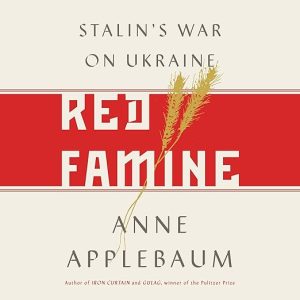
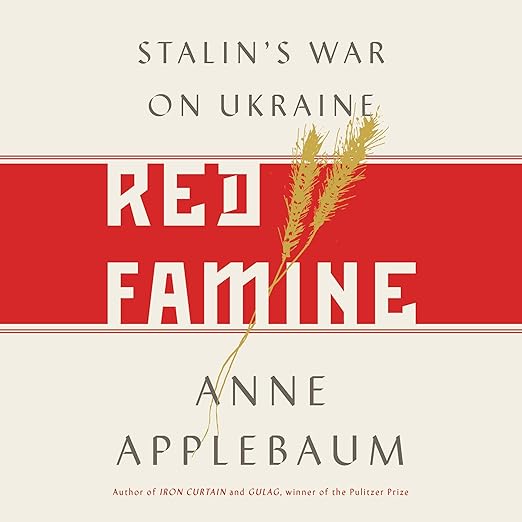
Random House Audio released this 17-hour-and-46-minute audiobook on October 10, 2017, with Suzanne Toren credited as narrator and a 4.7 badge hanging over a counter that reads two ratings. Now the complication, and it is a large one: the description under the title Stalin's War is a description of Red Famine, and it names Anne Applebaum as its author, while the byline on this listing reads Sean McMeekin. Every written response on the page discusses Applebaum's book. Read the description before you spend a credit, because the page is selling two different things at once.
Our Take on Stalin's War
Applebaum's argument, as the copy lays it out, is that the famine was an instrument rather than an accident. Collectivization began in 1929 and pushed millions of peasants off their land onto collective farms, the harvest collapsed, and then, instead of sending relief, the Soviet state used the catastrophe to solve a political problem. After a series of rebellions unsettled the province, the republic's borders were sealed and all available food was seized. That sequence is the case, and it is why the argument about the word genocide has consequences: an accident of policy and a deliberate campaign against a people are different crimes, and the book comes down firmly on the second. The copy carries the argument into the present as well, noting that Russia, as successor to the Soviet Union, has put Ukrainian independence back in its sights, and suggesting that a crime of the twentieth century may be rehearsing itself in the twenty-first.
That the page is titled Stalin's War is not random, and one reviewer accidentally explains it. The four-star response headed A Powerful, if One-Sided, Account of One of History's Greatest Tragedies quotes the book by its full name, Red Famine: Stalin's War on Ukraine, which is how a listing ends up titled with the tail of somebody's subtitle. So either the recording is Applebaum's Red Famine and the byline crediting Sean McMeekin is wrong, or the byline is correct and both the description and all five responses belong to a different book entirely. This page cannot tell you which, and the answer determines what arrives when you buy it.
Why Listen to Stalin's War
Whatever the credit says, the book being described is a serious one and the responses testify to it. Trainman95630 praises detailed records and moving oral histories covering life in Ukraine from 1918 to 1935, and singles out the campaign against the peasantry as the point where the material takes hold. Morgana1986 came in already having studied Stalin and having seen the film Bitter Harvest, and found the treatment of whether the genocide label applies more complex than expected. Fred, writing in October 2025, reads the book as explanation for the present, arguing that it accounts for why Ukraine does not trust Russia today. A short response from Canada calls it the historical truth about the Holodomor, genocide by starvation.
Nearly eighteen hours of testimony is also a case where audio does something print cannot. Oral history read aloud recovers the register it was collected in, and a book built from survivor accounts benefits from a single voice carrying them in sequence rather than a page of block quotations you skim. Suzanne Toren is credited alone for the whole recording, which means the statistics, the archival material, and the survivor accounts all arrive in the same register, and for material this heavy that consistency is a mercy rather than a limitation.
What to Watch For in Stalin's War
The numbers on this page do not work. A 4.7 average cannot be produced by two whole-star votes under any rounding convention, and yet the counter reads 2 while five written responses sit visibly beneath it. Something in the pipeline has attached one book's rating summary to another book's review column, which is the same class of error that put a Red Famine description under a Sean McMeekin byline. None of this reflects on the writing, but all of it should make you slow down at the checkout.
Nothing about the subject is easy, and two responses flag the practical obstacles. Trainman95630 warns that the first third is a little dry, dense with places, names, and events unfamiliar to most readers, which is harder to push through in audio than on paper where you can skim. The four-star review calls the account one-sided in its own title while still praising the research, an assessment worth carrying with you. And the content itself is brutal in a way the description does not disguise: starvation, corpses, and people killing each other for food are not framing devices here, they are the subject.
Who Should Listen to Stalin's War
Readers following the current war who want its historical roots will find the described book directly relevant, and Fred's response makes that link explicitly. Anyone interested in how states weaponize scarcity should hear the mechanism laid out step by step, since sealed borders and confiscated grain are administrative acts rather than battlefield ones. Listeners who have read about the Gulag and want the agricultural counterpart get a companion volume, as the copy positions this alongside that earlier work and the National Book Award finalist Iron Curtain. Students of the genocide debate will find the terminological argument treated as substantive rather than rhetorical, which is what Morgana1986 responded to.
Walk away if you cannot verify what you are buying, and that caution applies to everyone here until the byline and the description agree. Walk away too if you need history delivered as narrative momentum, because the opening stretch is archival and one reviewer says so plainly. Listeners who find famine, mass death, and cannibalism unbearable should choose a different subject rather than a different edition. Anyone hunting for the Sean McMeekin title named at the top of this page should check the description first, because what it describes is somebody else's book.
Whose book does this audiobook listing actually describe?
It is a description of Red Famine, whose author it identifies as Anne Applebaum, and yet the byline at the top reads Sean McMeekin. All five written responses discuss Applebaum's book, and one quotes the full title, Red Famine: Stalin's War on Ukraine. Confirm with the seller which recording ships before spending anything.
Why does the rating look impossible on this audiobook page?
Because it is. An average of 4.7 cannot come from two whole-star votes under any rounding rule, and the counter says two while five written responses are visible underneath. The rating summary and the review column appear to belong to different records, which fits the wider metadata problem on this page.