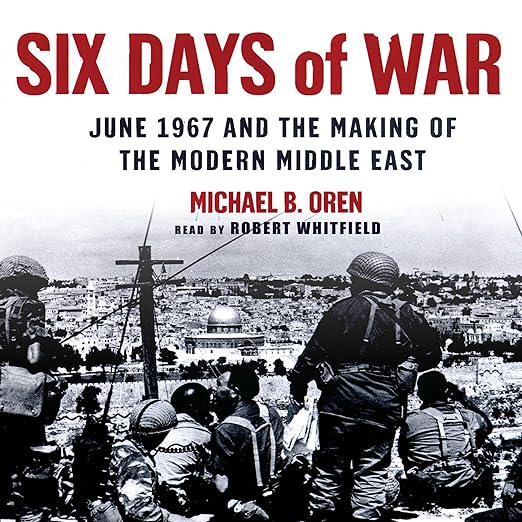
"Six Days of War" audiobook carries a striking rating discrepancy on this listing: the counter shows just one vote, yet five full written reviews sit directly beneath it, arriving from the United States, India, Germany, and Brazil, a genuinely international spread for a book about a conflict whose consequences reshaped global diplomacy.
What We Made of It
Michael B. Oren covers what Israel and the West call the Six Day War, and what the Arab world calls the June War, or simply "the Setback," tracing how a conflict this short and this largely unwanted by both sides went on to transform everything after it: the Yom Kippur War, the war in Lebanon, the Camp David accords, the ongoing controversy over Jerusalem and Jewish settlements in the West Bank, the intifada, and the rise of Palestinian terror, all traced back to those six days of Arab-Israeli fighting in the summer of 1967.
Oren spotlights every side directly, Arab, Israeli, Soviet, and American, along with the world leaders involved in what the synopsis calls an "earth-shaking clash." Reviewer Staz, writing from the United States, admits knowing "next to nothing" about the 1967 war before this book, and credits Oren with setting the stage thoroughly, tracing the Arab-Israeli conflict back to 1947 and covering the roles of Egypt, Syria, and Jordan leading up to the war itself. Staz calls that groundwork a fantastic job before the actual six days of fighting even begin, a useful signal for anyone who wants context rather than a narrow blow-by-blow account of the fighting alone.
Ali's review, titled "My Perspective on Six Days of War: Disunity, Surprise, and Hidden Agendas," frames the 1967 conflict as one of the most controversial and debated topics in modern history, and describes Oren's account as tracing decades of tension starting from the Arab revolt of 1936 and the Jewish uprisings that followed it, well before the 1947 to 1948 war that came next.
What Makes Six Days of War Worth Hearing
Robert Whitfield narrates a seventeen-hour-and-fifty-three-minute production, a substantial runtime that matches Ali's description of the book as "a detailed and well-researched account" of 1967, one that traces decades of prior tension starting from the Arab revolt of 1936 through the Jewish uprisings and the 1947 to 1948 war, when several Arab armies intervened after the UN acted, in Ali's own account of that period.
Placeholder, reviewing from India, calls the book "nicely interwoven" and specifically praises it for offering "an intriguing mesh of the events," spanning tactical, operational, strategic, diplomatic, political, and international levels rather than a simple day-by-day account, recommending it directly for learners of military strategy and diplomacy, not only history readers looking for a narrative retelling. Placeholder also notes explicitly that the book is not, in their words, "a run down of day wise event of the war," which for a title literally naming a six-day span sets a clear expectation: this covers causes and consequences at least as much as it covers the fighting itself.
That international spread of reviewers is itself worth pausing on: a book about a conflict this geopolitically significant drawing direct, detailed engagement from readers in the United States, India, Germany, and Brazil, each apparently finding something worth writing about at length, speaks to how far this particular history's relevance actually travels beyond the region it describes.
The synopsis itself frames the six days as transforming events well beyond their own timeframe: the Yom Kippur War, the Camp David accords, and the ongoing dispute over Jerusalem and the West Bank all trace back, in Oren's telling, to this single summer. That framing gives the runtime a clear throughline even across a genuinely sprawling cast of nations and leaders spanning multiple decades of history, holding together material that could otherwise feel scattered across a seventeen-hour runtime.
What Might Not Land
The rating counter itself is worth flagging directly: it reads a single vote, which cannot mathematically produce the displayed 4.5 average, while five full written reviews are visible on the same listing. Whatever is driving that gap, trust the written reviews over the number sitting at the top of the page.
A reviewer in Brazil, whose review title translates from Portuguese as "too bad there isn't one in Portuguese," rated the book four stars while describing the material as covering the war "from every political and military angle," a real signal that no Portuguese-language edition currently exists for readers who'd prefer one. A reviewer in Germany also left a five-star review written entirely in German, underscoring how far this book's reach extends beyond English-language readers even without a translated edition to match that demand.
The Right Listener for Six Days of War
Readers of serious geopolitical history, especially anyone wanting the full 1947-to-1967 buildup rather than just the six days themselves, are the clear audience, as are listeners specifically interested in military strategy and diplomacy given how directly Placeholder's review recommends it for exactly that readership rather than a general-audience narrative history.
Reach for something else if you want a narrower, faster-paced account of just the six days of fighting rather than the full decades-long buildup Oren provides, or if you were hoping for a Portuguese-language edition, since one reviewer's own title makes clear that option doesn't currently exist for this book, with nothing elsewhere in the listing suggesting a translated edition is currently in the works for that specific readership right now, despite the clear demand at least one reviewer expressed directly.
Does this Six Days of War audiobook only cover the actual six days of fighting?
No. Michael B. Oren traces the conflict's roots back to 1947, and reviewer Ali notes the buildup extends even further, to the 1936 Arab revolt and the Jewish uprisings that followed, before the seventeen-hour-plus runtime ever reaches the six days themselves.
Who narrates the Six Days of War audiobook?
Robert Whitfield narrates a seventeen-hour-and-fifty-three-minute production covering Michael B. Oren's account of the 1967 conflict and its decades of buildup and aftermath, a substantial listen for anyone committing to the full runtime rather than a shorter, narrower summary of the fighting alone.