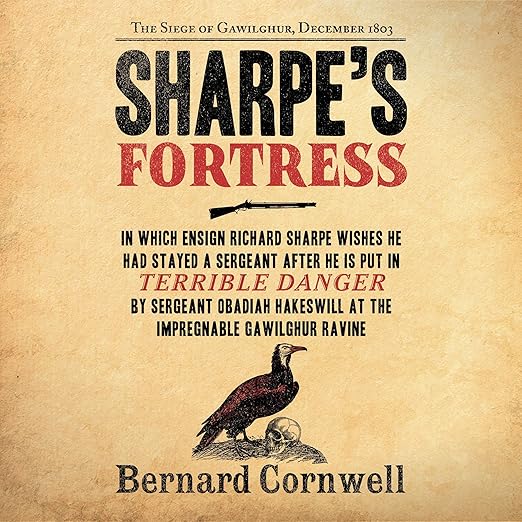
Cornwell fans already know whether they want this one, so let me address everybody else. This is the volume where Sharpe's Indian campaign ends, thirteen hours and twenty-four minutes of siege engineering, betrayal and infantry work, and it is unusually self-contained for a mid-series entry. The listing files it as book three, while the publisher's framing calls it a grand finale, a description that is accurate about the Indian campaign whether or not it holds for the series as a whole. Either way, this audiobook is a complete story with a beginning and an ending inside it.
How Sharpe's Fortress Holds Up
Ensign is the rank the description assigns Sharpe here, and that detail deserves a pause, because the response pool cannot agree on it. Suncoast, at five stars, describes this as number three and the last of Sharpe's adventures in India, served out as a foot-soldier under General Sir Arthur Wellesley, later the Duke of Wellington. The same entry sets the action at the Siege of Gawilghur, calls the place virtually unconquerable, and credits Wellesley with breaking the back of the Mahratta empire there. The entry ends abruptly, in mid-clause, just as it starts recounting Sharpe saving Wellesley's life in an earlier battle.
Gawilghur is what a four-star response from Jean fixes on too, describing an Impenetrable fortress rising above the Deccan plains and Wellesley's army closing on the retreating Mahrattas in western India in 1803. That entry flatly contradicts the other one on the point that matters, marking this as the first book in which Sharpe is an officer, albeit a lowly Ensign, and the description sides with the second reading. Jean also admits to having taken the series wildly out of order, acquiring the books as they turned up, which is useful context, because this volume assumes a great deal and explains very little of it.
Why Sharpe's Fortress Works as an Audiobook
Wellesley runs the campaign that gives this book a spine most series installments lack. A siege has a shape, a timetable and a set of obstacles that exist independently of whatever the hero happens to be doing, so the plot never has to manufacture urgency. A five-star entry from bill white reduces the human layer to two sentences: enemies inside the ranks working against a soldier trying to advance, and women following the army into hostile country and enduring a great deal for it. That second observation catches something the marketing never mentions and the book takes entirely seriously.
Battle writing is the reason the description quotes the reviews it quotes. The Washington Post line naming Cornwell the greatest writer of historical adventures today sits at the top of the page, followed by a claim that the fury, chaos and excitement of battle have rarely been captured better, and a San Francisco Chronicle line wishing all history lessons could be this vibrant. Marketing copy, every word of it. What holds up underneath the salesmanship is that assaults on fortified positions are punishing to render clearly on the page and harder still in audio, and this one stays legible while the noise climbs.
Treason drives the personal plot, and the description says so outright: Sharpe uncovers a foul treason and pursues a righteous revenge while the siege grinds forward. That structure is exactly why the volume functions as an entry point despite its number. The betrayal is local to this book, the antagonist is available inside the first hour, and the resolution never depends on grudges banked across two earlier volumes. December 1803 is the date given, the Maharatta War the conflict, the fortress the destination. Everything else arrives at the moment it becomes relevant, which is the most audio-friendly way to build a historical novel.
Weak Spots in Sharpe's Fortress
Four ratings are what this listing reports, at an average of 4.7, and those two figures cannot both be true. Four whole-star votes can average 4.5, or 4.75 which would display as 4.8, or a clean 5.0. They cannot produce 4.7. Something in the aggregation is pooling editions or importing a number from elsewhere, so treat the star line as decoration rather than data. More useful to know: not one of the five displayed responses says a word about the recording. Rupert Farley is credited as reader, and thirteen hours of siege narration sit here entirely untested by public comment.
Spelling is the next thing to notice, because the page cannot settle on a name. The description writes the conflict as the Maharatta War, while the response text uses Mahratta and Mahrattas instead. Neither form gets corrected, and a listener chasing background reading will land in different places depending on which they copy. The description carries physical damage as well: quotation marks are doubled throughout, so each blurb opens and closes with a pair of them, and the parenthetical listing Agincourt and The Fort appears twice, the second time bolted onto a comparison with Patrick O'Brian where it makes no sense whatsoever.
The Right Listener for Sharpe's Fortress
Newcomers can genuinely start here, which is not something worth saying about most third volumes. James M. Wilson's five-star response is honest about the trade involved: uncertainty about the historical accuracy of the battle, immediately balanced against the reminder that Sharpe is a fictional character and that the combat sections made the book hard to put down. That is the correct posture for this series. It is adventure fiction wearing a very well researched coat, and anyone who needs the history unimpeachable will find the coat starts to itch somewhere around the second assault.
Pick this up if you want a siege told at close range, a revenge plot that resolves inside its own covers, and a protagonist who survives considerably more than any person reasonably should. A one-line response from peter roberts compresses the appeal to Richard Sharpe saving the British Empire, fiction at its best, which is either precisely what you want from military adventure or precisely what puts you off it. Leave it alone if you would rather have the campaign from strategic altitude, because this one stays down among the ladders and the powder for most of its length.
Common Questions
How long is the Sharpe's Fortress audiobook, and who reads it?
Thirteen hours and twenty-four minutes, published by Harper on March 22, 2022, with Rupert Farley credited as the reader. No other performers are listed, so a single voice carries the officers, the ranks and the narration across the whole siege rather than a full cast production.
Can I start the Sharpe series with this audiobook?
You can. The listing marks it as book three, but the siege, the treason plot and the revenge all resolve inside this volume, and the description presents it as the grand finale of the India sequence. Earlier events are referenced rather than required, so nothing essential happens off the page.
Which historical events does the story build on?
The Siege of Gawilghur during the Maharatta War, dated December 1803 in the description, with Sir Arthur Wellesley commanding. Sharpe is an invented character, so treat the campaign framework as accurate scaffolding and the personal plot around it as adventure fiction rather than documented record.
Is this volume abridged, and does the listing say anything about the edition?
No abridgment note appears anywhere on the page. Harper is credited as publisher, the release is dated March 22, 2022, and no ISBN, edition statement or print page count is carried across. For a thirteen-hour military novel, an abridgment would materially change the product, so the silence is worth noting.