Before You Press Play
- Narrator: Tom Parks carries all seven portraits solo, moving between centuries and continents without a cast change.
- Subjects: Faith as motivation, courage under persecution, womanhood defined through conviction rather than fame.
- Tone: Reverent and steady, built for reflection rather than suspense.
- Bottom line: A solid pick for listeners who want Christian biography in bite-sized, character-driven portraits.
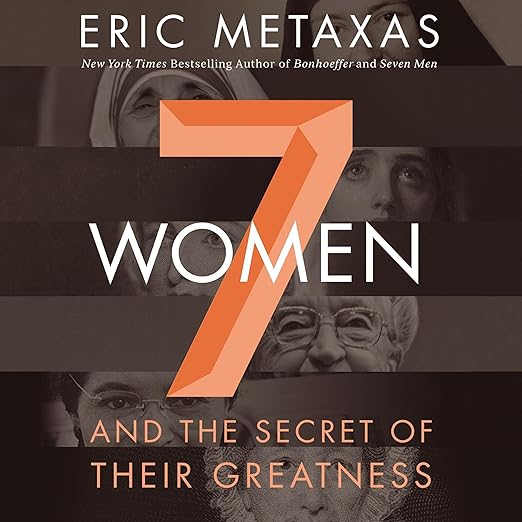
A trip out to my grandmother's turned out to be the right setting for this audiobook, the kind of visit where I want something that rewards half attention and still gives me something to talk about over dinner. Eric Metaxas builds Seven Women as seven short, self-contained biographical portraits, and that shape turned out to be exactly right for a drive broken up by gas station stops and one missed exit.
Metaxas moves through Joan of Arc, Susanna Wesley, Hannah More, Sister Maria of Paris, Corrie ten Boom, Rosa Parks, and Mother Teresa, and the synopsis is upfront about the lens he's using: each woman is offered as a model of what it calls true womanhood, chosen because she followed what the book frames as God's call on her life. The synopsis bills Metaxas as a New York Times bestselling author, and Seven Women itself carries that same bestseller tag, so this isn't an obscure title, it's one a lot of readers have already turned to before turning to it on audio. Still, this is not a neutral academic survey. It reads more like a series of sermons illustrated with biography, and once I adjusted my expectations to that, I found the individual chapters genuinely absorbing. The Corrie ten Boom section, which touches on her hiding Dutch Jews and surviving a concentration camp before astonishing the world by forgiving her captors, hit hardest for me. The Joan of Arc chapter, about a teenager who liberated her country and died a martyr, works almost as a stand-alone short story. Hannah More and Sister Maria of Paris were the two women I knew least going in, and they ended up being the chapters where the collection's premise felt strongest, since Metaxas isn't relying on name recognition to carry them the way he can with Joan of Arc or Rosa Parks.
Listener reviews back up my sense that the appeal here is intimacy rather than scholarship. Elise Howe calls it a beautiful glimpse into lives of women, some she already knew and others she'd never heard of. P J Williams singles out Susanna Wesley, the mother who raised nineteen children and, per the synopsis, gave the world the hymn writer and evangelist sons John and Charles, and writes about the courage it took to raise them to love God through hardship. KB Shank, who rated it four stars, makes a point I agree with: Metaxas doesn't hand you dry historical narratives, he offers these lives as stories that pull you in. Kate Weatherwax adds that even though each portrait is short, none of the biographies felt hollow to her.
What Works
Format is the selling point here. Because each woman gets her own chapter, you can listen in short bursts without losing a throughline, which matters if your listening happens in fifteen-minute increments between errands rather than in one sitting. Metaxas writes in what the synopsis calls his trademark conversational and engaging style, and that comes through even in text form, before you add a reader to it. Tom Parks is credited as the sole narrator across all seven sections, which means one voice carries you from medieval France to a Nazi-occupied Netherlands to the American civil rights movement to a convent, without a rotating cast to reset your ear each time. That's a real structural task for seven hours of material spanning that many settings, whatever you make of how it lands for you personally.
If you're drawn to books like this for the historical range as much as the faith angle, Seven Women delivers variety within a tight page count, or in this case a tight runtime of about seven hours. Rosa Parks and Mother Teresa anchor the twentieth century; Joan of Arc anchors the medieval; Hannah More and Susanna Wesley sit in between. Auntiem's review mentions reading, or in this case listening, to the book with a young teen, which struck me as a good use case: the chapters are short enough to discuss one at a time rather than needing to absorb the whole thing before talking about it.
Before You Commit to Seven Women
Go in knowing this is an explicitly Christian framing of these seven lives, not a general-interest history collection. If you want Rosa Parks covered primarily through the lens of legal strategy and the Montgomery bus boycott's organizing structure, or Joan of Arc through military history, this isn't that book. Metaxas is telling these stories as examples of faith in action first and historical case studies second. That's not a knock, it's just worth knowing before you press play, since the tone stays consistent and reverent across all seven portraits rather than shifting into a more critical or academic register at any point.
Star rating aside, a skeptical eye is worth applying here too: 4.6 is drawn from what the page counts as only two ratings, even though five complete written reviews are sitting right there for anyone to read. Two votes cannot mathematically average out to 4.6 under any rounding, so I'd chalk this up to a counting glitch rather than trust the number as a real signal of how this book has landed with its audience.
Who Eric Metaxas Is Writing For
Christian biography and inspirational nonfiction readers get the most out of this one, along with homeschool or family listening the way auntiem describes, and anyone who wants historical women's stories filtered through a specific faith perspective rather than a secular one. It also works well as an introduction if you know almost nothing about any of these seven women and want a starting point before digging into a full biography of one of them, whether that's Joan of Arc's trial transcripts or Corrie ten Boom's own account of her wartime years.
I'd steer secular readers looking for a warts-and-all critical treatment toward a different book, since the explicitly devotional framing isn't going anywhere. I'd also point secular listeners toward something else if the phrase following God's call as a description of historical achievement is going to grate on you for seven straight hours, because that framing doesn't let up. But Seven Women knows exactly what kind of book it is, and it delivers that with consistency across all seven chapters, which is really the best compliment I can give a collection like this.
How long is the Seven Women audiobook?
It runs about seven hours, structured as seven separate biographical portraits of Joan of Arc, Susanna Wesley, Hannah More, Sister Maria of Paris, Corrie ten Boom, Rosa Parks, and Mother Teresa, so you can listen to one chapter at a time without losing the thread.
Does one narrator read the entire Seven Women audiobook?
Yes, Tom Parks is the only narrator credited across all seven portraits, carrying the listener from medieval France through the twentieth century civil rights era without a cast change between chapters or a second voice ever stepping in to help.