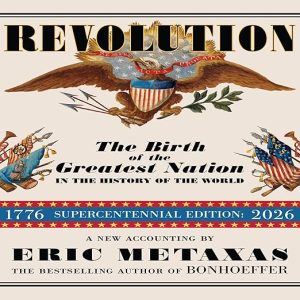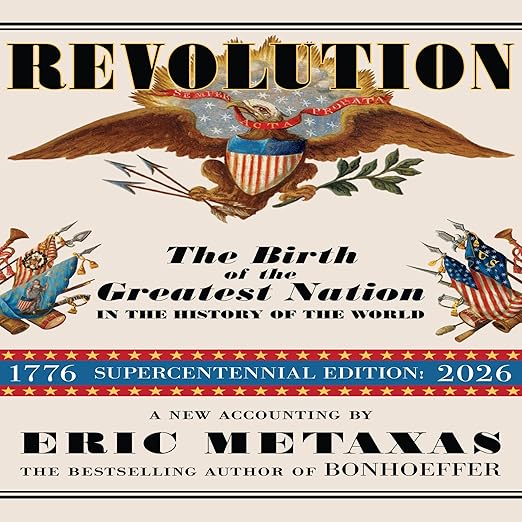
Eric Metaxas's Revolution audiobook is positioned by its publisher as the definitive popular treatment of the American founding that this generation has been waiting for. Metaxas is the author of the million-selling Bonhoeffer biography and six other New York Times bestsellers, and his approach to history, sweeping narrative, vivid individual portraits, explicitly patriotic framing, and more than 500 pages including photos, maps, and illustrations, is well established across his catalog. The production arrives at the 250th anniversary of American independence, a timing that shapes every aspect of how the book is framed and how it positions itself against the existing literature. No narrator is listed in the available information, suggesting the audiobook may still be in production; this review is based on the text and structural details Metaxas has outlined publicly.
The competition for this territory is fierce. David McCullough's 1776 covered the crucial first year of the war with novelistic precision. Ron Chernow's Washington and Hamilton provide the period's most celebrated individual portraits. Gordon Wood's scholarly synthesis offers the intellectual history of the founding at depth that popular narratives rarely match. Metaxas knows this and positions Revolution explicitly against the claim that no single book has yet done justice to the full story, not individual battles, not individual founders, but the complete arc from the accumulating grievances before 1775 through the settlement after Yorktown. That is a large claim, but it is also a genuine gap: the comprehensive popular narrative that integrates military, political, social, and cultural history across the whole span of the war does not exist in the same way that Robert Caro's comprehensive treatment of Lyndon Johnson exists.
Metaxas Chooses Celebration Over Skeptical Reassessment
Metaxas's cultural positioning will be immediately apparent to listeners familiar with his work. The framing in his synopsis, the contrast between the debacles of Vietnam and Watergate that made the Bicentennial awkward and the current explosion of patriotism, signals that this is not a history written in the tradition of skeptical reassessment that has characterized some of the best recent scholarship on the founding. Metaxas is writing a celebratory epic, not a critical reexamination. That orientation is a legitimate choice for popular history, and there is genuine value in having the founding story told with narrative energy and unambiguous investment in its significance.
The Bonhoeffer biography comparison is instructive. Metaxas's Bonhoeffer was both widely read and criticized by scholars for tendentiousness, for enlisting Bonhoeffer's legacy in support of contemporary political positions Bonhoeffer did not hold. The question for Revolution is whether Metaxas applies the same narrative discipline to the founding period that he brought to Bonhoeffer's biographical detail, or whether the Make America Great Again framing in the synopsis represents a closer integration of historical narrative with contemporary political argument. Listeners who want their American Revolution to include serious engagement with the experiences of enslaved people, Indigenous nations, Loyalists, and women who organized outside the formal political sphere should know that this framing tends to subordinate those perspectives to the main patriot narrative.
Storytelling Skill Meets the Revolutionary War's Drama
The strongest case for this audiobook is Metaxas's proven track record as a storyteller. His biographies work because he is genuinely skilled at finding the human drama inside historical events, at making readers feel the contingency of outcomes that now seem inevitable, and at sustaining narrative momentum across long productions. These are exactly the skills that a military and political history of the Revolutionary War needs. The battles of the period, Bunker Hill, Trenton, Saratoga, Cowpens, Yorktown, are inherently dramatic, and the political struggle to maintain the Continental Army through years of inadequate supply and uncertain support is the kind of institutional and personal drama that Metaxas has shown he can render compellingly.
The audience for this production is large and real. Many Americans who care deeply about the founding period have read individual founder biographies or single-campaign histories but have never encountered the complete story in one sustained narrative. Revolution is positioned to serve that audience, and if Metaxas delivers on the structural ambition, genuine comprehensiveness, the integration of military and political narrative across the full span from Lexington through Yorktown, the result could be the accessible general history of the American Revolution that this anniversary moment needs. At more than 500 pages, the book has the space to do what McCullough's focused 1776 could not.
Grievances and Valley Forge as Depth Tests
The treatment of the pre-Lexington period will be a significant test of the book's depth. The events that made revolution feel necessary, the Stamp Act, the Townshend Acts, the Boston Massacre, the Tea Party, are politically complex, and the grievances of colonial merchants, farmers, lawyers, and artisans were not identical. How Metaxas handles the diversity of motivations that drove people toward rebellion or kept them as Loyalists will indicate how much the book subordinates that complexity to a unified patriot narrative.
The treatment of Valley Forge and the logistical near-collapse of the Continental Army in 1777 and 1778 is also worth watching. That period is the emotional and organizational center of Washington's war leadership, and it is where the revolutionary project came closest to failure not through battlefield defeat but through the political failures of the Continental Congress to supply its own army. It is also the period best documented at the individual level. The letters, diaries, and after-action accounts are extraordinarily rich, and a narrative historian of Metaxas's skill should be able to make it among the book's strongest sections. How he handles the contrast between the army's suffering and the Congress's dysfunction will be one measure of whether this is genuinely comprehensive history or a celebration in narrative form.
Listeners Wanting Rigor Will Find It Underweighted
This audiobook will be most rewarding for general readers who love American history and want a sweeping, narrative-driven account of the Revolution's full arc, written by an author who brings genuine storytelling skill and deep investment in the subject's significance. Listeners who are already fans of Metaxas's biographical work and share his patriotic framing of American history will find this the most natural extension of his catalog.
Listeners who want rigorous scholarly engagement with the Revolution's contradictions, the gap between founding ideals and the realities of slavery, the erasure of Indigenous sovereignty, the Loyalist perspective, will find those dimensions underweighted relative to what specialist historians provide. The book's value is in its comprehensiveness and storytelling energy, not in critical depth. For the celebration of a 250th anniversary, that may be exactly what the moment calls for, but listeners should go in knowing what they are choosing.