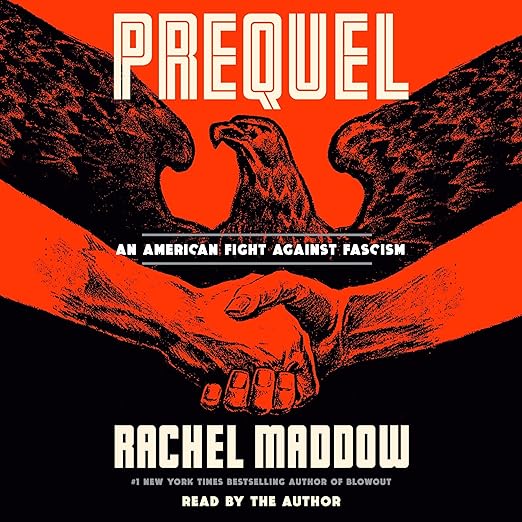
Rachel Maddow's craft in Prequel operates on two levels simultaneously, and understanding both is essential to evaluating the audiobook fairly. At the surface level, it is a recovery project: Maddow has excavated a largely forgotten episode of American history, the organized far-right conspiracy to steer the United States toward an alliance with Nazi Germany in the years before and during World War II, and brought it into the kind of vivid narrative detail that transforms archival material into compelling story. At a deeper level, it is an argument, explicit and sustained, that this episode is not actually forgotten but suppressed, and that understanding it is necessary for understanding certain patterns in contemporary politics. This audiobook is Maddow narrating her own work, which is the only sensible choice for material this entangled with her public persona.
Where This One Lands
The history at the center of Prequel is genuinely surprising even for listeners who follow American political history closely. Maddow documents a clandestine network that flooded the United States with Nazi-funded disinformation aimed at weakening the war effort and promoting antisemitism, and she shows that this network involved 'a large number of some of the country's most influential elected officials.' The 1941 Department of Justice prosecution she centers the book on, which resulted in federal charges against dozens of conspirators, is virtually unknown outside specialist circles, and Maddow's case that its obscurity is partly the result of deliberate interference rather than simple historical drift is one of the book's most disturbing arguments.
The New York Times called it 'a ripping read, well rendered, fast-paced and delivered with the same punch and assurance that she brings to a broadcast,' and the broadcast comparison is precise: Maddow structures the historical narrative the way she structures extended segments of her television work, which means the information arrives with an editorial momentum that is propulsive rather than ponderous. Reviewer David Bright calls it 'deeply researched' with 'amazing depth' across a range of characters including 'a few who are true heroes and many more miscreants,' which is also accurate. The heroic activists and journalists who tracked and exposed the conspiracy get as much attention as the plotters themselves.
Maddow self-narrating Prequel is not a neutral creative choice: it means the audiobook arrives with her political reputation attached in a way that a separate narrator would not produce. That is both the format's strength and its limitation. For listeners who trust her journalism and find her delivery compelling, hearing Maddow narrate this material produces a kind of continuity between her broadcast work and the book that amplifies the urgency of the argument. She reads with the controlled energy of someone who has lived with this research for years and is still genuinely disturbed by what she found. Reviewer Glenn Livezey describes it as 'quality and fierce journalism,' and the fiercenessis audible in the narration.
For listeners who approach Maddow's political analysis skeptically, the self-narration will foreground the book's contemporary political framing in ways that might obscure its genuine historical achievement. The parallels to present-day politics that the Times reviewer describes as 'strong, even startling' are not subtle. Maddow draws them explicitly and in the conclusion at length. Whether that contextualization feels like essential perspective or editorial overreach depends substantially on the listener's priors. The underlying history is documented with sufficient care that it stands regardless of where you come down on the framing.
Weak Spots in Prequel
At thirteen hours, the audiobook is substantial but never slack. Maddow's editorial instincts as a television journalist keep the pacing tight even in the most archivally dense sections. The book originated in research for her podcast Ultra, which Maddow acknowledges, and the podcast audience who comes to this already familiar with the story will find the book version considerably more detailed and analytically developed than the audio documentary format allowed. New listeners will not need the podcast as background; Prequel is entirely self-contained.
The final sections, where Maddow draws forward the 'tentacles of that unslain beast' into subsequent American political history, are where the book is most explicitly interpretive rather than documentary. The argument that the failure to fully prosecute the 1941 conspiracy had specific long-term consequences for the rule of law's relationship to political intimidation is both the book's most ambitious claim and the one that requires the most trust in Maddow's editorial judgment. Listeners who want to evaluate that claim independently will find the historical documentation in the earlier chapters provides the necessary foundation.
The cast of characters Maddow assembles is one of the book's sustained pleasures. Beyond the conspirators and their congressional enablers, the activists and journalists who tracked and exposed the scheme are given real biographical weight. These are people who operated outside institutional power, often at personal cost, to document a conspiracy that official channels were slow to address. Maddow is clearly drawn to this dimension of the story, and the detail she brings to the heroic figures is as generous as the detail she brings to the villains. The result is a book that functions as something more than exposure: it is also an account of how civic courage operated in a moment when institutional structures were bending under pressure.
Recommended For
Listeners interested in American political history, particularly the far-right movements of the 1930s and 1940s, will find this audiobook a meticulously researched and propulsively narrated account of an episode that deserves far more public attention than it currently receives. Maddow's self-narration is a genuine asset for the thirteen-hour runtime: her delivery is authoritative and engaged throughout. Listeners who prefer their history without explicit contemporary political framing should know that the parallels to present-day politics are drawn intentionally and frequently. For listeners who approach Maddow skeptically, the underlying historical documentation is strong enough to reward engagement regardless of where you come down on her interpretive conclusions.
A Few Questions About Prequel
Do I need to have listened to Rachel Maddow's Ultra podcast before this audiobook?
No. Prequel is entirely self-contained. The book originated in research for the Ultra podcast and goes considerably deeper than the podcast format allowed, but listeners with no podcast background will not be missing essential context.
How explicitly does this audiobook draw parallels to contemporary American politics?
Very explicitly. Maddow frames the historical documentation from the beginning as directly relevant to understanding present-day political patterns. The parallels are drawn intentionally and frequently, and the conclusion addresses them at length. Listeners who prefer their history without that framing should know it is central to the book's purpose.
Does Rachel Maddow's self-narration work for a thirteen-hour historical audiobook?
Yes, particularly for listeners who already respond to her broadcast delivery. Her narration carries the editorial momentum that keeps the archival material propulsive rather than ponderous. For listeners who approach her work skeptically, the self-narration does make her political perspective more present than a separate narrator would.
How much of the audiobook is documented history versus Maddow's interpretation?
The majority of the thirteen hours is documentary: Maddow traces the clandestine network, the conspirators, the DOJ prosecution, and the activists who exposed the scheme with archival specificity. The final sections draw the historical argument forward to contemporary implications. Reviewer David Bright specifically praises the research depth, which is grounded throughout.