Key Details
- Narration: Virtual Voice keeps pronunciation and pacing steady, but flattens the comedic timing this listicle-style writing clearly depends on.
- Themes: eighteenth-century medicine, political upheaval, historical oddities, Enlightenment-era daily life
- Mood: Playful and irreverent
- Verdict: A fun four-hour grab bag of strange 1700s facts, best enjoyed as trivia rather than rigorous scholarship.
Tobacco Enemas and a Pirate's Madagascar Kingdom
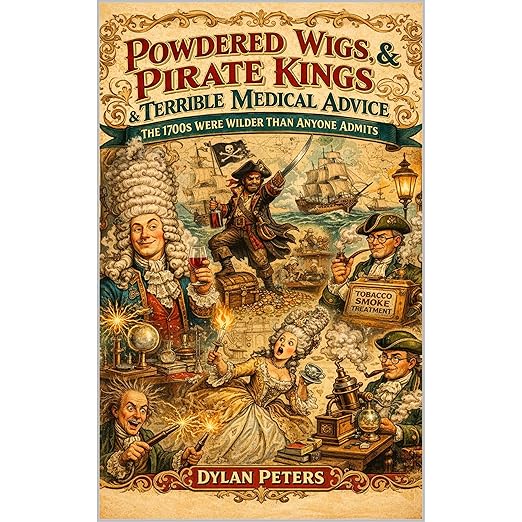
Tobacco smoke enemas open this audiobook's tour of 1700s medicine, administered by physicians convinced the treatment could revive drowning victims and cure a startling range of unrelated ailments besides. Dylan Peters treats the eighteenth century less as a costume drama of powdered wigs and candlelit philosophy than as a genuinely unhinged historical moment, and the setup alone promises a pirate who briefly ruled his own island kingdom, a fashion trend that set women on fire, and doctors who prescribed chocolate as medicine.
The pirate king material alone is worth the price of admission for listeners who have never encountered it, an actual pirate captain who established control over a portion of Madagascar and ran it with something resembling a functioning, if lawless, government, long before organized crime syndicates would attempt anything comparable at that scale. Peters treats this kind of story the way a good bar conversation treats a strange fact, setting it up, letting the absurdity land, then moving quickly to the next one before the momentum stalls.
The deadly fashion trends promised in the setup deliver on that promise repeatedly. Beyond the corset-fainting material, Peters spends time on the specific chemistry of certain cosmetic and clothing choices that turn out to have been genuinely poisonous, arsenic-laced dyes prized for their vividness, hairstyles built with pastes that housed vermin, wigs so heavy and awkwardly balanced that a stray candle flame turned an elaborate hairstyle into a real fire hazard rather than a colorful expression of status.
This is the kind of pop history built for listicle structure, and Peters leans into it rather than fighting the format. Chapters function more like themed segments than a single narrative arc, one on medical quackery, one on political chaos, one on fashion absurdity, one on scientific experiments that nearly killed the scientists running them. The throughline is less an argument than a mood, the sense that the eighteenth century was stranger and more dangerous than its portrait paintings suggest.
Royal Scandal to Fashion Catastrophe in Ten Minutes
The appeal here is entertainment first, education close behind. Peters is working the same vein as viral history threads and pub-trivia nonfiction, short punchy facts delivered with a wink rather than a syllabus, and at four hours the audiobook respects that it is a diversion rather than a commitment. It fits a single long drive or a couple of gym sessions, which is exactly the runtime this kind of material should have.
The pacing rewards listeners who enjoy density. A given ten-minute stretch might move from a royal scandal to a scientific mishap to a fashion catastrophe without much connective tissue between them, which works if the listener has bought into the format's premise, that the throughline is the era's general instability rather than any single narrative, and feels choppy if they were expecting something closer to a traditional chronological history.
Individual sections land well as standalone curiosities. The coffee house passage, framed as a hotbed of political rebellion serious enough that governments tried to shut them down, connects nicely to broader Enlightenment-era paranoia about free assembly. The corset-fainting material and the electricity demonstrations that shocked dinner guests both do the same work, using a vivid specific image to open a door into a larger social or scientific trend.
Virtual Voice Flattens Every Punchline's Timing
Virtual Voice narrates, and this is where the format shows its limits more than it did for the exam guides reviewed alongside this title. Peters writes with a wink, sentences built for a raised eyebrow and a comedic pause, and AI narration cannot deliver either. The jokes are still on the page; they just arrive flattened, at the same even pace as the factual claims around them, which blunts a good portion of the humor the writing is clearly reaching for.
Written text built around punchlines depends on where the emphasis falls in a sentence, and a human narrator would naturally lean into the setup and land on the reveal. Virtual Voice treats both halves of the sentence with identical weight, so a joke about, say, doctors prescribing chocolate as medicine reads more like a factual aside than the punchline it is clearly written to be. Listeners who have enjoyed similarly playful history content narrated by an actual comedian or performer will notice the gap immediately.
Listeners should also treat the framing as entertainment rather than rigorous scholarship. Individual claims are presented with confidence and drama rather than citation, which suits the tone Peters is going for but means a curious listener who wants primary sourcing on, say, the exploding wig claim will need to look elsewhere.
Fun for Podcast Fans, Thin for Researchers
This audiobook suits listeners who enjoy history as a source of surprising trivia rather than formal argument, the audience for a strange-facts podcast more than a university lecture series. Teens with a taste for the macabre and adults looking for an easy four hour listen on a road trip will both get what they came for.
It is a weaker fit for listeners who want their history delivered with restraint or academic caution, since Peters clearly prioritizes the vivid anecdote over the careful qualifier. Anyone building a research paper or looking for a primary-source-grounded account of eighteenth-century medicine or politics should treat this as a fun on-ramp at best, the kind of listen that generates curiosity worth chasing down elsewhere rather than a citable source in itself. Listeners sensitive to AI narration flattening comedic writing should sample a few minutes before committing.
Listeners who already follow strange-history podcasts or channels built around a similar premise, unbelievable-but-true anecdotes delivered at a rapid clip, will recognize the format immediately and likely already know whether they enjoy it. For that audience, the four-hour runtime is a feature rather than a limitation, long enough to satisfy without demanding the sustained attention a full academic history would require.
Good to Know
Does this audiobook cover real historical events or is it exaggerated for entertainment?
The events described, tobacco smoke enemas, corset fainting, the electricity demonstrations, are grounded in real eighteenth-century history, though Dylan Peters presents them with dramatic flourish rather than academic citation.
Is the Virtual Voice narration a problem for a book built on humor?
It is the biggest limitation here. Peters writes with a comedic wink that AI narration cannot replicate, so the jokes land flatter in audio than they likely read on the page.
How long is this audiobook and how is it structured?
It runs about four hours, organized into themed segments on medical quackery, political chaos, fashion absurdity, and scientific experimentation rather than one continuous narrative.
Is this audiobook appropriate for teen listeners interested in history?
Yes, with the caveat that some medical and fashion content is graphic or unsettling by design; curious teens who enjoy strange-facts content should find it engaging rather than upsetting.