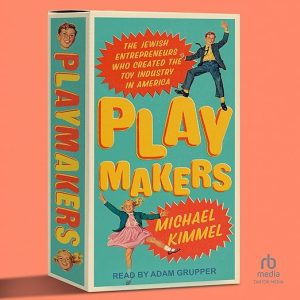
Playmakers runs 13 hours and 50 minutes, and this audiobook spends that time making a specific, well-documented argument: that the American toy industry, and a good slice of American childhood itself, took shape in the hands of first-generation Jewish immigrants working out of tenements and candy stores. Michael Kimmel wrote the book, Adam Grupper narrates it for Tantor Media, and the listing carries a single rating and no written reviews, so the synopsis is doing most of the talking here.
Morris and Rose Michtom's Teddy Bear Starts It All
Morris and Rose Michtom open the book's argument: in 1902 the couple invented the Teddy Bear in the back room of their Brooklyn candy store, then built the Ideal Toy Corporation out of it. Kimmel, a descendant of the founders, uses that origin story as a doorway into a much larger claim, that for most of the twentieth century the American toy business was largely Jewish, run by immigrants who built a make-believe version of the childhood they themselves never had. Calling itself the first full-scale toy history of the United States is a specific and checkable claim rather than vague praise, and it gives Playmakers a sharper focus than a general nostalgia piece about old toys or a loosely connected string of anecdotes. That claim sets up a book less interested in sentimental nostalgia than in tracing how a founding generation of immigrant toymakers shaped what several generations of American children came to expect from play itself.
Comic book creators, children's authors, parenting experts, and child psychologists all show up in the second half of Kimmel's argument, widening the lens past toys themselves into an entire twentieth-century culture built around children. That range, from the Teddy Bear's invention to the professionals who shaped how American families think about childhood, is ambitious for 13 hours and 50 minutes, and the synopsis presents it as one continuous argument rather than a loose collection of toy trivia strung together by era or brand. Whether that argument holds together across such a wide cast of professions is exactly the kind of question a listener has to judge for themselves, since the synopsis presents the connective thread as settled rather than as a case still being built out loud.
Poverty-to-Abundance Is the Book's Real Throughline
Specificity is the hook here. Rather than a broad survey of American toys, Playmakers ties the Teddy Bear, the Ideal Toy Corporation, and the rise of an entire children's culture to one set of overlapping experiences: being Jewish, being an immigrant, and being a child in a country that had not yet decided what childhood was supposed to look like. Anyone interested in immigration history, twentieth-century Judaism in America, or the business side of American pop culture has three separate reasons to be curious about the same book, rather than one narrow angle stretched thin. That same specificity also means the book risks alienating anyone hoping for a lighter, more nostalgic trip through classic toys rather than a pointed argument about who built American childhood and why.
Kimmel's own family connection to the material, as a descendant of the Ideal Toy Corporation's founders, also sets Playmakers apart from a more removed academic history. An idealized American childhood, full of wild creatures and struggles between good and evil, gets framed here as an invention built by people who had no access to that fantasy world growing up themselves. That tension between the poverty of the toymakers' own childhoods and the abundance they built for other people's children is the strongest thread running through the description, and framing the founders as builders of a world they never got to inhabit gives the book an emotional throughline a more detached corporate history would likely lack.
Filed Under Religion, Built on Business History
Genre tagging is a little scattered on this listing. It files Playmakers under both history and religion-spirituality, with a single tag of Religious attached, even though the synopsis describes a business and cultural history of the American toy industry rather than a devotional or theological work. Judaism appears here as an immigrant and ethnic identity shaping the toymakers' experience, not as a subject of religious instruction, so readers browsing under religion-spirituality expecting spiritual content should recalibrate before buying this particular title. Whether that tag reflects a deliberate editorial choice or a simple categorization slip is not something the listing clarifies, which leaves the burden on the shopper rather than the site itself.
Silence is the bigger gap. One rating sits on this page, and the underlying math is at least easy to follow: a single vote producing a displayed 4.0 can only mean that one vote was itself a 4, one star short of a perfect score. That is a real, if thin, data point, but it comes with no explanation attached, no sense of what a reader liked or disliked, since nobody has written anything down yet about pacing, tone, or how Grupper's reading lands across nearly 14 hours. Anyone weighing this purchase is relying almost entirely on the synopsis and Kimmel's credentials as a descendant of the founders rather than on other readers' reactions, since nothing else on the page currently fills that gap.
Thirteen Hours and Fifty Minutes With No Reviews Yet
American immigration history, Jewish-American history specifically, and the business history of toys and children's media are the three clearest entry points into Playmakers. The pitch is narrow and specific rather than a broad survey, which is a strength for anyone already interested in the Michtoms and the Ideal Toy Corporation, and a weaker fit for someone hoping for a general history of toys across cultures and eras. Given the total silence from written reviews, cautious listeners might want to sample Kimmel's other writing on masculinity and gender before committing 13 hours and 50 minutes to a book with no reader feedback attached to it yet. Listeners who prioritize a confirmed track record of reactions before starting a long nonfiction audiobook should treat that absence as a genuine open question, not a minor formality to shrug off.
Is the Playmakers audiobook based on Michael Kimmel's own family history?
Partly. The synopsis describes Kimmel as a descendant of the founders of the Ideal Toy Corporation, the company built by Morris and Rose Michtom after they invented the Teddy Bear in 1902, so the book combines that personal connection with a broader history of the American toy industry and its Jewish immigrant workforce.
How long is the Playmakers audiobook?
13 hours and 50 minutes, published by Tantor Media. That is a substantial history-genre runtime, roughly comparable to reading a dense nonfiction book cover to cover, and worth blocking out real time for rather than treating as a quick single-sitting listen.
Are there written reviews for the Playmakers audiobook yet?
No. The listing shows a lone rating and zero written reviews at the time of this piece, leaving no reader feedback yet on pacing, narration, or how the book's specific argument about Jewish immigrant toymakers actually plays out across 13-plus hours of listening.
Does Playmakers belong in the religion-spirituality category?
Loosely. The listing tags it Religious, but the synopsis describes a history of the American toy industry and Jewish immigrant experience, not devotional or theological content. Readers browsing specifically for spiritual material should know the religious element here is cultural and historical, not instructional.