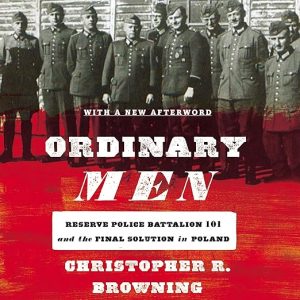
Reserve Police Battalion 101 was not composed of ideological fanatics. Christopher R. Browning's central finding, documented through extensive postwar interrogation records of the battalion's members, is that the men who participated in mass shootings of tens of thousands of Jewish people in Poland in 1942 were middle-aged working-class men with no particular history of antisemitism or violence. This audiobook, now available in audio for the first time with a new afterword and additional photographs, represents one of the most important and disturbing contributions to Holocaust scholarship precisely because it refuses the comfortable explanation. The perpetrators were not monsters by nature. They were ordinary, and that ordinariness is what makes Browning's argument so difficult to absorb and so necessary to understand.
Kevin Gallagher's narration sits with the material at exactly the right distance: present and serious without the theatrical solemnity that would turn the historical record into something performatively heavy. The book's power does not need help. It needs clarity, and Gallagher provides it consistently across ten hours of demanding material.
The Best Parts of Ordinary Men
Kevin Gallagher brings the even-handed, documentarian quality that Browning's text requires. Ordinary Men is a work of historical scholarship, not advocacy or elegy. Its aim is to understand how ordinary social and psychological mechanisms produced mass atrocity, and Gallagher's delivery does not editorialize through tone. He reads the battalion commanders' orders, the interrogation excerpts, and Browning's analytical commentary with consistent clarity, allowing the evidence to do what the evidence does. The result is narration that respects both the gravity of the subject and the intelligence of the listener.
Browning's methodology is rigorous. He works from the postwar interrogations of Battalion 101 members conducted by German legal authorities in the 1960s and early 1970s, and extracts from those self-interested accounts the contours of what actually happened. His analysis focuses on three clusters that emerged within the unit: a core of eager killers, a plurality who carried out orders without initiative, and a small minority who found ways to withdraw from the killing without facing serious consequences. That third group is the most analytically significant, because their existence proves that the men who did kill had a choice.
The question the book forces is not why the perpetrators were evil but how ordinary group dynamics, conformity, deference to authority, role adaptation, and the incremental normalization of moral compromise could produce these results in people who were not otherwise different from their neighbors. Hannah Arendt's concept of the banality of evil is the intellectual ancestor of this argument, and Browning extends her framework with granular historical evidence rather than philosophical generalization.
Before You Commit to Ordinary Men
The book is challenging in the specific way that honest historical scholarship about atrocity is challenging: it does not offer a simple account that makes the perpetrators safely alien. One reviewer notes that this forces readers to confront whether they themselves would have behaved differently, and that confrontation is not comfortable. Browning is not arguing that everyone would have participated in mass murder under those conditions. He is arguing that most people are vulnerable to the mechanisms that made it possible, which is a different and more disturbing claim.
The new afterword included in this audiobook edition addresses the historiographical debate that Ordinary Men generated, particularly the response from Daniel Goldhagen whose Hitler's Willing Executioners argued for a specifically German antisemitic ideology as the primary explanatory factor. Browning's response is measured and precise, and it gives this edition a useful contemporary dimension that the original text alone does not provide. For listeners coming to the book after encountering Goldhagen, that afterword is particularly valuable.
This is scholarship, and some sections, particularly those tracking specific operations and the organizational structure of the battalion, are dense with dates and names. Listeners who engage with it as narrative history rather than reference text will navigate this more comfortably. The cumulative argument builds across the full ten hours in a way that rewards sustained attention rather than fragmentary listening. This is not a book to have playing in the background; it asks for the kind of attention it pays to its subject.
The structural question that runs under the entire book, why did so few of the men in Battalion 101 refuse or evade when refusal was clearly available without fatal consequence, is one Browning answers carefully and without false resolution. The mechanisms he identifies, peer pressure, the desire not to be seen as weak, the gradual normalization of each successive atrocity, the way authority structures short-circuit individual moral reasoning, are not specific to Germany in 1942. That is the point. The same mechanisms have appeared in other historical contexts and, Browning implies, remain active in any situation where ordinary people are given authority over others and institutional permission to use it without limit. That implication is what has kept this book in print and in use in ethics curricula for decades.
Should You Listen to Ordinary Men?
This audiobook is essential for anyone engaged seriously with Holocaust history, the psychology of perpetrators, or questions about how ordinary people participate in institutional violence. It rewards historians, students of ethics, and general readers who want to understand genocide as a human phenomenon rather than as an aberration produced by extraordinary evil. Listeners who found Hannah Arendt's Eichmann in Jerusalem important will find Ordinary Men both complementary and more evidentially grounded. Those seeking survivor testimony or narrative accounts of the Holocaust should combine this with other readings, as Browning's focus throughout is the perpetrators rather than the victims. The supplemental enhancement PDF that accompanies this audiobook edition includes additional photographs and materials worth accessing alongside the audio.
- Narration: Kevin Gallagher brings documentarian clarity to Browning's scholarship, reading the evidence and analysis with consistent gravity and no editorial inflation.
- Themes: Perpetrator psychology, the mechanics of conformity, moral collapse under institutional pressure
- Mood: Relentless and demanding, the kind of audiobook that sits with you long after the final chapter
- Verdict: One of the most important works of Holocaust scholarship, now in audio for the first time, and Kevin Gallagher's narration serves Browning's unflinching argument exactly as it should.
A Few Questions About Ordinary Men
Is this audiobook appropriate for listeners who already know Holocaust history well, or is it introductory?
It is rigorous scholarship rather than an introduction. Readers familiar with the broad contours of Holocaust history will get the most from Browning's specific argument about perpetrator psychology. That said, Browning explains the historical context clearly enough that informed general readers will follow it without specialist preparation.
How does this audiobook differ from Daniel Goldhagen's Hitler's Willing Executioners on the same historical subject?
Goldhagen argued that specifically German eliminationist antisemitism was the primary explanatory factor for the Holocaust. Browning argues for broader psychological mechanisms, conformity, authority, role adaptation, that are not culturally specific. The new afterword in this audiobook edition addresses that debate directly.
Does this audiobook include the new afterword and additional material not in the original book?
Yes. This edition includes a new afterword in which Browning responds to the historiographical debate his book generated, and a supplemental enhancement PDF with additional photographs accompanies the audiobook.
How does Browning's argument challenge the idea that ordinary people would have resisted participating in atrocities?
By documenting that a small minority of Battalion 101 members did manage to avoid participation without facing significant punishment. Their existence proves the majority had a choice. Browning's analysis focuses on why most did not exercise that choice, using group dynamics, deference to authority, and incremental normalization as explanatory mechanisms.