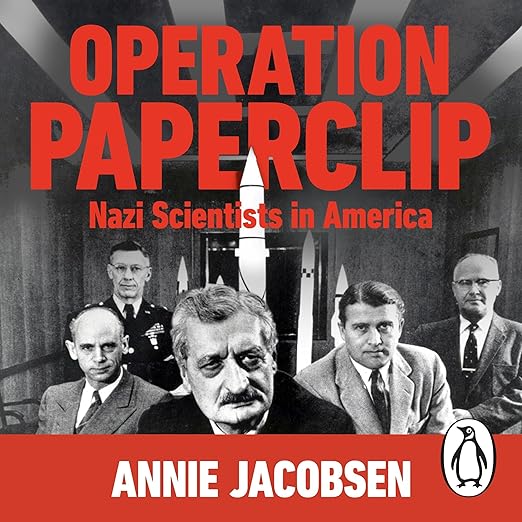
At a Glance
- Read by: Author-read, one voice carrying more than a dozen tracked biographies from Nuremberg onto the American payroll.
- At its heart: Postwar amnesty and its price, classified science, the distance between what a government does and what it admits.
- Vibe: Cold, documentary, morally unresolved.
- Short version: Worth the full length if you want the mechanics of a program rather than a moral scorecard.
Annie Jacobsen reads her own reporting here, and across nineteen hours and twenty-five minutes that decision carries far more weight than it would on a shorter book. Operation Paperclip is the story of what the United States decided to do with the Third Reich's scientific minds once the war ended: a covert project, running for decades, that brought Hitler's scientists and their families to America, many of them accused of war crimes, several of them tried at Nuremberg, one of them convicted of mass murder and slavery, and all of them useful. The audiobook puts a question in the middle of that record and then declines to settle it, which is whether a moral outrage can also be the thing that won the Cold War.
Holding Both Halves of an Uneasy Question
What Jacobsen does well is refuse to make the trade look simple in either direction. The rocketry, the medical treatments, the advances that fed the American space program: none of it is minimized to make the moral case easier, and none of the war crimes are softened to protect the achievements. The one response in the column that stops short of five stars came to the book after hearing the author interviewed on a podcast, and describes exactly this quality, a heavily researched account of a chapter that stays complicated the whole way through. That reading matches mine. The book is built to leave you holding both halves of its question rather than to hand you a finding.
The sourcing is where the length comes from, and where the confidence comes from too. Interviews with Paperclip family members, colleagues and interrogators. German archival documents, including papers made available by direct descendants of the Third Reich's ranking members. Files obtained through the Freedom of Information Act. Dossiers pulled out of government archives and out of Harvard University. Four separate evidentiary streams braided into one narrative, and the effect over nineteen hours is cumulative rather than dramatic. You do not get a revelation halfway through. You get a slow accretion of names, dates and countersignatures until the shape of the program stops being deniable, and that is a very different listening experience from a thriller about the same events.
Jacobsen Narrates Names She Already Knows
Rocketry is the part everybody already knows, and it is the part this book spends the least energy on. The reason to commit to it is the other material: the interrogators, the paperwork, the specific bureaucratic mechanisms by which scientists who had stood trial at Nuremberg ended up drawing American salaries a few years later. A response written in 2016 lays the sequence out plainly, first the German advances in aerodynamics, rocketry, chemicals and medicine, then the problem those advances arrived attached to, and that ordering is the book's own. Achievement first, then the bill. It is the only honest way to tell it, and it is also the reason the book is uncomfortable rather than merely interesting.
Jacobsen's voice on this material has one specific effect: it puts the reporting in the reporter's register. Hours of German surnames, wartime ranks, agency acronyms and archive references make a pronunciation problem long before they make a performance problem, and the person who collected those names is the person deciding how each one lands. Across the five responses the page shows, the recording itself never comes up at all, and the ones that argue at any length argue about the history instead. So take the credit as the fact it is rather than as a verdict on the reading. An author at the microphone on a book this dense in proper nouns is a production choice that favors Jacobsen over any performer who would arrive needing to be briefed.
Three Imprints, Two Dates, One Old Recording
Read the bottom of the description before you buy anything. The copy opens by crediting one publisher, the field above it names a second, and the copyright line at the end names a third while dating both the text and the recording to 2014, eleven years before the September 2025 date attached to this listing. Three imprints and two dates on one product is not a scandal, but it is a provenance problem with a practical edge: the thing being presented to you as new may be a re-release of a recording that is over a decade old, and it may already be sitting in your library under another imprint. Check before you spend a credit.
One reader says the name registered, years ago, as a story about rockets and jet planes, and describes finding something considerably darker underneath it. That is a fair warning about the emotional register. The subject takes in medical experimentation, slave labor and people who stood trial for what they did, and the book routes around none of it to protect the achievements it also has to report. Then add the density: more than a dozen German scientists tracked through their entire postwar lives is a great many people to hold in your head without a page to glance back at. One of the five responses is two words of Spanish, which settles neither problem but does tell you the usable column is smaller than the number suggests.
Built for Readers Who Want the Paperwork
Anyone who reads twentieth-century history for the mechanics rather than for the verdict will find this the right kind of long. Buy it when you want the paperwork, the interviews with interrogators, the names of the people who signed off, and when you are prepared for a book that keeps its central question open instead of closing it in a final chapter. It works as a corrective too. If your picture of the American space program begins at a launch pad, this supplies everything standing behind it, including the parts that stayed classified for reasons unconnected to engineering.
Nuremberg is where the moral accounting was supposed to happen, and the response describing layer after layer of an onion of deceit is describing what it looks like when that accounting does not arrive. Leave it where it sits if a clean argument with a conclusion bolted on is what you need, because this one ends holding the question it opened with. The same goes for anyone who wants the book to tell them how to feel about each name in it, since it declines that job with real consistency. Everyone else should treat the length as the point rather than as the price of admission. Paperclip ran for decades, and the book takes the time to show how a program that long survives that many opportunities to be stopped.