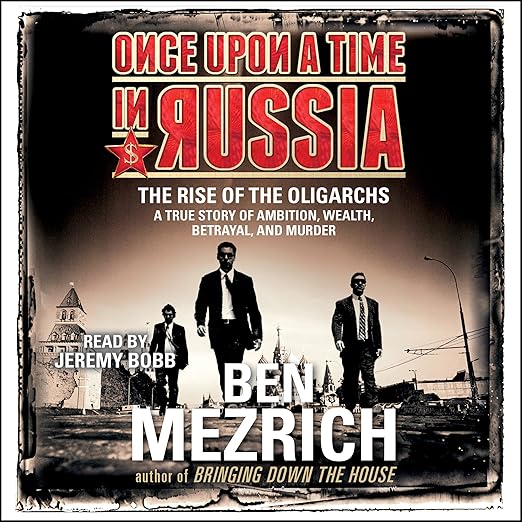
- Voice: Jeremy Bobb brings the oligarch world to life with controlled intensity; his performance suits Mezrich's cinematic, vignette-driven storytelling style.
- Big ideas: Power and its costs in post-Soviet Russia, the arc from patronage to betrayal, wealth as both armor and target
- Atmosphere: Propulsive and dramatic, closer to thriller than conventional nonfiction
- Worth it?: A sharply written dramatized account of Boris Berezovsky's rise and fall that reads more like a novel than a history book, best suited to listeners who want gripping narrative over rigorous documentation.
I spent two evenings with this one during a stretch when I had been reading a lot about contemporary Russian geopolitics. Ben Mezrich has built a career on making true stories move at fiction pace, and Once Upon a Time in Russia is among his most ambitious attempts at that project. The subject, the rise and catastrophic fall of oligarch Boris Berezovsky, is genuinely extraordinary material. The question is always whether Mezrich's approach serves or diminishes it.
The book opens in 1994 with Berezovsky already a powerful figure, the mathematician-turned-businessman who had leveraged the chaos of Soviet collapse into a position of remarkable influence. Mezrich describes him as the Godfather of the Kremlin, a title that captures both his reach and the nature of his power. Roman Abramovich appears early as Berezovsky's protege, and the dynamic between them, described through the Russian concept of krysha, meaning protector or roof, is one of the book's more interesting structural elements. Berezovsky provided the cover; Abramovich built the wealth.
Where This One Lands
Mezrich's method involves dramatizing real events with reconstructed dialogue and attributed emotions, a technique that makes the book read quickly but creates legitimate documentary questions. One reviewer who found the book choppy described how it strings vignettes together that occurred over a number of years into a semi-cohesive tale. That is an accurate characterization of both the method and its limits. If you want a carefully sourced academic account of the oligarch era, this book will frustrate you. If you want to understand the emotional and political texture of that period in a way that sticks, Mezrich delivers something real textbooks cannot.
The Alexander Litvinenko thread, the FSB agent whose Polonium-210 poisoning in London became an international incident, adds a genuine thriller dimension that the book does not need to manufacture. The material is already extraordinary. Mezrich's skill is in connecting these threads without losing momentum, and on that count, the book largely succeeds.
Why Listen to Once Upon a Time in Russia
Jeremy Bobb is a strong choice for this material. His narration has the quality of controlled urgency that Mezrich's pacing requires, and he handles the Russian names and context with authority. One reviewer described the book as Wolf Hall on the Moskva, and Bobb's performance supports that comparison; he understands that this is a story about men performing power for each other, and his vocal choices reflect that.
The book also arrives at a useful cultural moment for English-language listeners who want historical context for contemporary Russia. The dynamics Mezrich documents, the relationship between oligarchs and the Kremlin, the use of proximity to power as both asset and liability, the speed with which protectors become threats, are not ancient history.
What Gives Us Pause
The liberty Mezrich takes in ascribing feelings, emotions, and intent upon actual historical figures is real, and one reviewer noted it directly. This is not a neutral observation: Mezrich is writing narrative nonfiction in the tradition that prioritizes readability over strict documentary fidelity. If that approach bothers you in principle, no amount of good storytelling will overcome the objection. If you accept it as a genre convention, the book works well within its chosen mode.
Listeners already familiar with the major figures and events will likely find the coverage thin. One reviewer with prior knowledge of the oligarch world described it as a good quick overview rather than an in-depth treatment. That assessment is fair. The book is an excellent entry point, not a definitive study.
Who Should Listen to Once Upon a Time in Russia
Listeners new to the Russian oligarch story who want a gripping narrative introduction will find this exactly what it promises. Those curious about Berezovsky, Abramovich, or Litvinenko in particular will get the broad outlines with enough detail to contextualize current events. Listeners who want rigorous sourcing, measured tone, or significant depth on the post-Soviet economic transformation should look to academic or long-form journalistic treatments instead. At under seven hours, this is a genuinely efficient way to absorb a complicated story.