Quick Take
- Voice: Lauren Ingro delivers Visconti's analytical prose with clarity and unhurried precision, prioritizing comprehension over drama in a way that suits the beginner framing.
- Big ideas: Oral tradition and memory, Norse cosmology, mythology as practical wisdom
- Atmosphere: Calm and instructive, a guided introduction rather than a dramatic retelling
- Worth it?: A genuinely useful audiobook for newcomers that reframes Norse mythology through oral tradition rather than modern fantasy, with narration that keeps the analytical thread easy to follow.
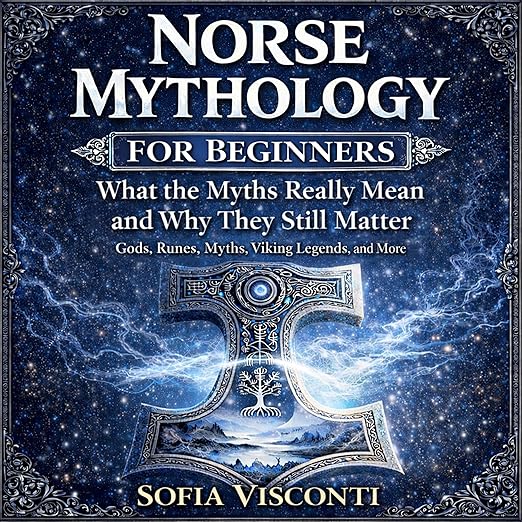
Understanding why Norse mythology feels fragmented and incomplete is the first thing this audiobook gets right. Sofia Visconti's Norse Mythology for Beginners opens with a genuinely useful reframe: these stories were never designed to exist on a page. They were built for memory and repetition, oral traditions shaped to survive without writing, and the gaps and contradictions that confuse modern readers are largely artifacts of their eventual transcription into a context that was already different from the world that created them. That framing changes how you hear everything that follows. Lauren Ingro's narration sustains it throughout with calm authority and consistent clarity.
At four and a half hours, this audiobook does not have time for elaborate vocal performance, and Ingro does not try to manufacture one. The delivery is unhurried, precise, and consistently easy to follow, which matters for a book covering mythology, oral tradition, the Nine Realms, specific deity functions, and practical lessons derived from ancient stories. None of it gets lost in the audio, which is harder to achieve than it sounds when the subject matter is this layered.
What Odin's Sacrifice Actually Costs
Visconti is making a specific argument throughout the book, not simply retelling the myths. The argument is that Norse mythology meant something within its original cultural context, and that recovering that meaning requires understanding the conditions under which it was created and transmitted. Odin's sacrifice is not just a story about wisdom; it is a story about what wisdom costs, and about a culture that understood preparation and self-reliance as moral virtues rather than simply practical ones. Thor as protector is not just the strong god with the hammer; he embodies a particular understanding of what strength is for and what restraint requires.
Reviewer Adeline noted that the book 'doesn't just tell the myths, it slows down, digs a little deeper,' which is accurate. Visconti consistently asks why the myths were shaped the way they were, and her answers come from cultural context rather than from modern fantasy or academic theory. Ragnarok, for instance, is presented not as apocalypse but as renewal: destruction serving a cosmological function that a culture organized around cyclical time would have understood differently than a modern reader expecting a definitive ending. That reframing is one of the book's most useful contributions.
Ingro Keeps the Analytical Thread Clear
The four-and-a-half-hour format serves the book's purpose well. Visconti does not attempt to cover every Norse myth or exhaust the subject. Instead she identifies a manageable set of core concepts, major figures, and practical frameworks, presents them clearly, and leaves the listener with a foundation for going further. Reviewer Angie Glenn described it as 'clear and well written' and noted that it 'explains things as clearly as possible given the source material,' which is the right benchmark for this kind of introductory text.
Ingro's narration supports that accessibility consistently. She reads Visconti's explanatory prose in a way that keeps the analytical thread easy to follow without dramatically performing the myths, which would have changed the register of the book into something closer to storytelling than scholarship. Reviewer Kindle Customer praised how the book provides 'background and cultural information' that makes the myths 'make more sense, and be more meaningful,' and Ingro's measured delivery is what keeps that information accessible across the full runtime.
Loki Embodies Disruption in a Needed System
Listeners who already have a solid grounding in Norse mythology may find the introductory level limiting. The book is explicit about its beginner scope and does not attempt depth for depth's own sake. If you have already read Neil Gaiman's Norse Mythology or engaged with academic texts on the subject, Visconti's book will feel like familiar territory, and the value of the oral-tradition framing may not compensate for the ground you have already covered.
The audiobook format also means you cannot flip between sections to cross-reference the Nine Realms explanation with the specific deity chapters that follow. Ingro's pace and clarity minimize this as a practical problem, but listeners who like to study with the ability to revisit earlier sections will find a print or ebook version more useful as a reference tool than the audio. For pure listening purposes, the book is well paced enough that earlier material stays accessible throughout.
The book's treatment of Loki is a good example of Visconti's analytical approach at its best. Rather than presenting Loki simply as the trickster or the villain, which modern popular culture has done thoroughly enough, Visconti frames him as the embodiment of disruption and unintended consequences within a cosmological system that requires both order and chaos to function. That framing is not original to her, but she deploys it clearly and explains why it matters for understanding how Norse culture thought about the relationship between control and change. Ingro's steady delivery keeps the argument legible even in these more interpretive passages, where the ideas are more complex than the clean summaries of individual gods that precede them.
Genuinely Valuable for Listeners Coming In Fresh
Anyone coming to Norse mythology fresh, whether through curiosity about Viking culture, popular culture references, or an interest in oral traditions and ancient religion, will find this audiobook a genuinely valuable starting point. The oral-tradition framing is original enough to interest people who have already read the myths in more traditional retellings but want a different analytical lens. Lauren Ingro's narration is clear and easy to follow across the full runtime, and the book earns its time without overstaying its welcome or reaching for a depth it has not promised to deliver.